
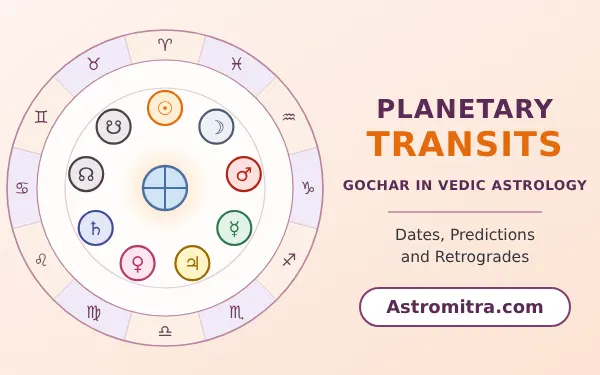
What a Transit Is and How It Works on Your Birth Chart
Your birth chart is the sky fixed at the moment you were born. The planets did not stop there. They keep moving through the twelve signs, each at its own speed, and wherever one of them stands today it falls in some house of that fixed chart. This movement is gochar, the transit of the planets, and it is the reason the same birth chart passes through easy years and hard ones. Where each planet stands at this moment is on the planet transit today page, with the sign and degree of every planet.
The birth chart is the promise; the dasha is the period in which a part of that promise is opened; the transit is the day and month on which it actually arrives. An astrologer who reads the chart without the dasha says what may happen, and one who adds the transits can also say when. That is why every serious prediction in Vedic astrology rests on these three: the natal chart, the dasha and gochar.
Why Transits Are Read From the Chandra Rashi
The classical texts on gochar, Phaladeepika among them, count every transit from the natal Moon, the Chandra rashi. The Moon is the mind, and a transit is felt first as a change in the mind: confidence or worry, appetite for effort or the wish to withdraw. Counting from the Moon also gives everyone born on the same two days the same starting point, which is why rashifal in India is written by Moon sign.
Count your Moon sign as the 1st house and go forward through the signs to the one the planet is in. Each planet has its own good houses from the Moon: Jupiter the 2nd, 5th, 7th, 9th and 11th; Saturn, Mars, Rahu and Ketu the 3rd, 6th and 11th; the Sun the 3rd, 6th, 10th and 11th; Venus all but the 6th, 7th and 10th. The Lagna is the second point to count from, and a transit good from both the Moon and the Lagna gives its result most fully.
What Each Planet's Transit Brings
The Moon changes sign about every two and a quarter days and colours only the mood of those days; its one transit everyone should know is Chandrashtama, the two days a month it passes the 8th from your Moon. The Sun spends a month in each sign and each entry is a Sankranti; it brings authority, the father and the government into the house it lights. Mercury and Venus keep close to the Sun and move through a sign in about a month, Mercury touching work, trade, writing and talks, Venus money, comfort, marriage and art. Mars stays about forty-five days, longer when it turns retrograde, and brings energy, disputes, land and surgery to the house it crosses.
These five set the tone of weeks. The years are shaped by the slow planets: Jupiter, about a year in a sign; Rahu and Ketu, always opposite each other, about eighteen months; and Saturn, about two and a half years. When an astrologer speaks of a good or a hard phase of life, he is almost always speaking of these four.
Saturn, Jupiter, Rahu and Ketu: The Transits That Shape the Years
Saturn's transit through the 12th, 1st and 2nd houses from the Moon is Sade Sati, seven and a half years of pressure, delay and maturing; its passage over the 4th and the 8th is Dhaiya, two and a half years each. Yet the same Saturn in the 3rd, 6th or 11th from the Moon is among the best transits there are: hard work that went unrewarded for years finally pays.
Jupiter is the protector of gochar. In the 2nd, 5th, 7th, 9th and 11th from the Moon it brings growth, marriage, children and the counsel of good people, and families still look for this Guru Bala before fixing a marriage. Rahu and Ketu work as a pair across the opposite signs: Rahu magnifies and unsettles the house it occupies, Ketu cuts away and turns the mind inward in the house opposite, and both give their best in the 3rd, 6th and 11th.
Why the Same Transit Gives Different Results: Vedha, Dasha and Ashtakavarga
Two people with the same Moon sign rarely have the same year, and three rules explain most of the difference. The first is vedha, obstruction: each good house has a partner house, and if another planet transits that partner house at the same time, the good result is held back. Jupiter's good 11th house, for example, is blocked by a planet in the 8th. The Sun and Saturn do not cause vedha to each other, nor do the Moon and Mercury.
The second is the dasha. A transit cannot give what the birth chart does not promise, and it gives most when the running dasha is of the transiting planet or of the lord of the house it is crossing. The third is ashtakavarga: a planet crossing a sign where it has many benefic points in your chart does well even from a weak house, and one crossing a sign with few points struggles even from a good one.
Turning Points Inside a Transit: Vakri, Asta, Nakshatra Change and Eclipse
A transit is not one event but a stay with turning points. A planet may turn retrograde and go back over degrees it has crossed: matters of that house return for completion, and a retrograde can even carry the planet back into the sign it left. Near the Sun a planet becomes combust, and its results weaken until it rises again; Guru Asta and Shukra Asta close the season for marriages. Inside every sign the planet crosses two or three nakshatras, and each change of star shifts the colour of the transit according to the nakshatra's lord. And twice a year the Sun and Moon meet the Rahu-Ketu axis in an eclipse, the most sensitive days of the nodes' transit for the signs it falls on.
Sidereal or Tropical: Which Zodiac Vedic Transit Dates Use
Every Vedic transit date on Astromitra is sidereal, measured from the fixed stars with the Lahiri ayanamsa, as the Indian almanac does. Western astrology uses the tropical zodiac, tied to the seasons, which now runs about 24 degrees ahead, so a planet changes tropical sign weeks before it changes sidereal sign. If you follow Western astrology, use the tropical planetary positions and the Western retrograde dates, and do not mix the two zodiacs in one reading.
How to Use the Transit Pages
Start with your Moon sign. To know what a planet's present transit means for you, open its predictions page from the first box below; it tells you the house the planet is crossing from your Moon and leads to the page for the sign it is in now. To know when a planet enters a sign in any year, open its transit dates page; for when it turns back, its retrograde dates page. For the whole year in date order, sign changes, retrogrades and eclipses together, use the transits timeline; for where every planet is this minute, the sign and degree of each one, the current planetary positions page; and for what every planet's present transit means for all twelve Moon signs at once, the transit predictions page.
How I Read Transits in My Own Chart
My Moon is in Virgo, and I count every transit from it. Jupiter sits in Libra in my own chart, so the year Jupiter returns to Libra, once in twelve years, is the one I watch most closely: it crosses the 2nd from my Moon, a good house, over its own natal place. In the years between, I read the slow planets first to know the season of my life, and only then the fast ones to choose the month: a month when the Sun or Mars passes a good house from my Moon is when I push work forward, and a month when they cross the 8th or 12th is when I finish what is already in hand.