Vedic Astrology Birth Chart Calculator with Interpretation
Get your complete Vedic astrology birth chart with detailed interpretations—absolutely free. Enter your birth date, exact time, and location to instantly generate an accurate astrological analysis in just 3 seconds. Our advanced calculator reveals planetary positions, zodiac signs, house placements, and Nakshatra details to provide deep insights into your personality, career potential, relationships, health tendencies, and spiritual path. Receive your personalized natal chart reading with actionable guidance based on authentic Vedic astrology principles.
- Complete birth chart (Rashi chart) with detailed interpretations
- Full Vimshottari Dasha analysis with 120-year timeline and detailed interpretations up to Pratyantar Dasha level
- All 16 divisional charts (Vargas) including Navamsa (D9), Dashamsa (D10), and specialized charts
- Planetary strength analysis (Shadbala)
- 50+ classical Yogas identification
- Comprehensive aspect interpretations
- Personalized remedial measures
- All calculations verified against Swiss Ephemeris and classical texts
✅ Verified Authentic & Accurate Calculations
20+ Million
Birth charts generated since 2007
18 Years
Trusted online platform since 2007
25+ Years
Professional astrological expertise
Methodology: This calculator uses the Swiss Ephemeris, powered by NASA JPL data, to ensure 100% astronomical calculation accuracy, and integrates wisdom from the Brihat Parashara Hora Shastra and hundreds of classical Vedic texts, along with the Lahiri Ayanamsa. Developed by Pramod Sharma, a fifth-generation astrologer and Jyotish Acharya (certified by Bharatiya Vidya Bhavan), bringing over 25 years of professional experience in authentic Vedic astrology.

Why Our Vedic Astrology Birth Chart Calculator Is the Most Advanced Jyotish Tool Online

If you’re new to Vedic astrology, it’s important to understand the difference between tropical and sidereal astrology . This will help you see why your Vedic birth chart may show different zodiac signs than those used in Western astrology.
This advanced Vedic astrology calculator represents the perfect synthesis of ancient wisdom and modern astronomical precision, delivering the most comprehensive Jyotish analysis available online. Built on the foundational principles of Brihat Parashara Hora Shastra—the authoritative classical text of Vedic astrology—our system ensures every calculation adheres to authentic traditional methodology passed down through centuries.
- Unmatched Astronomical Accuracy: We utilize Swiss Ephemeris powered by NASA JPL data to calculate planetary positions with scientific precision, ensuring your birth chart foundation is astronomically exact to the arc-second. This eliminates the inaccuracies often found in other calculators.
- Dual House System Analysis: Receive both Whole Sign Houses (traditional Vedic method) and Placidus Houses charts simultaneously for enhanced accuracy and comprehensive insights. This dual approach ensures you benefit from both classical Jyotish wisdom and precise cusp-based analysis.
- Comprehensive Analysis Suite: Beyond basic Rashi charts, instantly access all 16 divisional charts (Vargas) including crucial Navamsa (D9) and Dashamsa (D10) for detailed life area analysis.
- Deep Dasha Insights: Explore complete Vimshottari Dasha periods spanning 120 years, with detailed interpretations at Mahadasha, Antardasha, and Pratyantar Dasha levels—revealing the exact timing of life events.
- Classical Transit Analysis: Real-time transit predictions based on principles from Phaladeepika, Brihat Parashara Hora Shastra, and Jataka Parijata. Compare current planetary movements against your natal chart using authentic Vedanga (transit impact) rules for precise timing guidance.
- Modern Planetary Integration: Includes Uranus, Neptune, and Pluto alongside traditional nine planets for enhanced insights.
- Detailed Interpretations: Comprehensive analysis of planetary placements in houses, signs, and aspects—transforming astrological data into actionable life guidance.
How to Generate Your Free Vedic Birth Chart in 3 Simple Steps
Use the calculator above to instantly access your Janam Kundli. The process is fast, accurate, and completely free:
- Step 1: Enter Your Birth Details. Provide your exact date of birth, accurate time, and place of birth in the form fields.
- Step 2: Click ‘Calculate’. Tap the ‘CALCULATE’ button to generate your Vedic birth chart.
- Step 3: View Your Chart & Interpretation. Instantly receive your personalized Janam Kundli with a detailed reading of planetary positions, signs, and life insights.


What Is a Vedic Astrology Birth Chart Calculator?
A Vedic astrology birth chart calculator is a free online tool that instantly generates your complete Janam Kundali (birth horoscope) by calculating the precise astronomical positions of planets, stars, and celestial bodies at the exact moment and location of your birth. This digital calculator uses your date of birth, exact birth time, and birth place to capture the specific planetary alignment at the moment you were born, applying authentic Vedic astrology principles and sidereal zodiac calculations to create an accurate astrological chart that reveals your life's blueprint according to ancient Hindu astrology traditions.
Your birth chart unveils critical insights including your personality traits, natural strengths and talents, life challenges and weaknesses, karmic patterns and lessons, relationship compatibility, career potential, health indicators, financial prospects, planetary periods (dashas), and spiritual purpose—providing a comprehensive roadmap for personal growth and life decisions. Unlike basic horoscope tools, this advanced Vedic birth chart calculator provide professional-level analysis including divisional charts (Vargas), dasha timelines, planetary transits, yogas, and personalized remedies, making them complete online horoscope reading platforms.
Over 20 Million Predictions Delivered Since 2007
Since 2007, this calculator has produced more than 20 million birth chart interpretations with 100% technical accuracy. That number matters not as a marketing claim but as a validation dataset. Each calculation represents someone checking accuracy against lived experience. The interpretations that didn't resonate got revised. The timing techniques that consistently predicted actual events got emphasized. The remedies that users reported as effective got refined.
This evolutionary feedback loop—impossible to replicate in newer systems—means the interpretation database learns from reality, not just theory. When the calculator describes Saturn-Mars dasha combinations, it draws from hundreds of thousands of actual cases where people experienced those periods and reported back. Pattern recognition at scale reveals what classical texts hint at but don't explicitly state.
Developed by a Vedic Astrologer With 25+ Years of Experience
Pramod Sharma represents fifth-generation astrological lineage—knowledge transmitted father to son through five iterations, refined through direct practice, corrected through real predictions. He earned his Jyotish Acharya designation from Bharatiya Vidya Bhavan, India's premier institution for traditional learning, where curriculum emphasizes classical texts, not modern interpretations.
Twenty-five years of client consultations—thousands of birth charts analyzed, hundreds of prediction verifications tracked, decades of remedial measure feedback—inform this calculator's interpretation engine. This isn't academic knowledge translated into software. It's practitioner wisdom encoded into accessible format.
Most vedic astrology birth chart calculators were built by developers who learned Jyotish secondhand, implementing what they understood from books. This calculator was built by an astrologer who codes, ensuring every interpretation reflects how texts function in practice, not how they read in translation.
What is the best free Vedic birth chart calculator?
Astromitra's birth chart calculator stands out as one of the most accurate options available, providing professional-grade calculations found in leading paid software such as Parashara's Light and Solar Fire, and Jagannatha Hora. It generates detailed charts including planetary positions with exact longitudes, house cusps, planets in nakshatras (lunar mansions), dashas (planetary periods), and yogas, all essential for authentic Vedic astrology readings.
Methodology That Honors Both Calculation and Context
This calculator employs Lahiri Ayanamsa (24° 13' 4" sidereal correction) aligned with Indian astronomical standards and uses Swiss Ephemeris developed by NASA JPL for planetary positions accurate to the arc-second. These aren't unique features anymore—they're table stakes for serious Vedic astrology software.
What distinguishes this system: interpretations draw directly from Brihat Parashara Hora Shastra, Saravali, and Phaladeepika, with an astrologer's understanding of how these texts layer meaning. When the calculator interprets Saturn in the 7th house, it doesn't pull generic keywords. It synthesizes what Parashara says about Saturn's significations, what Saravali adds about 7th house manifestations, and what Phaladeepika clarifies about timing—then contextualizes this within your specific chart's planetary relationships.
The system calculates both whole sign houses (each sign equals one house, per traditional Jyotish) and Bhava chart using Placidus cusps. This dual approach isn't redundancy—whole signs show the sign-based house cusps traditionally used in classical texts, while Bhava calculations with Placidus cusps reveal the mathematical midpoints where planetary strength intensifies. Professional astrologers use both; you should have access to both.
Complete Vedic Astrology Chart Calculations
Your vedic horoscope analysis begins with precise birth chart generation showing all nine planets (Navagraha): Sun, Moon, Mars, Mercury, Jupiter, Venus, Saturn, plus the lunar nodes Rahu and Ketu. Planetary positions include exact degrees, minutes, sign placements, and nakshatra (lunar mansion) positions down to pada divisions.
The calculator generates charts in both North Indian diamond format and South Indian square format. North Indian style fixes house positions with signs rotating—the approach preferred across northern India and by traditional family lineages. South Indian style fixes signs with houses rotating—standard in Tamil Nadu, Kerala, and among Dravidian astrological traditions. Having both means you can work in whichever style your learning or guru tradition follows, without translation friction.
Beyond the Rasi chart, the system calculates all sixteen divisional charts (Shodasavarga) including Navamsa (D9) for marriage and dharma, Dasamsa (D10) for career and status, Dwadasamsa (D12) for parents, Trimshamsa (D30) for afflictions, and twelve others. Each divisional chart functions as a harmonic—a mathematical division of the zodiac that amplifies specific life dimensions. Your Saptamsa (D7) might reveal children patterns invisible in your birth chart, while Vimshamsa (D20) shows spiritual practices that accelerate your evolution.
Planetary Analysis Beyond Position Listings
Most vedic birth chart reading tools list where planets sit. This calculator explains how they function together through detailed aspect analysis covering classical drishti (planetary sight), special aspects (Mars aspects 4th-7th-8th, Jupiter aspects 5th-7th-9th, Saturn aspects 3rd-7th-10th), conjunctions where planets merge significations, and temporal aspects that activate when planets transit sensitive degrees.
The interpretation evaluates planetary strength through Shadbala calculations—examining positional strength (sthana bala), directional strength (dig bala), temporal strength (kala bala), motional strength (chesta bala), natural strength (naisargika bala), and aspectual strength (drik bala). You learn not just where Saturn sits, but whether it operates powerfully or struggles, whether its restrictions feel constructive or crushing.
Planets in houses analysis reveals manifestation domains. Venus in the 10th house channels artistic sensibility into professional reputation differently than Venus in the 4th house bringing aesthetic refinement to domestic spaces. The system explains these distinctions through sign lordships, natural significations, and house karaka principles—how planets naturally govern certain houses regardless of their position.
Planets in signs analysis explores essential expression. Mars in Aries operates with raw assertive power—it's in its own sign (swakshetra), expressing pure martial energy without modification. Mars in Cancer feels uncomfortable—it's debilitated (neecha), forcing warrior instincts to navigate emotional waters. The calculator doesn't just label exaltations and debilitations; it explains what these placements mean for actual experience.
Vimshottari Dasha: The Timing System That Makes Vedic Astrology Predictive
Generic online horoscope reading services might mention dashas. This calculator builds your entire predictive framework around them because that's how Vedic astrology chart interpretation actually works in practice.
The Vimshottari system divides 120 years into nine planetary periods (Mahadasha) of different lengths: Ketu 7 years, Venus 20 years, Sun 6 years, Moon 10 years, Mars 7 years, Rahu 18 years, Jupiter 16 years, Saturn 19 years, Mercury 17 years. Your starting Mahadasha depends on which nakshatra the Moon occupied at birth, with the balance calculated precisely based on the Moon's exact degree within that nakshatra.
The calculator generates your complete Mahadasha timeline with exact dates for each period shift. More critically, it analyzes current dashas three levels deep: Mahadasha (major period), Antardasha (sub-period running 9-36 months), and Pratyantara Dasha (sub-sub-period running days to months). This granularity matters because a Saturn Mahadasha feels dramatically different when you're in Saturn-Jupiter Antardasha versus Saturn-Mars Antardasha.
Current dasha interpretation covers career trajectory and professional opportunities, relationship dynamics and partnership timing, educational pursuits and skill development phases, health patterns and vitality cycles, relocation possibilities and travel windows, spiritual awakening and consciousness expansion, wealth accumulation and financial turning points. This comprehensive approach recognizes that planetary periods don't compartmentalize—they color every life dimension simultaneously, with emphasis shifting based on the planets involved and their relationships in your birth chart.
KP Astrology Integration for Precision Timing
Krishnamurti Paddhati revolutionized event timing by introducing sub-lord theory and cuspal analysis. This vedic astrology birth chart calculator generates complete KP charts showing planetary positions in KP format, calculates KP sub-lords for all planets (determining whether planets deliver promised results), and determines KP house cusps with their star lords and sub-lords.
KP analysis excels at answering specific questions with surgical precision. Traditional Vedic astrology describes themes and periods; KP pinpoints whether Saturn in the 7th house will actually bring marriage during its dasha, or merely create circumstances where marriage becomes thematically relevant without manifesting. The sub-lord of the 7th cusp determines outcome.
Having both systems integrated means you access classical Vedic analysis for character, life purpose, and broad timing, plus KP precision for specific event prediction and horary questions. Most calculators force you to choose one system. Astrologers use both. You should too.
All Sixteen Divisional Charts for Comprehensive Analysis
While basic vedic horoscope analysis might include Navamsa, this calculator generates all sixteen Varga charts recognized in classical texts: Rasi (D1) - Birth chart foundation, Hora (D2) - Wealth analysis, Drekkana (D3) - Siblings and courage, Chaturthamsa (D4) - Assets and properties, Saptamsa (D7) - Children and creativity, Navamsa (D9) - Marriage and dharma, Dasamsa (D10) - Career and status, Dwadasamsa (D12) - Parents, Shodasamsa (D16) - Vehicles and comforts, Vimshamsa (D20) - Spiritual practices, Chaturvimshamsa (D24) - Education and learning, Saptavimshamsa (D27) - Strengths and weaknesses, Trimshamsa (D30) - Evils and afflictions, Khavedamsa (D40) - Auspicious and inauspicious effects, Akshavedamsa (D45) - Character and general well-being, Shastiamsa (D60) - Karma from past lives.
Each divisional chart operates as a harmonic magnification of specific life areas. Your D10 might show career success your birth chart only hints at, revealing why you achieve professional recognition despite challenging 10th house placements in the Rasi chart. Understanding divisional charts transforms surface-level vedic birth chart reading into dimensional analysis.
Transit Analysis Against Your Natal Chart
Birth charts show potential. Transits activate it. This calculator generates current transit charts comparing today's planetary positions against your natal chart, identifying which transiting planets aspect which natal planets, when slow-moving transits (Saturn, Jupiter, Rahu-Ketu) cross critical degrees, and how transit patterns combine with dasha periods for compound timing.
The system tracks major transit events: Saturn Return when Saturn completes its 29.5-year orbit back to natal position, Jupiter transits through houses bringing 12-13 month growth cycles to different life areas, Rahu-Ketu axis transits shifting your nodal direction every 18 months, and eclipse activation points when eclipses occur near sensitive natal degrees.
Combined transit-dasha interpretation reveals the multi-layered timing mechanisms Vedic astrology employs. A favorable Jupiter Mahadasha amplified by Jupiter transiting your 1st, 5th, or 9th house creates maximum opportunity windows. A challenging Saturn dasha softened by beneficial Jupiter transits offers relief periods within difficulty. Understanding these layers transforms prediction from vague to actionable.
Vedic Remedies for Planetary Imbalances
Vedic astrology chart interpretation never stops at diagnosis—it prescribes remedies. The calculator provides specific recommendations based on your chart's particular imbalances:
Gemstone therapy: Prescribes stones aligned with weak or afflicted planets needing strengthening—emerald for Mercury, ruby for Sun, pearl for Moon, red coral for Mars, yellow sapphire for Jupiter, diamond for Venus, blue sapphire for Saturn. Gemstones work through continuous exposure to specific light wavelengths corresponding to planetary frequencies.
Mantra practice: Recommends planetary mantras targeting specific Grahas—"Om Suryaya Namaha" for Sun vitality, "Om Chandraya Namaha" for Moon emotional balance, "Om Budhaya Namaha" for Mercury clarity. Mantra repetition focuses consciousness on planetary archetypes, gradually aligning your inner state with that energy's higher expression.
Charitable actions (Dana): Suggests donations aligned with challenging planets—feeding crows for Saturn, donating to educational causes for Mercury, supporting women's welfare for Venus. Dana redirects selfish impulses into service, transforming afflicted planetary expressions.
Fasting observances: Recommends specific fasting days linked to planetary rulerships—Saturdays for Saturn, Thursdays for Jupiter, Fridays for Venus. Fasting disciplines the body and mind, creating receptivity to planetary remedies.
Deity propitiation: Identifies deities corresponding to your chart's needs—Hanuman for Mars strength, Lakshmi for Venus prosperity, Shiva for Saturn transformation. Devotional practices align consciousness with archetypal forces these deities represent.
These aren't superstitions. They're practical psychological and energetic interventions tested across centuries by millions of practitioners.
What Actually Separates Accurate from Generic Calculators
Every serious vedic horoscope calculator uses Lahiri Ayanamsa. Everyone cites Swiss Ephemeris. Many reference Brihat Parashara Hora Shastra. These baseline standards don't differentiate quality—they're prerequisites for basic accuracy.
Real differences emerge in interpretation depth: does the system understand that Shadbala calculations affect manifestation intensity, or just display numbers? Does it recognize that divisional chart analysis requires synthesizing multiple harmonics, or treat each Varga independently? Does it comprehend that dasha predictions must account for planetary relationships, not just period sequences?
This calculator handles these complexities because an astrologer built it. Software developers optimize code efficiency. Astrologers optimize interpretative accuracy. The former matters for speed. The latter matters for truth.
Why Detailed Analysis Matters More Than Simplification
Modern web design prioritizes simplicity. Users want quick answers, short paragraphs, mobile-friendly summaries. This calculator rejects that philosophy for online horoscope reading because astrology reveals complexity, not simplicity.
Your birth chart contains contradictions—Venus promising relationship ease while Saturn restricts partnerships, Mercury enhancing intelligence while Rahu creates mental restlessness, Jupiter expanding optimism while Ketu demands detachment. Generic interpretations resolve these contradictions through vague language that could apply to anyone. Detailed analysis explains how contradictory energies coexist in your specific case.
The calculator doesn't hide complexity behind user-friendly simplification. It presents complete planetary positions, all divisional charts, three-level dasha breakdowns, full aspect tables, and comprehensive transit analysis because understanding yourself requires seeing the full picture. Shortcuts create comfort. Completeness creates insight.
Interpretation That Reflects Classical Principles
Computational accuracy has become commoditized. Every calculator using Swiss Ephemeris produces identical planetary positions. Differentiation happens in interpretation—how the system explains what those positions mean.
This vedic birth chart reading system interprets through classical principles actually applied by practicing astrologers: evaluating planetary strength before making predictions, synthesizing multiple chart factors rather than isolated readings, contextualizing dasha predictions within natal promise, assessing transit impacts through dasha filters, and recommending remedies matched to specific afflictions.
When analyzing Mars in the 7th house, the calculator doesn't just warn about relationship conflict. It checks Mars's sign placement (strong in Aries, weakened in Cancer), evaluates aspects to Mars (Jupiter's aspect softens, Saturn's aspect hardens), examines Mars's Shadbala scores (strong Mars creates leadership in relationships, weak Mars creates aggression), reviews 7th lord condition (strong 7th lord mitigates Mars placement), and considers current dasha periods (Mars dasha activates 7th house themes). This multi-factor synthesis produces accurate interpretation, not keyword assembly.
The Astrology Tool That Professional Astrologers Use
Ask practicing Vedic astrologers which calculator they trust for client consultations. Many mention this one. Not because it's marketed to professionals, but because it handles edge cases correctly—retrograde planets in cuspal boundaries, planetary war situations, multiple planet conjunctions, complex aspect patterns that simpler calculators miss or misinterpret.
Professional reliability comes from handling not just common charts but unusual ones—people born during eclipses, at polar latitudes, with multiple planets combust, with rare yoga combinations. The calculator produces accurate results across these variations because an experienced astrologer built it, encountering these situations in real practice.
When you use the same vedic astrology chart tool that astrologers trust for paid consultations, you access professional-grade accuracy without requiring professional expertise.
Calculate Your Chart: What You'll Actually Receive
Enter your birth date, exact time, and location. The system generates comprehensive birth chart including precise planetary positions with degrees and minutes, sign and nakshatra placements for all nine planets, both North Indian and South Indian chart formats, complete Shadbala strength calculations, and detailed aspect tables showing all planetary relationships.
You receive all sixteen divisional charts (Shodasavarga) with planetary positions in each harmonic, complete Vimshottari dasha timeline showing your entire life's planetary periods, current Mahadasha-Antardasha-Pratyantara analysis with exact dates, KP chart with sub-lords and cuspal positions, and current transit chart compared against natal positions.
Interpretations cover planets in signs explaining essential expression modes, planets in houses revealing manifestation areas, planetary aspects describing relationship dynamics, current dasha analysis for all life dimensions, and personalized remedial recommendations for chart imbalances.
Your vedic horoscope analysis isn't a two-paragraph personality summary. It's a comprehensive document you reference throughout life as you move through dasha periods, experience transit activations, and watch predictions manifest.
The Chart That Reveals Your Karmic Blueprint
Your birth chart captures the exact planetary arrangement at your arrival—the cosmic blueprint encoding your karma, dharma, and life purpose. This isn't symbolic or metaphorical. Ancient seers observed that consciousness entering physical form at specific moments inherits the qualities of that moment's planetary configuration.
This vedic birth chart interpretation tool makes that blueprint accessible. You discover not just personality traits but the timing of their activation, not just potential but the periods when potential becomes opportunity, not just challenges but the remedies that transform obstacles into growth.
Calculate your chart with the precision heritage astrology deserves. Twenty million people have used this calculator since 2007 because it delivers accuracy, depth, and interpretations rooted in how Vedic astrology actually functions when practiced by someone who understands both the calculations and the consciousness they describe.
Your Complete Online Horoscope Reading Starts Here
The Vedic astrology birth chart calculator from AstroMitra delivers the most comprehensive, accurate, and detailed Jyotish analysis available online. With full charts, dasha timelines, KP analysis, divisional charts, planetary interpretations, and remedies, it gives you a complete Vedic birth chart interpretation that rivals an in-person consultation.
How to Read a Vedic Birth Chart: A Simple 10-Step Guide
By Pramod Sharma – Vedic Astrologer with 25+ Years Experience
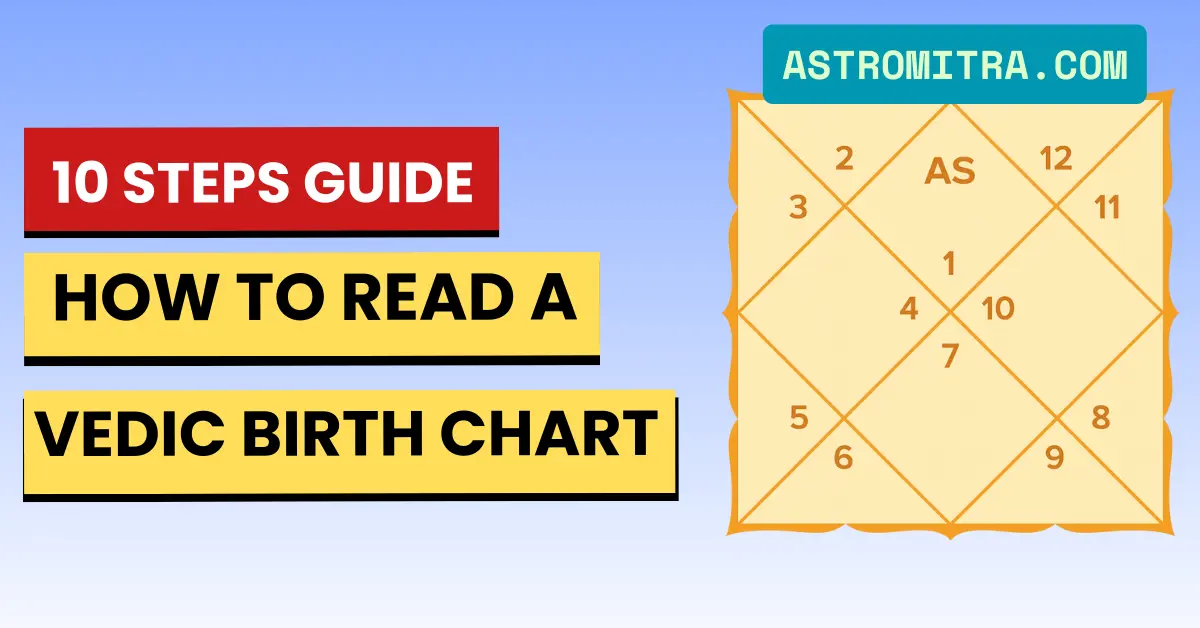
After spending over two and a half decades studying birth charts, I can tell you this with certainty: your Vedic astrology chart is not just a diagram—it's the sacred map of your soul's journey. Let me walk you through the exact process I use when reading a chart, step by step, so you can begin understanding your own cosmic blueprint.
Step 1: Choose the Right Chart Format for Your Reading
Before you even begin analyzing, you need to understand which chart style you're looking at. I've seen countless students get confused simply because they didn't recognize the format.
North Indian charts are diamond-shaped with houses that stay fixed while signs rotate. The first house always sits at the top. South Indian charts are square-shaped with signs fixed in place—Aries is always in the upper right corner, and you count houses clockwise from wherever your Ascendant (marked 'As' or 'L') appears. East Indian or Bengali charts look similar to North Indian but count clockwise.
Here's what matters: the planetary positions remain identical across all formats. Only the visual presentation changes. Once you know which format you're viewing, you can proceed confidently.
Step 2: Identify Your Lagna (Ascendant)—Your Life's Foundation
Every single birth chart reading I do begins here. Your Lagna is the zodiac sign rising on the eastern horizon at the moment of your birth. This is your window to the world—it shapes your physical body, your personality, and how you instinctively react to life's situations.
I once read the chart of a Virgo Lagna client with Mercury powerfully placed in the 10th house. She was a natural-born analyst and rose quickly in corporate leadership. Compare this to a Pisces Lagna person I know whose Jupiter sits in the 6th house—he dedicated his entire life to serving others through healthcare.
Look at your Lagna Lord (the planet ruling your Ascendant sign). Where is it placed? A strong Lagna Lord gives you vitality, confidence, and clear direction. A weak one? That's not a curse—it's an invitation to develop inner strength through conscious effort.
Step 3: Study Your Moon Sign (Chandra Rasi)—Your Emotional Blueprint
While your Lagna shows the world who you are, your Moon reveals who you are to yourself. After 25 years of practice, I can tell you that understanding the Moon is absolutely essential for predicting how someone will emotionally respond to life's ups and downs.
Your Moon sign governs your mind, emotions, and sense of security. A Moon in Taurus or Cancer typically indicates someone who's emotionally grounded and nurturing. But if your Moon sits in the 6th, 8th, or 12th houses, or receives harsh aspects from malefic planets, you might experience more emotional turbulence.
The Moon also determines your Vimshottari Dasha—the planetary time periods that unlock different chapters of your life. Never skip analyzing the Moon. It's the emotional weather you live with every single day.
Step 4: Assess Planetary Strength Using Shadbala
This is where beginners often go wrong. They see a planet well-placed by house and sign, then wonder why it doesn't deliver results during its Dasha period. The answer? They forgot to check the planet's actual strength.
Shadbala is a sixfold measurement system that reveals how much power each planet actually has. I've seen 10th house lords that look wonderful on paper but have weak Shadbala—and the person's career becomes inconsistent or unstable. Conversely, a planet with high Shadbala brings resilience and influence even under difficult transits.
Most modern Vedic astrology calculators will show you Shadbala scores. Use them. They tell you which planets can truly deliver on their promises and which ones need support through remedies.
Step 5: Dive Deeper with Divisional Charts (Vargas)
If the main birth chart (D-1) is like looking at a house from outside, divisional charts let you walk into each room and see what's really there. After decades of practice, I never make major predictions without consulting the relevant Varga charts.
The Navamsha (D-9) shows marriage, dharma, and spiritual potential. The Dashamsha (D-10) reveals career and public recognition. I've seen clients with strong career indicators in D-1 but afflicted D-10 charts—they experience success, yes, but it comes late or fluctuates unpredictably.
Always cross-reference your main chart with these divisions. They reveal the subtle truths that make your reading accurate and multidimensional.
Step 6: Master Vimshottari Dasha—The Timeline of Your Destiny
This is the heartbeat of Vedic astrology. The 120-year Vimshottari Dasha system shows when destiny unfolds. Each planetary period (Mahadasha) and sub-period (Antardasha) activates specific karmic themes in your life.
Let me give you an example from my practice. An Aries Lagna client running Mars Mahadasha came to me confused about why life suddenly became so action-packed. Mars ruled both his 1st house (self) and 8th house (transformation) and sat in the 11th house (gains through effort). I explained that this was his period for ambitious growth through intense personal transformation.
Before predicting any Dasha results, always check: (1) the planet's Shadbala, (2) its placement in relevant divisisional charts, and (3) its Ashtakvarga score. A strong planet brings success; a weak one teaches lessons through struggle.
Step 7: Track Current Transits (Gochar)—When Events Actually Happen
I always tell my students: Dasha loads the gun, but transit pulls the trigger. Even if you're running a favorable Dasha, without supporting transits, events remain dormant.
Saturn and Jupiter are the two transit giants I watch most carefully. Saturn brings structure, discipline, and karmic lessons. Jupiter expands opportunities and brings faith. When both simultaneously aspect a crucial house—like your 10th house of career—expect major visible developments.
Even the notorious Sade Sati (Saturn's seven-and-a-half-year transit) isn't something to fear. Yes, it's challenging, but it brings maturity, wisdom, and lasting stability. I've watched clients emerge from Sade Sati as completely transformed individuals—stronger, wiser, and more grounded.
Step 8: Use Ashtakvarga to Gauge Benefic Support
Ashtakvarga is one of the most practical tools in Vedic astrology, yet many people ignore it. This system assigns numerical points (Sarvashtaka Bindu) to each house, showing you which life areas flow easily and which require sustained effort.
Here's my simple guideline:
- 28 points: Balanced, average results
- Above 34 points: Strong support, natural ease
- Below 25 points: Requires persistent effort
I recently analyzed a chart where the 2nd house (wealth) scored only 22 points while the 10th house (career) scored 38. The message was clear: career success would come naturally, but building wealth required consistent, disciplined effort. And that's exactly how this person's life unfolded.
Ashtakvarga shows you the energetic support system of your entire chart at a glance.
Step 9: Understand Rahu and Ketu—Your Karmic Drivers
After 25 years, I can say with confidence that no chart reading is complete without analyzing Rahu and Ketu. These shadow planets represent the head and tail of the karmic dragon—desire versus detachment, hunger versus release.
Rahu (North Node) shows where you must grow, experiment, and embrace the unfamiliar. Ketu (South Node) indicates your comfort zone from past lives—areas of natural mastery but also potential detachment.
I've seen Rahu in the 7th house bring unconventional, even foreign relationships. Ketu in the 1st house often creates spiritual introspection or a sense of not fully belonging to the material world. When activated by Dasha or transit, these nodes trigger life-changing events that push your soul toward evolution.
Step 10: Synthesize Yogas and Weave the Complete Story
This final step separates beginners from masters. Reading a chart isn't about listing planetary positions—it's about weaving them into a coherent life narrative by identifying Yogas (planetary combinations).
Look for:
- Raja Yogas: Power and authority
- Dhana Yogas: Wealth
- Vipareeta Raja Yogas: Success through crisis
But here's the secret I've learned over decades: never interpret these Yogas in isolation. One Raja Yoga doesn't guarantee kingship if Saturn is crushing your chart with aspects. Context is everything. The real art lies in seeing how all these elements dance together to create your unique karmic pattern.
Living Your Chart: Remedies and Conscious Action
A birth chart shows your potential, but Upayas (remedial measures) help you harmonize difficult energies and activate your free will. If Saturn troubles you, cultivate discipline, serve others, and practice patience. If Jupiter is weak, embrace learning, charity, and gratitude.
Mantras, gemstones, fasting, and acts of service—when chosen correctly—don't change your karma. They change how you meet your karma. And that makes all the difference.
Remember: your Vedic birth chart is not a life sentence. It's a sacred syllabus for your soul's evolution. By understanding your Lagna, Moon, Dashas, transits, and Yogas, you learn to dance consciously with the cosmic rhythm rather than stumble through life blindly.
May the stars guide you toward your highest truth.
Frequently Asked Questions (Birth Chart Calculator)
How to generate an accurate free Vedic birth chart online?
To generate a 100% accurate Vedic birth chart (Kundli), you need your exact date of birth, precise birth time, and place of birth. At AstroMitra, we use the Swiss Ephemeris (NASA-level precision) with Lahiri Ayanamsa (official Indian government standard) and full geolocation database of 3.5+ million cities worldwide. Our calculator instantly computes your Lagna (Ascendant), 27 Nakshatras, planetary degrees, divisional charts (D-9 Navamsa, D-10 Dashamsa, etc.), Vimshottari Dasha up to sub-sub-sub periods, and Ashtakvarga points — everything a professional astrologer needs — completely free and without registration.
Can an Astrology Chart Predict Specific Events or the Future?
Astromitra's Detailed Life Horoscope is an exceptional tool that utilizes birth chart analysis to accurately predict significant life events within specific time frames. Through a meticulous interpretation of planetary positions at birth, it provides precise insights into forthcoming occurrences. While acknowledging individual agency, this astrological approach is remarkably adept at forecasting life's significant moments, offering invaluable guidance and clarity.
Is my Vedic birth chart different from my Western birth chart?
Yes, your Vedic birth chart can differ significantly from your Western chart. Vedic astrology uses the Sidereal zodiac based on actual star positions, while Western astrology uses the Tropical zodiac based on seasons. This creates approximately a 24-degree difference, meaning your Sun sign and other planetary positions may be in different signs. For example, if you're a Taurus in Western astrology, you might be an Aries in Vedic astrology. Additionally, Vedic charts use different house systems (Whole Sign) and include unique elements like Nakshatras and Vimshottari Dasha periods that don't exist in Western astrology.
Can I calculate my Vedic birth chart without knowing my exact birth time?
While you can generate a partial Vedic birth chart without your exact birth time, it will be incomplete and less accurate. Without birth time, you'll get correct planetary positions in zodiac signs, but you'll miss crucial elements: your Ascendant (Lagna), accurate house placements, and precise Vimshottari Dasha calculations. If you don't know your exact time, you can use 12:00 noon or sunrise time as approximations for general insights, but predictions based on houses and Dashas will be unreliable. For marriage compatibility, career timing, and major life event predictions, accurate birth time is essential.
What is Vimshottari Dasha and why does it matter in my birth chart?
Vimshottari Dasha is a unique 120-year planetary period system in Vedic astrology that predicts the timing of life events with remarkable precision. Unlike Western astrology which primarily uses transits, Vedic astrology calculates which planet rules each phase of your life based on your Moon's Nakshatra at birth. Each planet governs a specific time period (Mahadasha) ranging from 6 to 20 years, further divided into sub-periods (Antardasha and Pratyantardasha). Understanding your current Dasha period explains why certain themes dominate your life right now and helps predict when major opportunities, challenges, relationships, or career changes will manifest.
How do I read the North Indian vs South Indian birth chart format?
Both North Indian and South Indian chart formats contain identical astrological information—only the visual layout differs. In the North Indian diamond-shaped chart, houses are fixed (1st house always at top), and zodiac signs rotate counter-clockwise. In the South Indian rectangular chart, zodiac signs are fixed (Aries in top-right corner), and you locate your 1st house by finding where your Ascendant/Lagna is marked, then count clockwise from there. The planetary positions, aspects, and interpretations remain exactly the same regardless of format. Choose whichever format you find easier to visualize.
What makes a Vedic birth chart calculator accurate?
An accurate Vedic birth chart calculator must use four critical components: (1) Swiss Ephemeris data for NASA-grade planetary positions accurate to arc-seconds, (2) correct Ayanamsa calculation (typically Lahiri at 23°45') to convert from tropical to sidereal zodiac, (3) precise timezone and Daylight Saving Time (DST) handling for your birth location and date, and (4) accurate geocoding with exact latitude and longitude coordinates. Additionally, it should calculate Vimshottari Dasha based on your Moon's precise Nakshatra degree, use the traditional Whole Sign house system, and include all nine planets (Navagraha) including Rahu and Ketu. Our calculator meets all these standards and has been verified against professional software like Jagannatha Hora.
What is Nakshatra and how does it affect my Vedic chart reading?
Nakshatras are 27 lunar mansions that divide the zodiac into 13°20' segments, forming the foundation of Vedic astrology's predictive accuracy. Your Moon's Nakshatra at birth determines your entire Vimshottari Dasha sequence, emotional temperament, and karmic patterns. Each Nakshatra has unique characteristics, ruling deities, and planetary lords that influence your personality beyond just your zodiac sign. For example, two people with Moon in Aries could have completely different life experiences if one has Moon in Ashwini Nakshatra (ruled by Ketu, healing-oriented) versus Bharani Nakshatra (ruled by Venus, creative and intense). Nakshatra analysis adds precision and depth to your birth chart interpretation.
How often should I check my Vedic birth chart and Dasha periods?
Your Vedic birth chart never changes—planetary positions at the moment of your birth remain fixed for life. However, your Dasha periods change continuously, and this is where most timing-based predictions come from. Major Dashas (Mahadashas) shift every few years, but the sub-periods (Antardasha) and sub-sub-periods (Pratyantardasha) can change as frequently as every month or within a few months.
Since Astromitra provides Dasha interpretations up to the sub-sub-period level, it is important to keep track of these transitions. Regularly recalculating your chart for updated Dasha interpretations ensures you always understand the current planetary influences and can make informed decisions regarding career, relationships, finances, and other key areas of life.
Can Vedic astrology predict marriage timing in my birth chart?
Yes, Vedic astrology can indicate potential marriage timing with remarkable accuracy using multiple techniques. Astrologers examine: (1) your 7th house (marriage house) and its lord's strength and placement, (2) Venus position for women and Jupiter for men as karaka (significator) planets, (3) your current Vimshottari Dasha period—especially when you're running periods of 7th house lord, Venus, or planets placed in the 7th house, and (4) major transits of Saturn and Jupiter aspecting your 7th house, Ascendant, or Moon. The Navamsha chart (D-9) provides additional confirmation about marriage quality and timing. While astrology shows probabilities and favorable periods, remember that personal choice, effort, and free will play crucial roles.
What is the difference between Rasi chart and Navamsha chart?
The Rasi chart (D-1) is your main birth chart showing planetary positions in zodiac signs and houses at your birth moment. It reveals your physical life, personality, and general life circumstances. The Navamsha chart (D-9) is the most important divisional chart, dividing each zodiac sign into 9 parts of 3°20' each. It reveals your inner soul, spouse characteristics, spiritual evolution, and the second half of life (after age 35). Think of the Rasi chart as your outer destiny and Navamsha as your inner potential. A planet may appear strong in your Rasi chart but weak in Navamsha, or vice versa. Professional Vedic astrologers always analyze both charts together—the Rasi chart shows what happens, while Navamsha shows the quality and depth of those experiences, especially regarding marriage and dharma.
Why does my Vedic sun sign differ from my Western astrology sun sign?
Your Sun sign differs between Vedic and Western astrology because they use different zodiac systems with approximately 24 degrees of separation. Western astrology uses the Tropical zodiac, which is aligned with Earth's seasons and has remained fixed since around 2,000 years ago. Vedic astrology uses the Sidereal zodiac, which adjusts for the precession of equinoxes—Earth's gradual wobble that shifts the position of stars relative to the equinoxes. This means Vedic astrology tracks where the Sun actually is against the backdrop of constellations, while Western astrology maintains the seasonal alignment. Most people born after mid-month in Western astrology will find their Vedic Sun sign has shifted to the previous sign. This doesn't make either system "wrong"—they simply measure different astronomical phenomena and use different interpretive frameworks.