
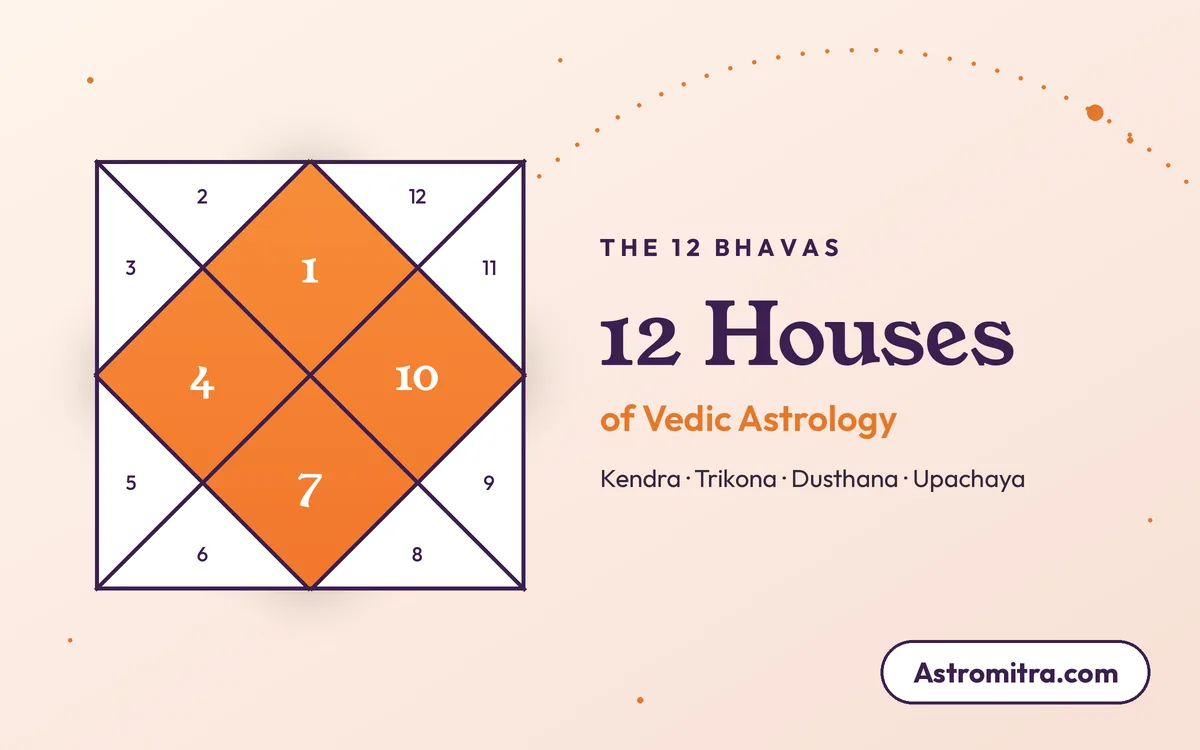

What a House (Bhava) Means in Vedic Astrology
The zodiac is the same for everybody. Leo is Leo whether you were born in Delhi or in Toronto. What makes a birth chart personal is the point where the zodiac meets the eastern horizon at the moment you were born, the ascendant. From that point the sky is divided into twelve houses, the bhavas, and each house takes charge of one part of life: the body, money, siblings, home, children, enemies, marriage, longevity, fortune, career, gains and losses.
Signs tell you how something happens, planets tell you what acts, and houses tell you where in your life it lands. Saturn is Saturn in every chart, but Saturn in the 7th house delays a marriage while Saturn in the 10th builds a career slowly and solidly. Before an astrologer predicts anything, he first asks which house the question belongs to.
All 12 Houses in Vedic AstrologyBhava, what it rules and its type | |||
|---|---|---|---|
| House | Bhava | Rules | Type |
| First House | Tanu Bhava | Self, body, health, appearance | Kendra, Trikona |
| Second House | Dhana Bhava | Wealth, family, speech, food | Maraka |
| Third House | Sahaja Bhava | Courage, siblings, effort, skills | Upachaya |
| Fourth House | Sukha Bhava | Mother, home, property, peace | Kendra |
| Fifth House | Putra Bhava | Children, intellect, education, romance | Trikona |
| Sixth House | Ripu Bhava | Enemies, disease, debt, service | Dusthana, Upachaya |
| Seventh House | Kalatra Bhava | Marriage, spouse, partnerships | Kendra, Maraka |
| Eighth House | Ayur Bhava | Longevity, sudden events, inheritance | Dusthana |
| Ninth House | Dharma Bhava | Fortune, father, guru, faith | Trikona |
| Tenth House | Karma Bhava | Career, status, authority | Kendra, Upachaya |
| Eleventh House | Labha Bhava | Gains, income, friends, wishes | Upachaya |
| Twelfth House | Vyaya Bhava | Expenses, foreign lands, moksha | Dusthana |
The table gives each house its main subjects; every house page goes much deeper. The first house is where the count begins, and it is also the house every other one is judged through.
Kendra, Trikona, Dusthana and Other House GroupsHow the houses are classed | ||
|---|---|---|
| Group | Houses | What It Means |
| Kendra (Angles) | 1, 4, 7, 10 | The pillars of the chart; planets here gain strength and act openly |
| Trikona (Trines) | 1, 5, 9 | Houses of merit and grace; the most fortunate houses in the chart |
| Dusthana | 6, 8, 12 | Houses of illness, obstacles and loss; their lords trouble whatever they join |
| Upachaya | 3, 6, 10, 11 | Houses of growth; results improve with age, and malefics do well here |
| Maraka | 2, 7 | Houses that can bring health crises in the periods of their lords |
| Panaphara (Succedent) | 2, 5, 8, 11 | Houses that follow the kendras and carry their results forward |
| Apoklima (Cadent) | 3, 6, 9, 12 | The weakest positions for a planet's strength |
The groups explain most of the classical yogas. A link between the lord of a kendra and the lord of a trikona is Raja Yoga, the combination for rise and status. The lord of one dusthana sitting in another dusthana gives Viparita Raja Yoga, success that comes out of trouble. And because a planet's house ownership decides whether it helps or harms you, the same planet can be a friend in one chart and an enemy in another, which is worked out in functional benefic and malefic planets.
The Four Aims of Life in the 12 HousesPurushartha | ||
|---|---|---|
| Aim | Houses | What They Show |
| Dharma (Duty) | 1, 5, 9 | Character, learning, faith and the path you follow |
| Artha (Wealth) | 2, 6, 10 | Money, work and the effort that earns it |
| Kama (Desire) | 3, 7, 11 | Ambition, relationships and the wishes you pursue |
| Moksha (Liberation) | 4, 8, 12 | Inner peace, transformation and letting go |
Read this way, the twelve houses are four rounds of the same circle. Each round starts with dharma and ends in moksha, and a chart crowded in one group shows where a person's life is spent. Many planets in the artha houses make a worker; many in the moksha houses make a seeker, whatever job he holds.
Natural Karakas (Significators) of the 12 HousesBhava karaka | |
|---|---|
| House | Karaka |
| 1st | Sun |
| 2nd | Jupiter |
| 3rd | Mars |
| 4th | Moon |
| 5th | Jupiter |
| 6th | Mars |
| 7th | Venus for a man, Jupiter for a woman |
| 8th | Saturn |
| 9th | Jupiter |
| 10th | Mercury |
| 11th | Jupiter |
| 12th | Saturn |
A karaka is the planet that naturally stands for a house's subject in every chart. Jupiter appears four times because wealth, children, fortune and gains are all forms of growth, and growth is Jupiter's nature. Saturn holds the 8th and 12th because longevity and loss both belong to time.
How an Astrologer Reads a House: Bhava, Bhavesh and Karaka
Every house is read through three pillars, and in this order. First the bhava itself: which planets sit in it and which aspect it. Benefics there protect it; Saturn, Mars, Rahu or Ketu there or aspecting it put pressure on it, unless the malefic owns the house, because no planet harms its own house. Second the bhavesh, the lord of the house: where it has gone, whether it is strong or weak by sign, and who aspects it, first in the birth chart and then in the Navamsa. Third the karaka from the table above, judged the same way.
The bhava and the bhavesh together decide the result; the karaka confirms or softens it. When the lord and the karaka are the same planet, as Jupiter is for the 5th house of a Sagittarius or Pisces ascendant, I read them together, once. This is also why a result can never be given from one rule. A good 7th house with an afflicted 7th lord gives a marriage that starts well and strains later; the reverse gives a hard start that settles. If that is your question, start with when will I get married; for work, the career prediction by date of birth reads the 10th house the same way.
Whole Sign Houses and the Bhava Chalit Chart
In the Parashari tradition used on this site, the sign rising at birth becomes the whole 1st house, the next sign the whole 2nd, and so on. This whole-sign method is what your free kundli shows in the main Lagna chart, and it is how the classical texts were written.
The Bhava Chalit chart refines it. It takes the exact degree of the ascendant as the middle of the 1st house, so a planet sitting late in one sign can slip into the next house. When the two charts disagree, the planet's house results are judged from the Chalit, while its sign strength is still read from the Lagna chart. KP astrology goes further and uses unequal Placidus houses; that system is read separately in the KP birth chart and never mixed with Parashari houses.
An Example From My Own Chart
Leo rises in my own chart, so the Sun rules my 1st house and the Moon, as the lord of Cancer, rules my 12th. Both of them sit together in my 2nd house, in Virgo. That one placement shows how houses talk to each other. The lord of the self and the lord of the 12th, the house of the inner life and of things beyond the visible, have both moved into the house of family and speech.
So the 2nd house in my chart carries three houses' worth of meaning. My work is spoken and written, it comes down through my family, and it deals with matters that cannot be seen. I am the fifth generation of astrologers in my family. Reading a chart this way, house by lord by house, is what each of the twelve house pages walks through in detail.