
Planetary Movement in Nakshatra: Vedic Astrology Tool
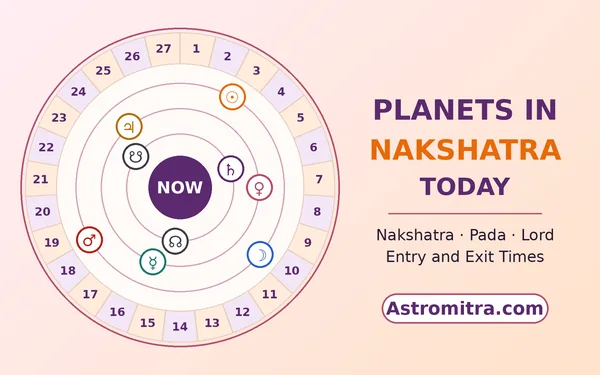
The table at the top of this page is the nakshatra transit of this very minute. For every planet it gives the nakshatra and pada it is passing through, the lord of that nakshatra, how much of the nakshatra it has already crossed, and the two moments that matter most when you time anything by the stars: when the planet entered its present nakshatra and when it will move on. Rahu and Ketu are shown twice, Mean and True, and Uranus, Neptune and Pluto are there for those who follow them.
Change the date, the time or the city in the strip above and the table follows at once. The entry and exit times are given in your own city's time zone, which is why the city matters even though the nakshatras themselves are the same everywhere on Earth. Below the main table you will find every nakshatra change of the month, so you can see at a glance which planet moves on next, and the Moon's daily changes folded away beneath it.
Understand Nakshatra Transits
Most people read a transit by sign: Saturn in Pisces, Jupiter in Cancer. That is the first layer, and it is a broad one. A sign is thirty degrees wide, and Saturn needs two and a half years to cross it. Ask any experienced Jyotishi how Saturn's transit will feel in its first months against its last, and the answer will come from the nakshatras.
The zodiac holds 27 nakshatras of 13°20' each, so every sign holds two and a quarter of them. Each has its own deity, its own nature and, most usefully for prediction, its own planetary lord. A planet transiting a nakshatra works through the matters of that nakshatra's lord. Saturn in Uttara Bhadrapada, a star of Saturn's own, is steady and inward; the same Saturn in Revati, ruled by Mercury, turns toward paperwork, travel, trade and endings that clear the way. Same sign, different chapter.
This is also how the old astrologers timed the Moon. The Moon's nakshatra of the day is the nakshatra of the panchang, the one every muhurta begins from, and the nakshatra the Moon held at your birth is your janma nakshatra, the starting point of your Vimshottari dasha.
What the Pada Adds
Each nakshatra is divided into four padas, or quarters, of 3°20'. The 27 nakshatras give 108 padas in all, and each pada is one navamsa: Ashwini's four padas fall in the Aries, Taurus, Gemini and Cancer navamsas, Bharani's in Leo, Virgo, Libra and Scorpio, and so on around the zodiac. So the pada tells you where a transiting planet stands in the D9 chart, the chart of a planet's inner strength.
In practice I watch the pada for the slow planets. A Saturn or Jupiter crossing from one pada to the next changes its navamsa sign every few weeks, and a planet moving into its own or its exalted navamsa gives noticeably better results than the same planet in its debilitated navamsa, even though the sign of the transit has not changed at all.
How Long a Planet Stays in One Nakshatra
The table Planets Transit Time in Each Nakshatra above gives the average stay of every planet. The Moon passes through a nakshatra in about a day, which is why the panchang changes its nakshatra daily. The Sun spends about thirteen and a half days in each, Jupiter around five months, Rahu and Ketu around eight, and Saturn more than a year.
Averages hide a lot. Mercury and Venus keep close to the Sun, so over a year they cover the zodiac just as the Sun does, but a retrograde can keep Venus in one nakshatra for six weeks or more, and Mercury can dart through one in under a week. Mars, which slows down and turns back every two years, sometimes spends months in a single nakshatra. That is why the main table gives the real entry and exit time for each planet, not the average.
Reading a Nakshatra Transit From Your Birth Star
The classical way to judge a nakshatra transit for yourself is tara bala, the strength of the star. Count from your janma nakshatra, the Moon's nakshatra at your birth, to the nakshatra a planet is transiting, counting your own nakshatra as one. Divide the count by nine and look at the remainder. One is janma, your own star; two is sampat, wealth; three is vipat, danger; four is kshema, wellbeing; five is pratyari, obstacles; six is sadhana, accomplishment; seven is naidhana, the hardest of the nine; eight is mitra, a friend; and a remainder of nothing is parama mitra, the best of friends.
The second, fourth, sixth, eighth and ninth taras support you, the third, fifth and seventh test you, and the janma tara makes you feel the transit in your own body and mind. For the Moon this decides whether a day is good for a fresh start. For Jupiter, Saturn, Rahu and Ketu, which stay for months, it colours a whole season. If you do not know your janma nakshatra, make your free kundli once and it is printed with your Moon sign.
The Nakshatra Lord and Your Dasha
The nine lords of the nakshatras, Ketu, Venus, Sun, Moon, Mars, Rahu, Jupiter, Saturn and Mercury, are the same nine that rule the Vimshottari dashas, in the same order. That is no accident. A transit through a nakshatra ruled by your running mahadasha or antardasha lord switches that dasha on, and it is one of the most dependable timing tools I know.
Say you are running Venus mahadasha and Jupiter enters Bharani, Purva Phalguni or Purva Ashadha, the three stars of Venus. For those months Jupiter's transit carries the Venus dasha with it, and whatever Venus promises in your chart, marriage, a home, a vehicle, comfort, tends to move. The Lord column of the table is there for exactly this check.
Mean and True Rahu-Ketu in the Nakshatras
Rahu and Ketu are not bodies but the two points where the Moon's path crosses the Sun's. The Mean node is their averaged position and moves steadily backwards; the True node is their actual position, which swings around the mean by up to about a degree and a half and, for a few days at a time, can even turn direct.
Most of the time both stand in the same nakshatra. Near the edge of a nakshatra they part company, and Mean Rahu can sit in one star while True Rahu has already moved into the next. Both are in the table, with their own entry and exit times, so you can read whichever node your tradition follows. Most astrologers in the Parashari tradition use the Mean node.
Nakshatra Transit in My Own Chart
My own Moon is in Uttara Phalguni, the nakshatra of the Sun, so every tara I read is counted from there. Count from Uttara Phalguni to Pushya and you reach the sixth tara, sadhana, the star of accomplishment.
Jupiter spent about two months in Pushya this summer, until it crossed into Ashlesha in the third week of August. Jupiter is the planet of expansion, and on my sadhana tara it did what that star promises: a new project I had been building for months was finished in those weeks and launched. Work that had been a plan for a long time became something real.
The table above shows where Jupiter is now: Ashlesha, my seventh tara, naidhana. Jupiter does not turn harmful there, but it is not a star to start new things under, so I am spending these weeks consolidating what was launched rather than beginning the next thing. At the end of October Jupiter moves into Magha, my eighth tara, mitra, the friend, and that is the month I have marked for the next step.