Online PujaPerformed in your name, watch it live Login or sign upSave charts, wallet and past readings

Lal Kitab Teva: Your Lal Kitab Kundli and Every Planet's Effect

Your Lal Kitab teva with every planet in its fixed house, the planets in their pakka ghar, the exalted and the weak, and what each planet does in its house

Enter Your Birth Details
Lal Kitab · Teva

Leave these alone unless you know the values. They are filled automatically from your birth place.

Never sold or shared Swiss Ephemeris, to the minute Dasha and transit windows

Ask an astrologer

Ask an astrologer about career

Answered from your own chart, in writing — not a template. Ask more together and each one costs less.

  • Answered by a verified astrologer, not AI
  • Within 24 to 48 hours
  • In writing, from your own chart
Your own question 0 / 160

Added questions appear in the list above and count toward your price. Up to 10 in all.

Your questions

1 question ₹40
2 questions ₹5 / Qsave 88%
3 questions ₹3.33 / Qsave 92%
4–6 questions ₹450 / Q
7–10 questions ₹400 / Q

Tap any question on the left. Pick two or more and the price per question drops.

Select up to 10 0
Answered in writing within 24 to 48 hours, by the verified astrologer you are matched with.

Your Lal Kitab Teva, Read the Lal Kitab Way

People come to the Lal Kitab when ordinary answers have run out — a job that will not settle, money that will not stay, a marriage that keeps getting delayed. What they find is a book that reads the chart in a way of its own, plainly and almost bluntly, and then hands over remedies a person can actually do at home. All of it starts from one chart: your Lal Kitab teva, the name the book itself gives to the Lal Kitab kundli.

The Lal Kitab teva uses the same planets as your ordinary birth chart, in the same houses. What changes is the sign on each house. The lagna sign is set aside and every house is given a fixed sign — Aries in the first, Taurus in the second, and so round the chart. A planet is then judged by its house alone, and its Lal Kitab result can be quite different from what your ordinary chart says.

What you get from the calculator above: your Lal Kitab teva, each of the nine planets in its house with its pakka ghar, whether it is exalted or debilitated, its strength and the planets that share its house, and a reading of what each planet does there.

Also Called
Teva
Signs
Fixed to the houses
Reads
All nine planets
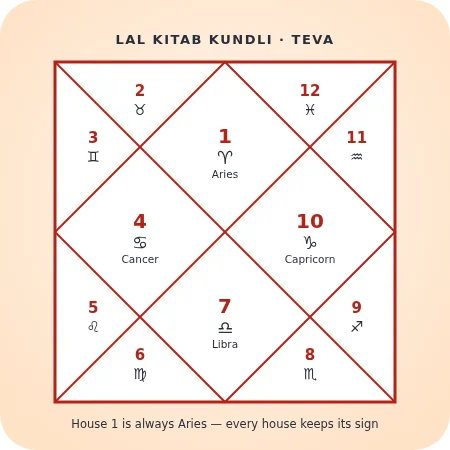
A Lal Kitab teva, or Lal Kitab kundli, in the North Indian style, with house 1 fixed as Aries and every other house keeping its own sign
In a Lal Kitab teva the first house is always Aries — every house keeps its sign.

What Makes a Lal Kitab Teva Different

Start with your ordinary Vedic birth chart. Every planet sits in a house counted from your lagna. The Lal Kitab keeps those houses exactly as they are and changes only one thing: it takes the lagna sign away and writes a fixed sign on every house. The first house becomes Aries whatever your lagna is, the second Taurus, the seventh Libra, the tenth Capricorn.

That single change has large effects. Exaltation and debilitation now depend on the house, not on the sign the planet occupies in the sky. Mars in the fourth house is treated as debilitated, because the fourth house is Cancer; the Moon in the second is treated as exalted, because the second is Taurus. Degrees and nakshatras step into the background, and the house becomes the whole story.

The Lal Kitab also reads the planets with each other in its own way: which planets share a house, which are friends and enemies, which houses look at which. That is why two people with the same planet in the same house can still get different Lal Kitab readings.

The Five Special Kinds of Lal Kitab Teva

In the Lal Kitab the horoscope is called the teva, so a Lal Kitab teva and a Lal Kitab kundli are the same thing. The book also picks out five special kinds of teva, where the chart as a whole behaves differently from an ordinary one:

TevaAlso CalledWhat It Means
Minor ChartNabalig tevaThe chart's promise matures slowly and settles only with age
Blind ChartAndha tevaEffort often misses its mark until the chart is set right
Half-Blind ChartRatandha tevaSome areas of life are seen clearly, others are not
Religious ChartDharmi tevaA protected chart in which even harsh planets do little harm
Sleeping ChartSoya tevaResults arrive late, when the right planets wake the chart

Most charts are none of these. When one applies, it colours every other reading, so the dashboard checks all five for you on its Lal Kitab Teva page, one click on from your Lal Kitab kundli. Sleeping planets and houses, which can occur in any chart, are read on the sleeping planets page.

Pakka Ghar, Exalted and Debilitated Houses

Every planet has a pakka ghar, a permanent house where it belongs. Because the signs are fixed to the houses, every planet also has a fixed house of exaltation and a fixed house of debilitation:

PlanetPakka GharExalted In · Debilitated In
Sun1st house1st (Aries) · 7th (Libra)
Moon4th house2nd (Taurus) · 8th (Scorpio)
Mars3rd house10th (Capricorn) · 4th (Cancer)
Mercury7th house6th (Virgo) · 12th (Pisces)
Jupiter2nd house4th (Cancer) · 10th (Capricorn)
Venus7th house12th (Pisces) · 6th (Virgo)
Saturn8th house7th (Libra) · 1st (Aries)

Some planets are given more than one permanent house in the book — Mars the eighth as well as the third, Jupiter several houses — and Rahu and Ketu, the shadow planets, have their own (the twelfth and the sixth). A planet in its pakka ghar gives its results steadily; an exalted planet gives them generously; a debilitated one needs care, and usually a remedy.

How Each Planet Gives Its Result in Its House

Lal Kitab readings are famous for being concrete. A planet in a house is described by what it does in daily life — to money, to the father or mother, to the home, to health, to work. The same planet can be generous in one house and harsh in the next, and the book does not soften the difference.

Three things change the reading. The planets sharing the house: a friend makes a planet stronger, an enemy disturbs it. The planet's strength, from its house, dignity and company. And whether the planet is awake or asleep — a sleeping planet holds its results back until something wakes it. The calculator puts all of this in one table and then reads each planet on its own card.

From the Lal Kitab Teva to the Remedies

The Lal Kitab is best known for its remedies, the upay — feeding certain animals, giving certain things away, keeping certain objects at home, avoiding certain habits. They are cheap and simple, and that is their genius: anyone can do them.

But a remedy is given for a planet, not for a person. The Lal Kitab teva comes first because it shows which planets are weak, debilitated, asleep or in trouble — and only those need help. Your chart's remedies are on the Lal Kitab remedies page, and the karmic debts that call for their own remedies on the debts of planets page. When to expect results is shown by the Lal Kitab varshphal and the Lal Kitab dasha.

The Book Behind the Chart

The Lal Kitab — literally the "red book" — was published in five editions between 1939 and 1952, written in Urdu and associated with Pandit Roop Chand Joshi of Punjab. It draws on Vedic astrology and palmistry but sets out a system of its own, with its own houses, its own rules for the planets and its own remedies.

I use it beside classical Jyotish, not instead of it. Parashari astrology tells me what a chart promises and when; the Lal Kitab often tells me, more directly than any other system, what a person can do about it.

A Worked Example: My Own Lal Kitab Teva

Here is my own chart redrawn as a Lal Kitab teva, read the way the calculator reads yours. Every placement is the real one.

  1. From the Birth Chart to the TevaMy lagna is Leo. In my Lal Kitab teva that sign is set aside: the first house becomes Aries and every planet keeps its house.
  2. The Crowded Second HouseThe Sun, Moon, Mercury and Venus all sit in the second house — the house of money, family and speech, and the pakka ghar of Jupiter.
  3. An Exalted MoonThe second house is Taurus in the Lal Kitab, so the Moon there is exalted. In my ordinary birth chart the same Moon is in Virgo and has no such dignity.
  4. A Debilitated MarsMars sits in the fourth house, which is Cancer in the Lal Kitab, so it is debilitated. In my ordinary birth chart the same Mars is in Scorpio, its own sign. This is the planet I would look at first for a remedy.
  5. The Rest of the ChartJupiter and Saturn share the third house, Ketu sits in the fifth and Rahu in the eleventh. The first, sixth, seventh, eighth, ninth, tenth and twelfth houses are empty.

The Mars example is the reason I read both charts. A planet that looks strong in the ordinary birth chart can be the one that needs help in the Lal Kitab, and the remedy then goes exactly where it is needed.

About the Author

Astrologer Pramod Sharma

Written and reviewed by

Jyotish Acharya · Bharatiya Vidya Bhavan, New Delhi

Verified astrologer
25+ Years
In practice since 2001
5th Generation
Family of Vedic astrologers
Systems
Parashari, KP, Jaimini, Lal Kitab

He reads the Lal Kitab teva beside the ordinary birth chart, and gives remedies only for the planets that need them.

Questions

Lal Kitab Teva: Questions People Ask

A Lal Kitab teva, or Lal Kitab kundli, is your birth chart redrawn by the rules of the Lal Kitab. The planets keep the houses they hold in your ordinary birth chart, but the signs are fixed: the first house is always Aries, the second always Taurus, and so on. Each planet is then read by the house it sits in, with Lal Kitab's own effects and remedies.

Teva is the Lal Kitab name for the horoscope itself. When a Lal Kitab astrologer asks for your teva, they mean your Lal Kitab kundli. The book also names five special kinds of teva — minor, blind, half-blind, religious and sleeping — that change how the whole chart gives its results.

In an ordinary Vedic birth chart the sign on each house depends on your lagna. In the Lal Kitab teva the lagna sign is set aside and every house carries a fixed sign, so planets are judged by house alone. A planet can be in its own sign in your ordinary chart and debilitated in your Lal Kitab kundli, or the other way round.

Pakka ghar is the permanent house of a planet — the house where it is most at home in Lal Kitab, such as the 1st for the Sun and the 4th for the Moon. A planet sitting in its pakka ghar gives its results steadily; the calculator marks every planet that does.

Yes. The houses come from your lagna, and the lagna changes about every two hours. With the wrong time a planet can move to the next house, and in Lal Kitab the house is everything. If you are unsure of the time, read the chart with care.

Not as its main timing. Lal Kitab has its own 35-year cycle of planetary periods and its own annual chart, the Lal Kitab varshphal. The Lal Kitab teva shows what each planet promises; those tools show when.

Lal Kitab remedies are simple, everyday actions — feeding animals, giving certain things away, keeping certain objects at home — and most are harmless. They are given for a planet that needs help, not for every planet, so it is wise to follow the remedies your own chart calls for rather than a general list.

Yes. Your Lal Kitab teva, every planet in its house with its pakka ghar, dignity, strength and effect, is free, with nothing held back behind a payment.
AI Astrologers Talk to Astrologer