Online PujaPerformed in your name, watch it live Login or sign upSave charts, wallet and past readings

Debts of Planets in Lal Kitab: Pitra Rin and the Nine Karmic Debts

Which of the nine Lal Kitab debts your teva carries, what each one brings, the relatives it is linked to, and the remedies that clear it

Enter Your Birth Details
Lal Kitab · Rin

Leave these alone unless you know the values. They are filled automatically from your birth place.

Never sold or shared Swiss Ephemeris, to the minute Dasha and transit windows

Ask an astrologer

Ask an astrologer about career

Answered from your own chart, in writing — not a template. Ask more together and each one costs less.

  • Answered by a verified astrologer, not AI
  • Within 24 to 48 hours
  • In writing, from your own chart
Your own question 0 / 160

Added questions appear in the list above and count toward your price. Up to 10 in all.

Your questions

1 question ₹40
2 questions ₹5 / Qsave 88%
3 questions ₹3.33 / Qsave 92%
4–6 questions ₹450 / Q
7–10 questions ₹400 / Q

Tap any question on the left. Pick two or more and the price per question drops.

Select up to 10 0
Answered in writing within 24 to 48 hours, by the verified astrologer you are matched with.

When the Past Leaves a Bill to Pay

Some troubles do not seem to belong to the person who has them. A good man whose work keeps collapsing at the last step. A family where every generation loses money the same way. A home where peace never lasts, though no one can say why. The Lal Kitab has a name for this: rin, a debt — something left unpaid in the family line that now falls due. Of the nine debts it describes, pitra rin, the debt to the father and ancestors, is the one most people have heard of.

The book treats these debts practically. Each one is carried by a planet, each shows up in particular areas of life and through particular relatives, and each has a remedy — often one the whole family does together. Reading the debts is one of the most useful things a Lal Kitab teva can do, because it explains trouble that ordinary readings leave unexplained.

What you get from the calculator above: all nine Lal Kitab debts checked in your teva; for each debt you carry, what it brings, the relatives it is linked to, its planet and its remedies; and the debts your chart is clear of.

Debts Checked
All nine
Best Known
Pitra rin
With
Remedies for each
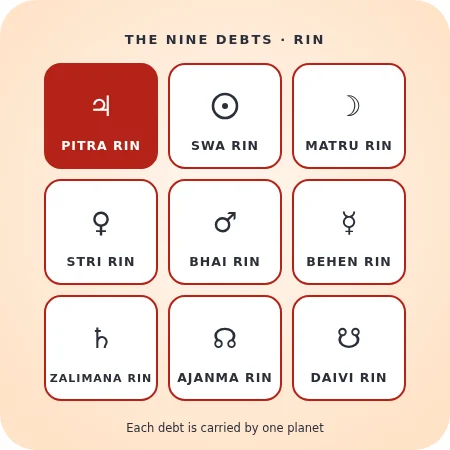
The nine Lal Kitab debts, each with its planet: pitra rin with Jupiter, swa rin with the Sun, matru rin with the Moon, and the rest
The nine Lal Kitab debts — pitra rin first — each carried by its own planet.

The Nine Debts of the Lal Kitab and Their Planets

DebtOwed To · PlanetWhat It Brings
Pitra RinFather and ancestors · JupiterSuccess that slips away at the last step
Swa RinYourself · SunYour own effort held back, recognition late
Matru RinThe mother · MoonLittle peace at home, money draining away
Stri RinWomen and the wife · VenusMarried life that needs extra care
Bhai RinBrothers and relatives · MarsFamily and property disputes that drag on
Behen RinSisters and daughters · MercuryStrained ties, trouble through words and deals
Zalimana RinPast cruelty · SaturnHardship through property, home and workers
Ajanma RinThe unborn · RahuSudden setbacks from an unseen side
Daivi RinGod and nature · KetuDisturbed peace and worry about children

Pitra Rin: The Debt to the Father and Ancestors

Pitra rin — pitru rin in some spellings — is the debt Jupiter carries for the family line. Jupiter stands for the father, the elders, the guru and the blessing that passes down from one generation to the next. When that blessing is blocked, its absence shows in a very particular way: things go well right up to the end and then fall through. A deal collapses at signing, a promotion goes to someone else at the last meeting, help promised by elders never quite arrives.

The Lal Kitab does not blame the person for it. It reads pitra rin as something the family owes — a duty left undone, a temple or a place of worship neglected, an elder not cared for — and treats its remedy as a family matter too. That is one reason the book's debt remedies so often involve every blood relative, not just the person whose chart shows the debt.

How a Debt Forms in a Lal Kitab Teva

Every debt belongs to one planet, and every planet has houses it considers its own. A debt forms when planets hostile to that planet move into its houses — strangers in the family home, in the Lal Kitab's way of seeing it. Enemies of Jupiter in Jupiter's houses point to pitra rin; enemies of Venus in Venus's houses point to stri rin; and so on through all nine.

This is why the debts are read in the Lal Kitab teva, where the houses carry fixed signs and the friendships of the planets decide so much. The calculator checks all nine for you and names only those your chart actually carries.

How a Debt Shows Itself in Life

A debt rarely announces itself as one big misfortune. It shows as a pattern: the same kind of trouble returning, often through the same relatives. With matru rin it is the home and peace of mind; with stri rin, married life; with bhai rin, brothers and property; with ajanma rin, setbacks that come from a side no one was watching.

The pattern is often shared by the family. Brothers and sisters may carry the same debt in their own charts, and the trouble may have run through a parent's life too. When a family recognises the pattern together, the remedy becomes far easier to carry out.

How Lal Kitab Debts Are Remedied

The remedies for debts are among the most distinctive in the Lal Kitab. Because a debt belongs to the family, the remedy is often collective: an equal share of money, or an item, is collected from every blood relative concerned, and all of it is used at once for the act the debt calls for — a donation, a feeding, an offering. Each debt has its own act, tied to its planet.

For a debt in your chart, the calculator lists its remedies right below the reading. The planets that need help beyond the debts are covered on the Lal Kitab remedies page.

Pitra Rin and Pitra Dosha

The two names are often mixed up. Pitra dosha belongs to classical Jyotish, read from the ordinary birth chart — usually from the Sun, the ninth house and Rahu or Ketu — and is remedied through shraddha and other rites for the ancestors. Pitra rin belongs to the Lal Kitab, read in the Lal Kitab teva from Jupiter's houses, and is remedied with the Lal Kitab's own acts.

They point at the same idea — a duty to the ancestors left unpaid — from two different systems. When both show up for the same person, I take the ancestral theme very seriously and suggest both kinds of remedy.

A Worked Example: My Own Lal Kitab Teva

Here is my own Lal Kitab teva, read for its debts. Every placement is the real one.

  1. The Houses to WatchThe Sun, Moon, Mercury and Venus are all in the second house. The second house is one of Jupiter's houses in the Lal Kitab, and also one of Venus's.
  2. A Pointer to Pitra RinVenus and Mercury are not friends of Jupiter, and here they sit in a house of Jupiter. That is the classic Lal Kitab pattern behind pitra rin.
  3. A Pointer to Stri RinThe Sun and Moon are not friends of Venus, and they sit in a house of Venus. That is the pattern behind stri rin.

One crowded house can raise two debts at once — which is why a second house full of planets deserves more care than it first appears to. The calculator confirms which debts your own teva carries and gives the remedy for each.

About the Author

Astrologer Pramod Sharma

Written and reviewed by

Jyotish Acharya · Bharatiya Vidya Bhavan, New Delhi

Verified astrologer
25+ Years
In practice since 2001
5th Generation
Family of Vedic astrologers
Systems
Parashari, KP, Jaimini, Lal Kitab

He reads the nine Lal Kitab debts in every teva before giving a remedy, and brings the family into the remedy when a debt calls for it.

Questions

Pitra Rin and Lal Kitab Debts: Questions People Ask

Pitra rin, also written pitru rin, is the debt to the father and the ancestors — the most widely known of the nine Lal Kitab debts, carried by Jupiter. It shows work the family left unfinished falling to you: success that slips away just as it seems certain, and help from elders that is slow to come.

Pitra rin (the father and ancestors), swa rin (yourself), matru rin (the mother), stri rin (women and the wife), bhai rin (brothers and relatives), behen rin (sisters and daughters), zalimana rin (past cruelty), ajanma rin (the unborn) and daivi rin (God and nature). Each is carried by one planet.

The Lal Kitab reads a debt from your teva: it forms when planets hostile to the debt's own planet sit in that planet's houses. The calculator checks all nine debts in your Lal Kitab teva and shows which ones you carry.

No. The Lal Kitab describes a debt as an obligation, not a punishment — something left unpaid by the family line that now asks to be settled. It shows where life feels blocked, and the remedy is meant to clear it.

Debts are usually remedied together with the family. A common form is to collect an equal share of money or an item from every blood relative concerned and use it all at once for the remedy the debt calls for. The calculator gives the remedies for each debt your chart carries.

Yes. A teva can carry no debts, one, or several. When there are several, the one carried by the planet that troubles you most is usually remedied first.

The nine debts are a Lal Kitab idea, read in the Lal Kitab teva. Classical Jyotish has its own ways of reading ancestral trouble, such as pitra dosha, but the Lal Kitab debts and their remedies belong to the Lal Kitab.

Yes. The nine debts checked in your Lal Kitab teva, what each debt found brings and its remedies are all free.
AI Astrologers Talk to Astrologer