
Free Lal Kitab Astrology Online
Lal Kitab Astrology: Your Teva, Read the Lal Kitab Way
The Lal Kitab reads a birth chart like no other book — every house with a fixed sign, every planet judged by its house, and remedies a person can do at home. Start with your Lal Kitab teva, the Lal Kitab kundli the whole system is built on, and follow it through the sleeping planets, the debts of the planets, the remedies, the year ahead and the 35-year cycle of periods.
All Seven, All Free
Free Lal Kitab Calculators
Every Lal Kitab reading works from the same birth entry, and every one of them is free.
The Book
What the Lal Kitab Is, and How It Differs From Vedic Astrology
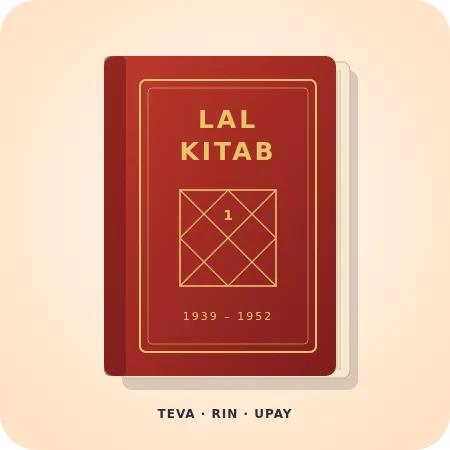
The Lal Kitab — the "red book" — appeared in five Urdu editions between 1939 and 1952 and is associated with Pandit Roop Chand Joshi of Punjab.
It borrows the planets and houses of Vedic astrology but changes the rules. The lagna sign is set aside and every house carries a fixed sign, so each planet is judged by its house alone. Signs, nakshatras and divisional charts step back; the house, the planets sharing it and the planet's permanent house, its pakka ghar, decide the reading. And where classical texts prescribe gemstones and long rituals, the Lal Kitab prescribes small, everyday acts that anyone can do.
Fixed Signs
House 1 is always Aries, house 2 always Taurus. Your lagna sign is set aside.
House Is Everything
A planet's result depends on its house, its company and its pakka ghar.
Its Own Timing
A 35-year cycle of periods and an annual chart of its own, not the Vimshottari.
Simple Remedies
Upay done at home, for the planets that need help and no others.
The Vocabulary
Key Lal Kitab Terms: Teva, Pakka Ghar, Rin and Upay
Eight words carry almost every Lal Kitab reading. Knowing what each one means makes your own Lal Kitab teva readable.
Teva
The Lal Kitab name for the horoscope — your Lal Kitab kundli, with a fixed sign on every house.
Pakka Ghar
A planet's permanent house, where it is most at home: the 1st for the Sun, the 4th for the Moon, the 7th for Venus.
Soya Graha
A sleeping planet that holds back its results until something in the chart or in time wakes it.
Kayam Graha
A settled planet, steady in its house and left undisturbed by the planets around it.
Masnui Graha
An artificial planet: two planets together that act as a third, such as the Sun and Venus behaving like Jupiter.
Rin
A karmic debt — nine in all, from pitra rin, the debt of the ancestors, onwards — each with its own remedy.
Upay
A Lal Kitab remedy: a small, specific act for a planet in trouble, usually kept up for a fixed number of days.
Varshphal
The Lal Kitab annual chart, in which the planets move to new houses for each year of life.
Upay
How Lal Kitab Remedies Work
A Lal Kitab remedy is given for a planet, never for a person in general. First the Lal Kitab teva shows which planets are weak, debilitated, asleep or carrying a debt; only those get a remedy. Then the remedy is kept up steadily, one planet at a time, so it is clear what is working. That is why the Lal Kitab remedies on this site are worked out from your own chart rather than copied from a general list.
- Read the Teva FirstFind the planets that need help before doing any remedy.
- Check the DebtsA planetary debt calls for its own remedy, often shared with the family.
- One Planet at a TimeStart with the planet that matters most and keep it up steadily.
- Follow the YearThe varshphal shows which planets need help in the year you are in.
Questions
Lal Kitab Astrology: Common Questions
Lal Kitab — the "red book" — is a system of astrology published in Urdu in five editions between 1939 and 1952 and associated with Pandit Roop Chand Joshi. It reads the birth chart with fixed signs on the houses, judges each planet by its house, and is best known for its simple, everyday remedies.
Teva is the Lal Kitab name for the horoscope. Your Lal Kitab teva, or Lal Kitab kundli, keeps every planet in the house it holds from your lagna but writes a fixed sign on each house: Aries on the first, Taurus on the second, and so round the chart.
Vedic astrology reads signs, nakshatras, divisional charts and the Vimshottari dasha. Lal Kitab sets the lagna sign aside and reads planets by house alone, with its own pakka ghar, its own rules for friends and enemies, its own 35-year cycle of periods and its own annual chart. The remedies are its own as well.
Most Lal Kitab remedies are simple acts — feeding animals, giving certain things away, keeping certain objects at home — and are harmless in themselves. The rule is to do only the remedies your own chart calls for, one planet at a time, rather than a general list.
Yes. The Lal Kitab teva is built from the houses, and the houses come from the lagna, which changes about every two hours. With the wrong time a planet can move to the next house, and in Lal Kitab the house decides everything.
Yes. Your Lal Kitab teva and every Lal Kitab reading on the dashboard are free, with nothing held back behind a payment. Talking to an astrologer is the only paid part.
Start Here
Your Lal Kitab Teva, Free and in Full
Free, no sign-up, and computed from the Swiss Ephemeris. Talking to a Lal Kitab astrologer is the only paid part.


