Online PujaPerformed in your name, watch it live Login or sign upSave charts, wallet and past readings

Sleeping Planets in Lal Kitab: Soya Graha, Qurbani ka Bakra and Khota Sikka

Which planets and houses in your Lal Kitab teva are asleep, whether the whole chart sleeps, and which planet pays for another

Enter Your Birth Details
Lal Kitab · Soya Graha

Leave these alone unless you know the values. They are filled automatically from your birth place.

Never sold or shared Swiss Ephemeris, to the minute Dasha and transit windows

Ask an astrologer

Ask an astrologer about career

Answered from your own chart, in writing — not a template. Ask more together and each one costs less.

  • Answered by a verified astrologer, not AI
  • Within 24 to 48 hours
  • In writing, from your own chart
Your own question 0 / 160

Added questions appear in the list above and count toward your price. Up to 10 in all.

Your questions

1 question ₹40
2 questions ₹5 / Qsave 88%
3 questions ₹3.33 / Qsave 92%
4–6 questions ₹450 / Q
7–10 questions ₹400 / Q

Tap any question on the left. Pick two or more and the price per question drops.

Select up to 10 0
Answered in writing within 24 to 48 hours, by the verified astrologer you are matched with.

Why Some Planets in Your Chart Seem to Do Nothing

Every astrologer meets this puzzle. A planet looks strong in the chart — well placed, well supported — and yet the person says it has given them nothing. The Lal Kitab has a plain answer: the planet is asleep. It is there, its promise is real, but it has nothing to act on, so its results wait. The book calls such a planet a soya graha, and finding the sleeping planets is one of the first things a Lal Kitab astrologer does with a teva.

The same idea runs through the whole chart. Houses can sleep. The whole teva can sleep. And two other conditions show a planet that loses out: the qurbani ka bakra, the planet that suffers so another can do well, and the khota sikka, the planet whose promise turns out false.

What you get from the calculator above: the sleeping planets in your Lal Kitab teva, split into helpful planets held back and harsh planets kept quiet; the sleeping houses and the planet whose remedies wake each one; whether your whole chart sleeps; and any sacrificed or counterfeit planet, each explained.

Soya Graha
Sleeping planet
Soya Ghar
Sleeping house
Also Checks
Sacrificed, counterfeit
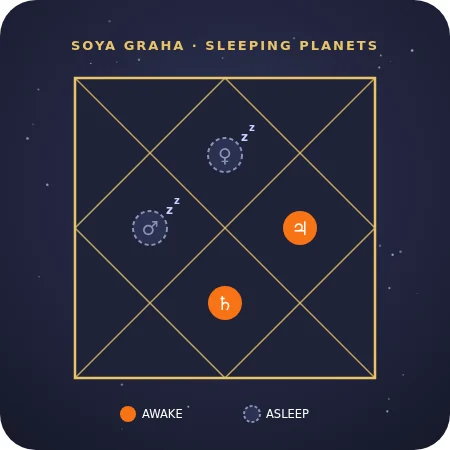
A Lal Kitab teva at night, with two planets awake and two sleeping planets marked as asleep
In a Lal Kitab teva some planets are awake and some are asleep — soya graha.

How a Planet Falls Asleep in a Lal Kitab Teva

In the Lal Kitab a planet works by looking — every house casts its sight on certain other houses, and a planet acts on the house it looks at. When that house is empty, the planet has nothing to work on. It does not lose its strength; it simply has no target, so it rests. That resting planet is the soya graha.

This is why the Lal Kitab never reads a planet on its own. The same Jupiter can be wide awake in one Lal Kitab teva and fast asleep in another, depending only on what lies in the house it looks at. A planet that is awake gives its results in its own time; a sleeping one holds them back.

Sleeping Helpers and Sleeping Malefics

A sleeping planet is not good or bad by itself. What matters is which planet is asleep. When a helpful planet sleeps — a well-placed Jupiter, Venus or Moon — the good it promises comes slowly and in a smaller measure. That is a loss, and the Lal Kitab offers remedies to wake it.

When a harsh planet sleeps — a troublesome Saturn, Rahu or Ketu — it cannot do the harm it otherwise would. That is a protection, and the rule is to leave it alone. The calculator keeps the two apart, so you know which planets to wake and which to let sleep.

Sleeping Houses and the Sleeping Chart

A house sleeps when no planet sits in it and none looks at it. The part of life it rules — money, marriage, children, career — stays quiet, neither troubled nor helped, until something wakes it. For each sleeping house the calculator names the planet whose remedies can wake it.

When the first and the seventh houses are both empty, the Lal Kitab treats the whole chart as asleep: a soya teva. The promise of the chart is still there, but it arrives late, often well into adult life, and the right remedies matter more than in an ordinary chart. It is one of the five special kinds of teva the book describes.

When and How a Sleeping Planet Wakes

The Lal Kitab gives every planet an age at which it comes into its own, and a sleeping planet often stirs around that age:

PlanetComes Into Its Own AtWhat Wakes With It
Jupiter16Learning, guidance, elders
Sun22Respect, the father, the government
Moon24Peace of mind, the mother
Venus25Marriage, comfort, beauty
Mars28Courage, brothers, property
Mercury34Speech, trade, sisters
Saturn36Hard work, property, lasting gains
Rahu42Sudden gains, links abroad
Ketu48Children, travel, inner peace

You need not wait. A helpful planet can be woken earlier through its own Lal Kitab remedies or the remedies of the planet that wakes its house. Years in which a planet moves into the right house in your Lal Kitab varshphal can wake it for that year too.

Qurbani ka Bakra: The Planet That Pays for Another

The Lal Kitab's most vivid idea is the sacrificial goat. When a planet comes under pressure, it protects itself by passing the trouble to another planet. The sacrificed planet then pays: the relatives it stands for, or the part of life it looks after, take the blow while the first planet's results stay safe.

It explains a pattern astrologers see often — a strong career next to a strained relationship with a brother, or good fortune that seems to cost someone else in the family. Knowing which planet is the sacrifice lets the remedy go to the right place.

Khota Sikka: The Counterfeit Planet

A khota sikka is a false coin: a planet that looks valuable in the chart and does not deliver. It sits where its promise cannot hold, so the results it seems to offer do not arrive as expected. The danger is relying on it — making plans around a planet that will not keep its word.

The calculator marks any counterfeit planet in your Lal Kitab teva so that you count on it only after its remedies, never before. Debts carried by the planets, which work in a similar hidden way, are read on the debts of planets page.

A Worked Example: My Own Lal Kitab Teva

Here is my own Lal Kitab teva, read for sleeping planets and houses. Every placement is the real one.

  1. Where the Planets SitThe Sun, Moon, Mercury and Venus are in the second house, Jupiter and Saturn in the third, Mars in the fourth, Ketu in the fifth and Rahu in the eleventh.
  2. A Sleeping ChartBoth the first house and the seventh house are empty. By the Lal Kitab's own rule that makes my teva a soya teva — a sleeping chart, whose promise arrives late.
  3. What That Means in PracticeA sleeping chart does not deny anything. It asks for patience: the results build slowly, and the planets come into their own around their ages of maturity rather than early in life.
  4. Many Empty HousesSeven of the twelve houses hold no planet. Wherever such a house also has no planet looking at it, it sleeps too, and the calculator names the planet whose remedies wake it.

This is the reading I give most often to people whose lives took off late: the chart was never weak, it was asleep. Seeing it written in the teva usually brings more relief than any prediction.

About the Author

Astrologer Pramod Sharma

Written and reviewed by

Jyotish Acharya · Bharatiya Vidya Bhavan, New Delhi

Verified astrologer
25+ Years
In practice since 2001
5th Generation
Family of Vedic astrologers
Systems
Parashari, KP, Jaimini, Lal Kitab

He checks every Lal Kitab teva for sleeping planets before giving a single remedy, and wakes only the planets that help.

Questions

Sleeping Planets in Lal Kitab: Questions People Ask

A sleeping planet, or soya graha, is a planet in your Lal Kitab teva that has nothing to work on. In the Lal Kitab a planet acts through the house it looks at; when that house is empty, the planet has no target and falls asleep. It does not vanish — its results are held back and come late or in a smaller measure.

It depends on the planet. A helpful planet asleep is a loss, because the good it promises comes slowly. A harsh planet asleep is a blessing, because it cannot do the harm it otherwise would. That is why the Lal Kitab wakes some sleeping planets and leaves others alone.

A sleeping house, or soya ghar, is a house with no planet in it and no planet looking at it. The part of life it rules stays quiet until a planet, a transit or a remedy wakes it.

When both the first house and the seventh house of a Lal Kitab teva are empty, the Lal Kitab treats the whole chart as asleep — a soya teva. The good the chart promises is real but arrives late, and remedies matter more than usual.

Qurbani ka bakra — the sacrificial goat — is a planet that suffers so that another can do well. A planet under pressure protects itself by passing the trouble on, and the matters or relatives ruled by the sacrificed planet bear it instead.

Khota sikka — the counterfeit coin — is a planet that looks good in the chart but does not deliver. Its promise does not hold where it sits, so it should not be relied on without its remedies.

Through the remedies of the planet itself or of the planet that wakes its house, and in time through its own age of maturity, when every planet comes into its own. Only a helpful planet should be woken; a sleeping malefic is best left asleep.

Yes. Your sleeping planets and houses, the sleeping chart check, the sacrificed planet and the counterfeit planet are all free, with nothing held back behind a payment.
AI Astrologers Talk to Astrologer