Online PujaPerformed in your name, watch it live Login or sign upSave charts, wallet and past readings

Lal Kitab Yogas: Kayam, Masnui and Grahan Yoga in Your Lal Kitab Teva

The yogas formed in your Lal Kitab teva — settled and artificial planets, eclipse yogas, crowded houses and the religious chart — each read for what it brings

Enter Your Birth Details
Lal Kitab · Yogas

Leave these alone unless you know the values. They are filled automatically from your birth place.

Never sold or shared Swiss Ephemeris, to the minute Dasha and transit windows

Ask an astrologer

Ask an astrologer about career

Answered from your own chart, in writing — not a template. Ask more together and each one costs less.

  • Answered by a verified astrologer, not AI
  • Within 24 to 48 hours
  • In writing, from your own chart
Your own question 0 / 160

Added questions appear in the list above and count toward your price. Up to 10 in all.

Your questions

1 question ₹40
2 questions ₹5 / Qsave 88%
3 questions ₹3.33 / Qsave 92%
4–6 questions ₹450 / Q
7–10 questions ₹400 / Q

Tap any question on the left. Pick two or more and the price per question drops.

Select up to 10 0
Answered in writing within 24 to 48 hours, by the verified astrologer you are matched with.

Combinations the Lal Kitab Reads Differently

Ask a classical astrologer about yogas and you will hear of Raj yoga and Gaja Kesari. Ask a Lal Kitab astrologer and you will hear something stranger: two planets that turn into a third, a planet that sits so steady nothing can shake it, a Moon clouded over by Rahu, a house so crowded its planets fight. These are the Lal Kitab yogas, and they are read in your Lal Kitab teva, house by house, with remedies attached.

The Lal Kitab does not care much for grand titles. Its yogas describe how the planets in your chart actually behave together — who supports whom, who imitates whom, who clouds whom. That makes them practical: each one points to a part of life and, where it troubles you, to a remedy.

What you get from the calculator above: the Lal Kitab yogas formed in your chart, counted as helpful or harmful; your settled planets; your artificial planets and what they imitate; any eclipse yoga; every crowded house and whether its planets work together; and the other yogas checked.

Kayam
Settled planets
Masnui
Artificial planets
Grahan
Eclipse yoga
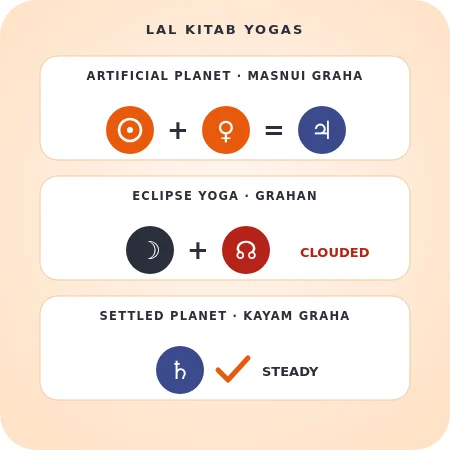
Three Lal Kitab yogas: the Sun and Venus making an artificial Jupiter, the Moon clouded by Rahu in an eclipse yoga, and a steady settled Saturn
Masnui graha, grahan yoga and kayam graha — three of the Lal Kitab's own yogas.

Kayam Graha: The Settled Planet

A kayam graha is a planet left in peace. No enemy disturbs it in its house, nothing pulls it off course, so it gives its results steadily and in full. The word means established, fixed in place — and that is how a settled planet feels in a life: a dependable strength that does not come and go.

A Lal Kitab teva with several settled planets is a stable chart even when it has hard placements elsewhere. Settled planets rarely need remedies; they are the parts of the chart you can lean on.

Masnui Graha: Two Planets That Become a Third

The most original idea in the Lal Kitab is the masnui graha, the artificial planet. Two planets sitting together can blend into the nature of a third. The Sun and Venus together, for instance, behave like Jupiter. The artificial planet can be helpful or harmful, depending on the planet it imitates and how it sits.

This matters in two ways. An artificial planet can stand in for a real one that is weak or badly placed, so a chart can enjoy Jupiter's blessings even with a troubled Jupiter. And an artificial planet takes on the remedies of the planet it imitates, which is why Lal Kitab remedies sometimes seem to target a planet that is not obviously involved.

Grahan Yoga: The Eclipse in a Lal Kitab Teva

When the Sun or the Moon is joined by Rahu or Ketu, the Lal Kitab sees an eclipse in the chart — grahan yoga. Rahu eclipses fully, Ketu partly. With the Sun eclipsed, respect, standing and dealings with the government or the father can suffer. With the Moon eclipsed, it is peace of mind and the bond with the mother that clouds over.

Grahan yoga is one of the conditions the Lal Kitab remedies most directly, and its remedies are among the best known in the book. It is also a reason to read the debts of the planets, because an eclipsed luminary often goes with a family debt; that is the subject of the debts of planets page.

Crowded Houses: Planets That Help or Fight

When three or more planets share a house, that part of life carries great weight. The Lal Kitab then asks one question: are these planets friends or enemies? Friends back one another and the house gives strong, steady results. Enemies pull in different directions and the house swings between extremes — great gains and sudden losses, warm years and cold ones.

The calculator reads every crowded house in your Lal Kitab teva and marks it as working together or pulling apart, so you know which parts of life are a foundation and which need care.

Dharmi Teva and the Moon–Saturn Yoga

Two more yogas are checked for every chart. The dharmi teva, the religious chart, is a blessing: even the harsher planets do little harm, and the life leans towards duty and faith. It is one of the five special kinds of teva described on the Lal Kitab teva page.

The Moon–Saturn yoga is the opposite kind of note. When the Moon and Saturn are bound together, the mind grows heavy and worry comes easily. It is not a sentence — it is a reason to protect the Moon, and the Lal Kitab has simple ways to do it.

Lal Kitab Yogas and Vedic Yogas

The yogas of classical Jyotish — Raj yoga, Dhan yoga, Gaja Kesari, the Pancha Mahapurusha yogas — are judged from signs, house lordships and aspects in the ordinary birth chart. The Lal Kitab yogas are judged in the Lal Kitab teva, where the signs are fixed and the house is everything, and by the friendship and enmity of the planets.

The two do not replace each other. Your Vedic yogas describe the promise of the chart; your Lal Kitab yogas describe how the planets actually get along — and what to do when they do not.

A Worked Example: My Own Lal Kitab Teva

Here is my own Lal Kitab teva, read for its yogas. Every placement is the real one.

  1. A Crowded Second HouseThe Sun, Moon, Mercury and Venus share the second house. With four planets in one house, everything turns on whether they work together — and the Sun and Venus are not natural friends in the Lal Kitab.
  2. An Artificial JupiterThe Sun and Venus sit together, and in the Lal Kitab that pair acts as Jupiter. Here it forms in the second house, which is Jupiter's own pakka ghar — the artificial planet lands in the home of the planet it imitates.
  3. No Eclipse on the LuminariesThe Sun and Moon are in the second house, Rahu in the eleventh and Ketu in the fifth. Neither luminary shares a house with a node, so no grahan yoga forms by conjunction.
  4. Moon and Saturn Kept ApartThe Moon is in the second house and Saturn in the third, so the two do not sit together.

The second house is the whole story of this chart's yogas: crowded, mixed in temperament, and carrying an artificial Jupiter in Jupiter's own house. In a reading I would start there, and the calculator does the same — it shows whether that crowded house is working together or pulling apart.

About the Author

Astrologer Pramod Sharma

Written and reviewed by

Jyotish Acharya · Bharatiya Vidya Bhavan, New Delhi

Verified astrologer
25+ Years
In practice since 2001
5th Generation
Family of Vedic astrologers
Systems
Parashari, KP, Jaimini, Lal Kitab

He reads Lal Kitab yogas house by house in the teva, and checks every crowded house for friends and enemies before anything else.

Questions

Lal Kitab Yogas: Questions People Ask

Lal Kitab yogas are the combinations the Lal Kitab looks for in a teva: planets that are settled and steady, pairs of planets that act together as a third, eclipse yogas that cloud the Sun or Moon, houses crowded with planets, and special charts such as the religious chart. They work differently from the Raj yogas and Dhan yogas of classical astrology.

A masnui graha is an artificial planet: two planets in your Lal Kitab teva that together behave like a third. The Sun and Venus together, for example, act as Jupiter. The artificial planet carries the nature of the planet it imitates, and can stand in for it where the real one is weak or absent.

A kayam graha is a settled planet — one left undisturbed by the planets around it, so it gives its results steadily and in full. A chart with several settled planets is a stable chart, whatever else it shows.

Grahan yoga, the eclipse yoga, forms when the Sun or the Moon is joined by Rahu or Ketu. The luminary is clouded: with the Sun, respect and dealings with authority can suffer; with the Moon, peace of mind. Rahu eclipses fully, Ketu partly.

A crowded house is a strong part of life, for better or worse. If the planets there are friends and back one another, that area gives strong results; if they are enemies and pull apart, results in that area swing from one extreme to the other.

A dharmi teva is a religious chart — a protected Lal Kitab teva in which even the harsher planets do little harm, and life leans towards duty, faith and doing right by others.

No. Vedic yogas such as Gaja Kesari or Raj yoga are judged from signs, lordships and aspects in the ordinary birth chart. Lal Kitab yogas are judged in the Lal Kitab teva, by house and by the friendship of the planets, and they come with Lal Kitab remedies.

Yes. The Lal Kitab yogas formed in your teva, with the settled and artificial planets, eclipse yogas, crowded houses and the other yogas checked, are all free.
AI Astrologers Talk to Astrologer