Online PujaPerformed in your name, watch it live Login or sign upSave charts, wallet and past readings

Will my marriage last? Separation and divorce prediction by date of birth

Free reading — the 7th house, its lord and the marriage karaka, from your Vedic kundli

Enter your birth details
30M charts computed

Leave these alone unless you know the values. They are filled automatically from your birth place.

Never sold or shared Swiss Ephemeris, to the minute Dasha and transit windows

Full marriage report

Your full marriage report — everything the stars hold for you

One chart, read end to end for marriage. The 7th house and every planet that touches it, the 7th lord in the birth chart and the Navamsa, the karaka, Upapada Lagna and Darakaraka — and, for this question above all, which placements are causing the strain and what protects against them.

  • How the marriage holds — separation and divorce risk, honestly read
  • Exactly which placements cause the strain, and which protect
  • The 7th lord in your birth chart and your Navamsa, in full
  • Manglik and other doshas, checked properly
  • Your spouse — nature, background, and the direction they come from
  • Remedies matched to the planet doing the harm
  • Marriage predictions for the next 10 years

₹599

18–22 pages · PDF

Get the report

In your inbox within 10 minutes

Ask an astrologer

Ask an astrologer about marriage

Answered from your own chart, in writing — not a template. Ask more together and each one costs less.

  • Answered by a verified astrologer, not AI
  • Within 24 to 48 hours
  • In writing, from your own chart
Your own question 0 / 160

Added questions appear in the list above and count toward your price. Up to 10 in all.

Your questions

1 question ₹40
2 questions ₹5 / Qsave 88%
3 questions ₹3.33 / Qsave 92%
4–6 questions ₹450 / Q
7–10 questions ₹400 / Q

Tap any question on the left. Pick two or more and the price per question drops.

Select up to 10 0
Answered in writing within 24 to 48 hours, by the verified astrologer you are matched with.

Separation and divorce in the kundli — what the chart can and cannot say

This is the question people find hardest to ask. They come in for something else — a child's career, a property matter — and only at the end, at the door, does it come out: Panditji, will my marriage last? Sometimes it is a parent asking about a match before the engagement. Sometimes it is a husband or a wife three years in, already tired. I have learnt to answer all of them the same way.

The kundli does not predict divorce. Let me say that first, because half the pages on this subject pretend otherwise. What the kundli shows — and shows with real precision — is how much strain the marriage carries and where it comes from. A marriage with a clean 7th house, a well-placed 7th lord and an unafflicted karaka holds itself. A marriage where all three are afflicted does not; it has to be held. Between those two lies every chart I have ever read, and the honest reading is the one that tells you which kind yours is.

The calculator above reads your chart the way I read it in consultation: three pillars, in a fixed order, and no arithmetic. The rest of this page explains what those three pillars are.

The house
7th
Works against it
6th · 8th · 12th
Protects it
Jupiter
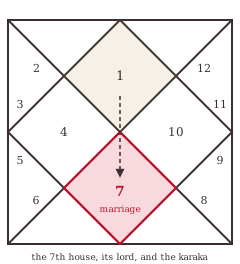
North Indian kundli with the 7th house of marriage marked
The house, its lord and the karaka — Bhava, Bhavesh, Karaka. All three are read; the marriage is judged on how they stand together.

What a divorce prediction by date of birth actually reads

I want to be careful here, because this subject attracts more nonsense than any other in marriage astrology. A page that counts up "divorce yogas" and returns a percentage has misunderstood the shastra. Astrology is not arithmetic. A single Rahu aspect on the 7th house does not add three points to anything; it either matters in the context of the whole 7th house or it does not, and an astrologer decides which by looking at what else is there.

So this reading does not score. It asks three questions of the chart, in a fixed order, and each is answered in words — afflicted, mixed, strong — the way I would answer them at the table. Then the three answers are read together. That is what a divorce prediction by date of birth means when it is done as Jyotish rather than as a quiz.

And the usual warning applies with more force than usual. All three pillars are counted from the lagna, which changes every two hours. A birth time that is off by an hour can move the 7th lord to a different planet altogether, and with it the entire reading. For a question this serious, get the birth time right before you read anything.

What this page does not do. It does not date anything. It will not tell you the year a rough patch comes or the year it ends — that is a dasha reading, and a page cannot do it responsibly. It reads the birth chart's promise and stops there. For who your spouse is, see the marriage prediction page; for the timing of a marriage, the when will I get married page.

The three pillars: Bhava, Bhavesh, Karaka

Every bhava in the kundli is read the same way, and my teachers were strict about the order. First the house itself — bhava. Then the lord of the house — bhavesh. Then the karaka, the planet that signifies the matter regardless of which house it falls in. For marriage the house is the 7th, the lord is whoever rules the sign on the 7th, and the karaka is Venus in a man's chart and Jupiter in a woman's.

PillarWhat is checkedAfflicted when
Bhava — the 7th house Who sits in it. Who aspects it — Mars, Saturn, Rahu, Ketu, the Sun. Whether the lords of the 6th, 8th or 12th are placed there. A malefic sits in it; the lord of the 6th, 8th or 12th sits in it; three or more malefics aspect it; or two aspect it and a malefic sits in the 7th of the Navamsa.
Bhavesh — the 7th lord Which house it sits in, its dignity, who sits with it, who aspects it — in the birth chart first, then the same planet in the Navamsa. In the 6th, 8th or 12th; with a malefic; aspected by two or more malefics; or debilitated with any malefic contact.
Karaka — Venus or Jupiter Exactly as the lord is: house, dignity, conjunction, aspects, birth chart then Navamsa. Venus is still read, more lightly, in a woman's chart. The same conditions as the lord. When the karaka is also the 7th lord and is afflicted, the wound is concentrated and reads heavier.

Then the three are read together. The house and its lord decide: both afflicted, and the marriage needs protecting. The lord alone afflicted — or the house together with the karaka — is real strain. One pillar touched is the ordinary strain most charts carry. And a protecting influence, which we come to below, steps the whole reading down a grade.

Debility on its own is not affliction. This is where most quick readings go wrong. A 7th lord in its fall, sitting in a good house with no malefic touching it, is weak — not wounded. It becomes afflicted when the malefic contact arrives. The same is true of combustion. The reading records these as minor weaknesses and says so, rather than counting them as the blow they are not.

The 7th house — malefics in it and on it

The house comes first because it is the marriage itself. A malefic sitting in the 7th — Mars, Saturn, Rahu or Ketu — puts its nature into the marriage: Mars its heat, Saturn its coldness, Rahu its restlessness, Ketu its detachment. Two of them together crowd the house and the reading grows heavy. The lords of the 6th, 8th and 12th sitting in the 7th bring their houses with them — dispute, upheaval, separation.

Aspects matter as much as occupancy, and here I apply the classical drishti, not the Western orbs. Mars sees the 4th, 7th and 8th from itself; Saturn the 3rd, 7th and 10th; Jupiter the 5th, 7th and 9th; Rahu and Ketu the 5th, 7th and 9th; every other planet the 7th. One or two malefic aspects on the 7th house create pressure. Three make an affliction. Two, with a malefic also sitting in the 7th house of the Navamsa, make one too.

Mars
Temper, quick words, quick wounds
Saturn
Distance, duty without warmth
Rahu
Restlessness, the eye elsewhere
Ketu
Detachment, the heart elsewhere

A planet never harms the house it owns. Saturn rules the 7th for Cancer and Leo ascendants; Mars rules it for Libra and Taurus. When the 7th lord happens to be a malefic and sits in the 7th, or aspects it, that is the lord in its own house — it strengthens the marriage, it does not afflict it. The same rule holds in the Navamsa. Any reading that counts the 7th lord against its own house is wrong.

The 7th lord — birth chart first, then the Navamsa

If the 7th house is the marriage, the 7th lord is its constitution — how much it can take. Always check the lord's position in the birth chart first, and then find the same planet in the Navamsa. A badly placed or badly influenced 7th lord is not good for a long-lasting marriage, and no amount of strength elsewhere in the chart fully makes up for it.

The 7th lord isWeightWhat it says
In the 6th, 8th or 12th Heavy The marriage's own lord sits in a house that works against marriage. The single most reliable sign of strain in the chart.
With a malefic Heavy Mars, Saturn, Rahu or Ketu in the same house colours the lord with its nature. With the lord of the 6th, 8th or 12th, the affliction is doubled.
Aspected by two or more malefics Heavy Pressure from more than one direction. One malefic aspect is noted; two is an affliction.
Debilitated, with malefic contact Heavy A lord in its fall cannot resist what touches it. Debility with a clean house is only a weakness; debility with a malefic on it is a wound.
Combust, or debilitated alone Minor Weakened, not wounded. When the Sun doing the combusting is the lagna lord, it is barely a weakness at all.
Exalted or in own sign, vargottama Strong The same sign in both charts, and dignified in it. The firmest 7th lord the chart can have — it carries the marriage through what the house cannot.

The Navamsa check is not optional. Take the birth chart's 7th lord and find where it lands in the D9. Afflicted in both charts, and the strain is confirmed at the root — that is the pattern behind most of the separations I have seen. Afflicted in the birth chart but exalted or in its own sign in the Navamsa, and the marriage has a reserve the birth chart alone did not show. Strong in both, and I stop worrying about the 7th lord entirely, whatever else is going on.

The third pillar

The karaka — Venus for a man, Jupiter for a woman

The karaka is the planet that stands for the spouse no matter which house it sits in. In a man's chart it is Venus, the wife; in a woman's it is Jupiter, the husband. It is read exactly as the 7th lord is — its house, its dignity, who sits with it, who aspects it, birth chart first and then the Navamsa — and the same rule about debility applies: a debilitated Venus in a good house with no malefic near it is a minor weakness, not a wound.

Two things are particular to the karaka. Venus is read in every chart, because Venus speaks for the marriage whoever the karaka is — in a woman's chart it is read a step more lightly than Jupiter, but it is read. And the 7th lord's own aspect on the karaka is not an affliction, even when the 7th lord is Saturn or Mars; the house's own lord looking at the house's own significator is a connection, not an attack.

Man's chart
Venus
Woman's chart
Jupiter, with Venus read lightly
Karaka = 7th lord
Afflicted, the wound is concentrated

When the karaka is also the 7th lord. For a Gemini or Virgo ascendant in a woman's chart, Jupiter rules the 7th and is the karaka. For an Aries or Scorpio ascendant in a man's, Venus does both. One planet then carries two pillars — and if that planet is afflicted, it is not two ordinary afflictions but one concentrated one. The reading treats it so: the strain grows heavier, and no protecting influence softens it.

What protects a marriage in the chart

Affliction is only half the reading. Every chart I have seen that held together against a bad 7th house had something standing between the affliction and the marriage, and it is almost always one of three things.

  • Jupiter's aspect on the 7th house, its lord, or the karaka. The single strongest protection there is. Jupiter's drishti is always good — and I mean always, even when Jupiter rules the 6th, the 8th or the 12th. Jupiter as the 8th lord aspecting the 7th is still Jupiter. It does not become a malefic because of the sign it happens to own.
  • A strong 7th lord. In its own sign or exaltation, and above all vargottama — the same sign in the birth chart and the Navamsa. A 7th lord like this can be combust, can be aspected by Rahu, can sit next to the 8th lord, and still carry the marriage.
  • A benefic alone in the 7th. Venus, Mercury or the Moon sitting in the 7th with no malefic beside them. Or the 7th lord itself in its own house, which counts as support whatever planet it is.

Protection steps the reading down one grade. It does not erase the affliction — a heavily afflicted chart with Jupiter's aspect reads as real strain rather than a marriage that needs protecting — and where the karaka and the 7th lord are one wounded planet, it does not soften the reading at all.

Case study: two charts, one afflicted lord

Let me put two charts from my own files side by side, because together they show why the order of reading matters more than the count of afflictions.

The first is a Leo ascendant, a man. Saturn rules the 7th and sits in the 3rd — exalted in Libra, but combust, next to Jupiter who rules the 8th, with Rahu's aspect on it. Venus, the karaka, is debilitated in Virgo and combust as well. The 7th house is empty, and both Mars and Rahu aspect it. A quick reading counts five afflictions and pronounces. But look again. Saturn is vargottama — Libra in the Navamsa too — and exalted in both charts: a 7th lord that strong is not wounded by combustion. The Sun doing the combusting is the lagna lord, a friend. Venus is debilitated but no malefic touches it. Jupiter aspects the 7th house. The house has pressure, the lord is strong, the karaka is merely weak. Mild strain. The marriage argues and stays, and has for many years.

The second is a Gemini ascendant, a woman. Jupiter rules the 7th and is also the karaka — one planet, two pillars. It sits in the 8th, debilitated in Capricorn, aspected by Mars. In the Navamsa it is exalted, but in a different sign, so no vargottama. The 7th house has four malefic aspects on it — Mars, Saturn, Rahu and the Sun — and Mars sits in the 7th house of the Navamsa. Bhava afflicted. Bhavesh afflicted. The karaka is the same wounded Jupiter, so the wound is concentrated, and no Navamsa exaltation softens it. A marriage that needs protecting. It ended in divorce.

The first chart had more things "wrong" with it by count. The second had the one thing that matters: the house and its lord both afflicted, and the lord carrying the karaka's burden as well. That is the difference between counting and reading.

Common patterns and what they mean

Four readings come across my table again and again. If yours is one of them, you are in ordinary company, and the note beside it is what I would say to you.

Firm

Clean 7th house, strong 7th lord, Jupiter's aspect

The marriage holds itself. Difficulties come from outside — money, in-laws, health — and are met as a pair. Charts like this rarely reach an astrologer with this question at all.

Reads as
Firm
What to watch
Nothing in the 7th. Look to the 4th for the home.
Mild strain

Malefic aspects on the 7th, but a vargottama lord

Pressure on the house, strength in the lord. This is the argumentative, durable marriage — sharp words, long memory, no real doubt about staying. The strength of the lord is what the reader usually cannot see for themselves, and it changes everything.

Reads as
Mild strain
What helps
Remedies for the aspecting planet, not for the marriage.
Real strain

7th lord in the 6th, 8th or 12th, with Jupiter protecting

The lord is afflicted, and that is serious; but Jupiter's aspect on the 7th, or a strong Navamsa, stands in the way. These are marriages with a hard stretch built into them that come through it — provided the couple knows the stretch is coming and does not mistake it for the end.

Reads as
Notable
What helps
A consultation before the hard stretch, not after.
Needs protecting

House and lord both afflicted, karaka wounded too

Malefics in or on the 7th, the lord in a dusthana or with malefics, the karaka the same. Nothing stands between the affliction and the marriage. The union will not hold itself; it has to be held, deliberately, by both people, with help. Some are. Many are not.

Reads as
High strain
What helps
Honesty first. Then remedies, then counsel — in that order.

Remedies for strain in a marriage

The same caution I give on every page, and here I mean it more than usual. No upaya turns an afflicted 7th house into a clean one, and anyone who sells you a stone to "save your marriage" is selling you a stone. What a remedy does is take some of the heat out of the planet doing the harm — and in marriage strain that planet is nearly always one of four. The remedy is aimed at the planet, not at the spouse.

  • Mars on the 7th or its lord. Temper is the affliction. Tuesdays kept simple, Rudrabhishek, and the Hanuman Chalisa — which works on the person reciting it, which is the point.
  • Saturn on the 7th or its lord. Coldness and distance. Saturdays, service to the elderly or to labourers, and patience measured in years rather than weeks. Saturn is not moved by urgency.
  • Rahu on the 7th, the lord or the karaka. Restlessness, the eye elsewhere. Feed street dogs; and wait a full period before any irreversible step, because Rahu makes a passing dissatisfaction feel like a life sentence.
  • Venus afflicted. Fridays for Goddess Lakshmi, white sweets, Om Shukraya Namah. A diamond only on a proper recommendation.

The remedy that works most often is not astrological. In every heavily afflicted chart I have seen hold together, the couple did one thing the chart did not prescribe: they took the strain seriously early, and they talked to someone. The kundli shows where the pressure is. It does not tell you to bear it alone.

How accurate is divorce prediction by date of birth?

Reliable about the degree of strain; unreliable about the outcome — and I say that as someone who has read this question for twenty-six years. The three-pillar method separates the marriages that hold themselves from the ones that need holding, and it does that well against an accurate chart. What it cannot do is tell you whether two people will choose to hold theirs. That is not a limitation of the method. It is what free will looks like in a kundli.

Three things limit it. Birth time, since all three pillars are counted from the ascendant. The spouse's chart, which this page has not seen — a strain in one chart is often answered by a strength in the other, which is the whole point of matching. And the running periods, which this page deliberately does not read: a chart with real strain may show it in one dasha and not the next, and dating that is a consultation, not a calculator.

Have it verified before you act on it. The reading here is produced from a fixed set of classical parameters. A horoscope is larger than any set of rules, and placements that look decisive in isolation often read differently once the whole chart — both charts — is in front of an astrologer. Treat this page as the beginning of the reading and speak to an astrologer before you take a decision on it. For this question above all others, please do.

About the astrologer

Astrologer Pramod Sharma, Jyotish Acharya, Astromitra

Pramod Sharma is a fifth-generation Vedic astrologer and Jyotish Acharya from Bharatiya Vidya Bhavan, New Delhi, with more than twenty-six years in practice. He learnt the shastra first from his father and then under senior gurus at the Bhavan, and has read charts for thousands of people across India and abroad on marriage, career, progeny and health.

The method on this page is the one he uses in consultation and nothing else: the 7th house, its lord in the birth chart and then in the Navamsa, and the karaka by gender — Bhava, Bhavesh, Karaka — read in words rather than in points. He supervises every calculation that runs on Astromitra, which are computed on the Swiss Ephemeris using JPL NASA data.

A last word from him. "No chart has ever ended a marriage. People do that, and people also hold marriages the chart said would not hold. What the chart gives you is honesty about the strain — and honesty, early, is what most marriages actually need."

Read his full profile

Questions

Divorce astrology — common questions

A kundli shows how much strain a marriage carries, and it shows it clearly. What it does not do is decree an outcome. The same chart that reads as heavily afflicted belongs to couples who separated and to couples who saw the strain coming and worked through it. A proper reading gives you the degree of strain and where it comes from — the 7th house, its lord, or the karaka — so that you know what to protect. Anyone who tells you a date for a divorce is guessing.

The 7th house is the marriage; the 6th, 8th and 12th are the houses that work against it — the 6th brings dispute and litigation, the 8th brings breaks and upheaval, the 12th brings separation and loss. When the 7th lord sits in one of these three, or their lords sit in the 7th, the marriage carries strain. Malefics in the 7th or aspecting it add to it.

The classical combinations are: the 7th lord in the 6th, 8th or 12th house; the lords of those houses in the 7th; two or more malefics in the 7th; the Rahu-Ketu axis across the 1st and 7th; Mars and Saturn both afflicting Venus; and the same afflictions repeated in the Navamsa. None of these alone produces a divorce. It is the combination — the house, its lord and the karaka all afflicted together — that describes a marriage under serious threat.

No. Saturn in the 7th delays marriage and makes it serious, considered and often late — it does not break it. And where Saturn actually rules the 7th house, as it does for Cancer and Leo ascendants, it sits there as the lord in its own house and does no harm at all. A planet never harms what it owns.

On its own, rarely. Mars in the 1st, 2nd, 4th, 7th, 8th or 12th from the ascendant gives a temper to the marriage — quick anger, quick words. It becomes serious only when the 7th house is already afflicted by other planets and the 7th lord is weak. A Manglik chart with a strong 7th lord and Jupiter's aspect on the 7th is an ordinary, argumentative, lasting marriage.

Yes, and it is the single strongest protection in the chart. Jupiter's aspect on the 7th house, on the 7th lord or on the karaka softens whatever affliction is there. This holds even when Jupiter rules a difficult house — Jupiter as the 8th lord aspecting the 7th is still Jupiter. Its aspect is always good.

The Navamsa is the deciding chart for marriage. Take the 7th lord from the birth chart and find where it sits in the D9: in the 6th, 8th or 12th, or debilitated, or with malefics, the affliction is confirmed. In its own sign or exaltation, or in the same sign as the birth chart (vargottama), the marriage has a strength the birth chart alone did not show. Affliction in both charts is the pattern behind most separations.

It is reliable about the degree of strain and unreliable about the outcome — because the outcome is a decision two people make. Read against an accurate birth time, the three-pillar method separates the marriages that hold themselves from the ones that need holding. It cannot tell you whether you will choose to hold yours.

No, and deliberately. Dating a rough patch is a dasha reading, and it needs the whole chart and usually both charts in front of an astrologer. This page reads what the birth chart promises about how the marriage holds, and stops there. If the reading shows real strain, that is the moment to book a consultation — before the period, not during it.
AI Astrologers Talk to Astrologer