Online PujaPerformed in your name, watch it live Login or sign upSave charts, wallet and past readings

Is there a second marriage in my kundli? Second marriage prediction by date of birth

Free reading — plurality in the 7th, the 2nd and 9th houses, and the Navamsa

Enter your birth details
30M charts computed

Leave these alone unless you know the values. They are filled automatically from your birth place.

Never sold or shared Swiss Ephemeris, to the minute Dasha and transit windows

Full marriage report

Your full marriage report — everything the stars hold for you

One chart, read end to end for marriage. The 7th house and every planet that touches it, the 2nd and 9th houses of the next union, the Navamsa in full, Upapada Lagna and Darakaraka — and, for this question, exactly which placements point to more than one union and what the second one would be like.

  • Second marriage — which placements show it, and how strongly
  • How the marriage holds — separation and divorce risk, honestly read
  • The 2nd and 9th houses — what a second union would be like
  • Your spouse — nature, background, and the direction they come from
  • Manglik and other doshas, checked properly
  • Remedies matched to the planet doing the harm
  • Marriage predictions for the next 10 years

₹599

18–22 pages · PDF

Get the report

In your inbox within 10 minutes

Ask an astrologer

Ask an astrologer about marriage

Answered from your own chart, in writing — not a template. Ask more together and each one costs less.

  • Answered by a verified astrologer, not AI
  • Within 24 to 48 hours
  • In writing, from your own chart
Your own question 0 / 160

Added questions appear in the list above and count toward your price. Up to 10 in all.

Your questions

1 question ₹40
2 questions ₹5 / Qsave 88%
3 questions ₹3.33 / Qsave 92%
4–6 questions ₹450 / Q
7–10 questions ₹400 / Q

Tap any question on the left. Pick two or more and the price per question drops.

Select up to 10 0
Answered in writing within 24 to 48 hours, by the verified astrologer you are matched with.

Second marriage in the kundli — what the chart shows, and what it does not

Two kinds of people ask me this question, and they need opposite answers. The first has a marriage that is over — separated, divorced, widowed — and wants to know whether the chart holds another. The second is in a marriage and is frightened that the chart says it will not be the only one. I read both charts the same way, and I say the same thing to both before I begin.

A second marriage is not one thing in the kundli. It is two things that must both be present: a plurality of partners, which the chart shows in the 7th house and its lord; and a break in the first union, which the chart shows in the afflictions on that house. Plurality without a break describes a person with several attachments around one marriage. A break without plurality describes a marriage that ends and is not replaced. Only where the two meet does the chart lean toward a further union — and even then, the 2nd and 9th houses have to carry it.

The calculator above reads your chart the way I read it in consultation: four witnesses, in words. No arithmetic, no percentage.

Plurality
7th house, 7th lord, Venus
The break
6th · 8th · 12th
The next union
2nd · 9th
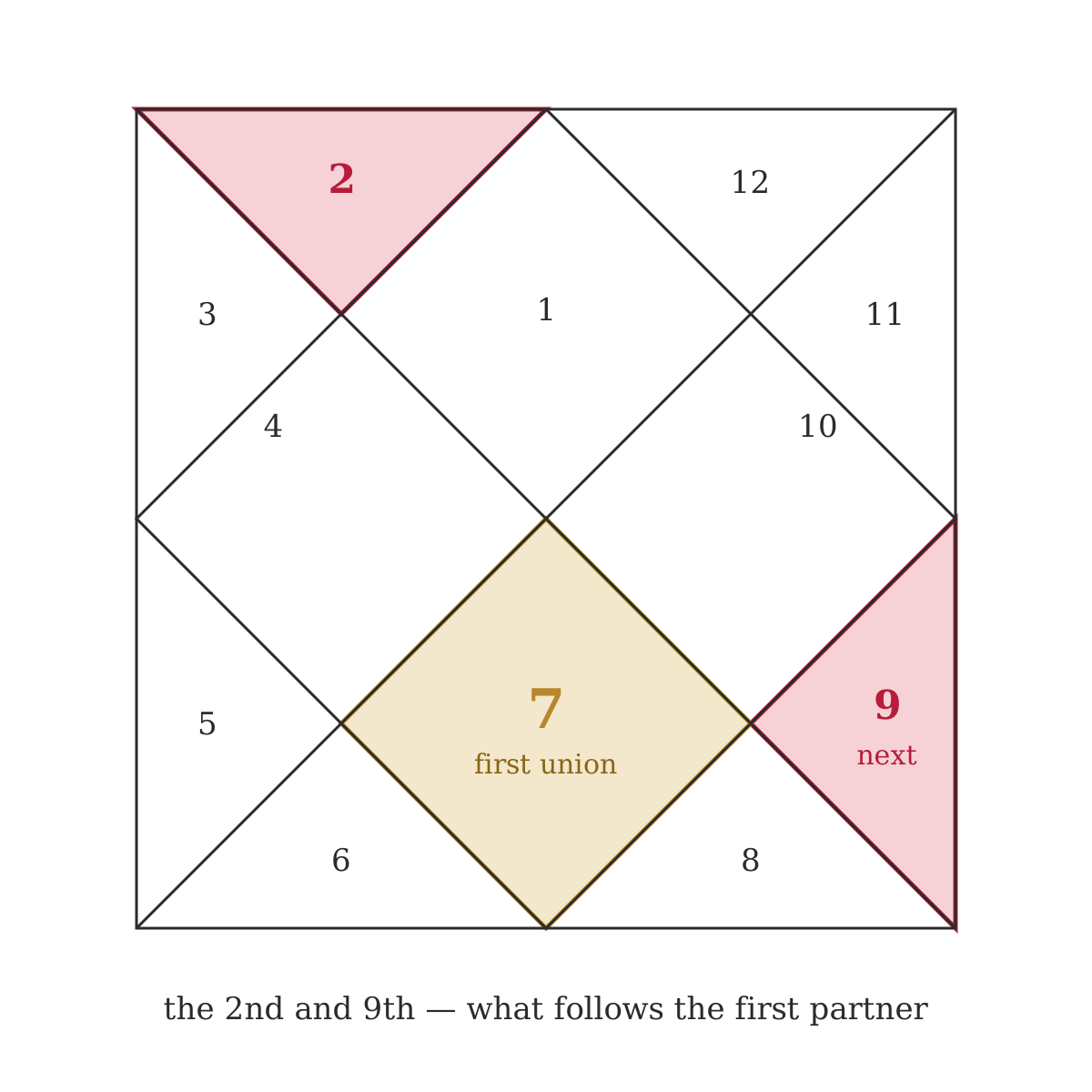
North Indian kundli with the 7th house of marriage and the 2nd and 9th houses of the next union marked
The 7th is the first union. The 2nd is the 8th from it, the 9th the 3rd from it — the houses of what follows.

What a second marriage prediction by date of birth actually reads

Most pages on this subject give you a list of "second marriage yogas" — twenty or thirty placements, any one of which is said to mean two marriages. That is not how the shastra works and it is not how any astrologer I respect reads a chart. A single placement is a hint. A second marriage is a picture, and the picture has four parts that must be read in order and then read together.

So this reading does not count yogas. It asks four questions of the chart — is there plurality, is there a break, do the houses of the next union connect, does the Navamsa agree — and answers each in words. Then it reads the four answers as a whole. Plurality and a break together are what a second marriage needs. The next-union houses and the Navamsa lift the reading from indicated to strong. Any one witness alone is a slight leaning and nothing more.

What this page does not do. It does not date a second marriage, and it does not tell you that your first one will end. The strain in the first union is read on the separation and divorce page and taken here as one witness among four. For who your spouse is, see the marriage prediction page; for the timing of a marriage, the when will I get married page.

Plurality — more than one partner in the 7th house

The first witness. Before anything else the chart must show that this person's life holds more than one significant partner, and it shows that in a handful of ways the texts agree on. The dual signs — Gemini, Virgo, Sagittarius and Pisces — are the signs of multiplicity, and the 7th lord or Venus placed in them is the most repeated mark. Rahu in the 7th is the strongest single one. Two or more planets crowding the 7th is another.

PlacementWeightWhat it says
7th lord in a dual sign Clear The lord of the marriage in a sign of two. The most repeated mark of plurality in the classical lists; heavier still when Venus is in a dual sign as well.
Rahu in the 7th Clear Restlessness in the house of the partner, and a willingness to cross lines. The strongest single indicator there is.
Two or more planets in the 7th Clear A crowded 7th house is a crowded partnership life. The planets themselves colour how.
Venus in the 7th in a movable sign Clear Aries, Cancer, Libra or Capricorn — the significator of marriage in a sign that moves on.
Venus or the Moon with Rahu Supporting Attraction and attachment joined to the boundary-crosser. Sudden, intense, and not always lasting.
7th and 11th lords connected Supporting The house of the partner and the house of gains and friendships tied together — the texts read it as more than one union.

Plurality is not a second marriage. This is the error behind most frightened questions. A 7th lord in Gemini with a strong, well-supported 7th house describes a person with several attachments and one marriage — very often a happy one. It becomes a second marriage only when the first union also carries a break, which is the next witness.

The break — the first union has to end

The second witness is the one people least want to hear about, and the one without which nothing else on this page matters. A second marriage follows the end of a first. If the chart gives the first union a firm footing — a clean 7th house, a strong 7th lord, an unafflicted karaka — then whatever plurality it shows describes relationships, not marriages.

The break is read exactly as it is on the separation and divorce page: the 7th house, its lord and the karaka, in the birth chart and the Navamsa — Bhava, Bhavesh, Karaka. That reading is taken here as it stands, so the two pages never disagree with each other. To it the texts add a few signatures specific to remarriage: Mars in the 7th with Saturn or Rahu in the 8th; Saturn and Rahu together in the 7th with no benefic aspect; the 2nd and 7th houses both afflicted.

Firm
No second marriage, whatever else is shown
Mild strain
A possibility at most
Real strain
With plurality, indicated
Heavy strain
With plurality and the next-union houses, strong

The 2nd and 9th houses — where the next union is read

The third witness answers a different question: not whether there is room for a second marriage, but whether the chart has actually written one. Two houses carry it, and both are counted from the 7th.

The 2nd house is the 8th from the 7th — the transformation of the first partner, what follows their departure. The sage Kalidasa read the second spouse from here, and each subsequent marriage eight houses on from the last. The 9th house is the 3rd from the 7th — the next partner, as a younger sibling of the first. When the lords of these houses connect to the 7th or its lord — by exchange, by conjunction, by one sitting in the other's house, by aspect — the second union is not a possibility but a structure in the chart.

  1. The 8th lord in the 7thThe clearest classical line on the subject — randhreshe darabhavasthe bharyadvayam bhavet: the lord of the 8th in the house of the spouse, two wives. The house of endings placed in the house of the partner.
  2. The 9th lord in the 7th, or the 7th lord in the 4thFrom the same classical list. The next-partner house sitting in the marriage, or the marriage lord in the house of the home — both read as a further union.
  3. A 2nd–7th lord exchangeThe houses of the first partner and the next exchanging lords, in the birth chart or the Navamsa. A strong tie.
  4. The 2nd or 9th lord joined to the 7th lordTogether in a house, or in mutual aspect. Supporting rather than decisive.
  5. The 11th lord in the 7thGains and friendships in the house of the partner — the texts note it beside the 8th lord, more lightly.

Case study: plurality with no break

A chart from my own files, because it shows the mistake this page is built to avoid. A Leo ascendant, a man. Venus, the karaka, sits in Virgo — a dual sign. The Navamsa's 1st and 11th lords are in aspect, and so are its 2nd and 5th — two links of the five-lord pattern, both by aspect. A list-based reading would tick two boxes and start talking about a second wife.

Now read it properly. Plurality: Venus in a dual sign, and nothing else — the 7th lord is not in a dual sign, the 7th house holds no planet, Rahu is elsewhere. One faint mark. The break: the 7th lord is exalted and vargottama, the house has Jupiter's aspect on it, the strain reads as mild. The next union: the 2nd and 9th houses are quiet. The Navamsa pattern: two links, but both by aspect, no exchange and no conjunction — supporting, not indicating. Four witnesses, and only one of them speaks, faintly. A slight leaning; one marriage. Which is what it has been for many years.

Plurality was there. A break was not. Without the break, the plurality describes the man's attachments, not his marriages — and that is exactly the difference between a person who has several people who matter to him and a person who marries twice.

Common patterns and what they mean

Four readings come across my table again and again. If yours is one of them, the note beside it is what I would say to you.

One marriage

A firm 7th house, whatever plurality is shown

Plurality in the 7th or the Navamsa, but no break — the lord strong, Jupiter protecting, the karaka clean. Several attachments, one marriage. The plurality shows in the life around the marriage, not in its place.

Reads as
One marriage
What to watch
Rahu periods, which inflate the attachments.
Possible

Plurality with mild strain, the next-union houses quiet

The chart has room for a second marriage but has not written one. These are the charts that go either way, and the decision is made by the people, not the planets. Most settle into one union once its early years are past.

Reads as
Possible
What helps
Reading the strain honestly, and early.
Indicated

Plurality and a real break together

The two things a second marriage needs, both present. If the first union ends, the chart holds another. Nothing here forces the first to end — but the person should know the chart reads this way, before the strain arrives rather than after.

Reads as
Indicated
What helps
The separation reading, taken seriously.
Strong

Plurality, heavy strain, and the 8th or 9th lord in the 7th

The full classical picture — bharyadvayam. More than one partner, a first union that does not hold, and the house of the next union sitting in the house of the first. Charts like this most often bring two committed unions across a lifetime, and the second is frequently the settled one.

Reads as
Strong
What helps
Matching the second chart with real care.

Will the second marriage be happier than the first?

Often, and the chart says why. The first marriage is read from the 7th; the second from the 2nd and the 9th. When the 7th is afflicted and the 9th is clean — a benefic lord, well placed, Jupiter's aspect, nothing from the 6th or 8th touching it — the second union is the one the chart is actually built for. I have watched this pattern play out many times: a difficult first marriage in the twenties, a settled second one in the thirties, and the person wondering afterwards why the chart did not warn them. It did. They read the 7th and stopped.

The reverse is also true, and it is the reason I will not read a second marriage's quality on a page. When the 2nd or 9th house carries its own affliction, the second union repeats the first's difficulties in a different form — and that is something a person should hear across a table, with the second partner's chart beside their own.

How accurate is second marriage prediction by date of birth?

Reliable about the leaning; silent about the outcome. The four-witness method separates charts built for one union from charts built for more than one, and it does that well against an accurate birth time. What it cannot do is tell you that your first marriage will end — because a second marriage depends on that, and no chart states it with certainty. Two people hold a marriage, or they do not. The chart shows what they are holding against.

Three things limit it. Birth time, since every witness is counted from the ascendant. The partner's chart, which this page has not seen. And the running periods, which this page deliberately does not read — plurality in the chart may show itself in one dasha and stay quiet for the rest of a life.

Have it verified before you act on it. The reading here is produced from a fixed set of classical parameters. A horoscope is larger than any set of rules, and placements that look decisive in isolation often read differently once the whole chart — both charts — is in front of an astrologer. Treat this page as the beginning of the reading and speak to an astrologer before you take a decision on it.

About the astrologer

Astrologer Pramod Sharma, Jyotish Acharya, Astromitra

Pramod Sharma is a fifth-generation Vedic astrologer and Jyotish Acharya from Bharatiya Vidya Bhavan, New Delhi, with more than twenty-six years in practice. He learnt the shastra first from his father and then under senior gurus at the Bhavan, and has read charts for thousands of people across India and abroad on marriage, career, progeny and health.

The method on this page is the one he uses in consultation and nothing else: plurality in the 7th house and its lord, the break read as Bhava, Bhavesh and Karaka, the 2nd and 9th houses of the next union, and the Navamsa — including the five-lord pattern his teachers passed on. He supervises every calculation that runs on Astromitra, which are computed on the Swiss Ephemeris using JPL NASA data.

A last word from him. "The chart does not tell you that you will marry twice. It tells you whether your life has room for it and whether your first marriage has to be held. Both of those are worth knowing early, and neither is a sentence."

Read his full profile

Questions

Second marriage astrology — common questions

A second marriage needs two things in the chart: a plurality of partners, and a first union that carries an ending. Plurality shows in the 7th lord or Venus in a dual sign, Rahu or several planets in the 7th house, and the same signs in the Navamsa. The break shows in the 7th house, its lord and the karaka afflicted. Where both are present, and the 2nd or 9th house connects to the 7th, the chart leans toward a further marriage. Either alone does not.

Two houses. The 2nd house, because it is the 8th from the 7th — what follows the end of the first partner, as the sage Kalidasa read it. And the 9th house, because it is the 3rd from the 7th — the next partner, as a younger sibling of the first. Their lords connected to the 7th, or the 8th lord sitting in the 7th, are the classical marks of a further union.

Rahu in the 7th is the single strongest mark of plurality in the chart — it brings restlessness into the marriage and a willingness to cross lines. But plurality alone is only half the reading. Rahu in the 7th with a strong 7th lord and Jupiter's aspect describes an unconventional first marriage that lasts. It reads as a second marriage only when the first union also carries a break.

It means multiplicity — Gemini, Virgo, Sagittarius and Pisces are the dual signs, and the 7th lord or Venus placed in them shows more than one significant partner. Whether that becomes two marriages depends on the rest of the chart. Many people with this placement have one marriage and several relationships around it.

Two ways. First, the same plurality marks repeated in the D9 — its 7th lord in a dual sign, Rahu in its 7th, Venus or the Moon with Rahu. Second, a pattern my teachers pointed out: when the lords of the 1st, 2nd, 5th, 9th and 11th houses of the Navamsa connect to one another by exchange, conjunction or aspect. In the birth chart that is a wealth yoga. In the Navamsa it marks a multiplicity of partners.

The chart shows a break in the first union, not the form it takes — separation, divorce or loss are all read from the same afflictions. It also shows plurality that never becomes a second marriage at all: several relationships around one legal union.

That is read from the 2nd and 9th houses themselves — a clean, well-lorded 9th house with benefics is the classical mark of a settled second union, and the same reading in the Navamsa confirms it. This page reads whether a second marriage is shown. The quality of it is a consultation, because it needs the second partner's chart as well.

It is reliable about the leaning and silent about the outcome, because a second marriage depends on a first one ending, and no chart states that with certainty. Read against an accurate birth time, the four-witness method separates charts built for one union from charts built for more than one. It cannot tell you that yours will end, and it does not try to.

No, and deliberately. Timing a second marriage needs the dashas read against the 2nd, 9th and 11th houses and, honestly, the first marriage's end read before it — which is a consultation, not a calculator. This page reads what the birth chart promises about more than one union, and stops there.
AI Astrologers Talk to Astrologer