
Online PujaPerformed in your name, watch it live Login or sign upSave charts, wallet and past readings

When Will I Have a Child?

Child birth prediction from your Vedic birth chart

Enter Your Birth Details
30M charts computed

Leave these alone unless you know the values. They are filled automatically from your birth place.

Never sold or shared Swiss Ephemeris, to the minute Dasha and transit windows

Ask an astrologer

Ask an astrologer about child & pregnancy

Answered from your own chart, in writing — not a template. Ask more together and each one costs less.

  • Answered by a verified astrologer, not AI
  • Within 24 to 48 hours
  • In writing, from your own chart
Your own question 0 / 160

Added questions appear in the list above and count toward your price. Up to 10 in all.

Your questions

1 question ₹40
2 questions ₹5 / Qsave 88%
3 questions ₹3.33 / Qsave 92%
4–6 questions ₹450 / Q
7–10 questions ₹400 / Q

Tap any question on the left. Pick two or more and the price per question drops.

Select up to 10 0
Answered in writing within 24 to 48 hours, by the verified astrologer you are matched with.

5th House · Jupiter · D7

When Will I Have a Baby? Reading Children in Your Kundli

When will I have a child is a question every kundli answers in two steps. First it says whether children are promised and how easily they come, from the 5th house of your kundli, its lord, Jupiter and the Saptamsa. Then it says when, from the dasha running over your life and the slow transits of Jupiter and Saturn. Child birth prediction by date of birth is the craft of reading both steps in order, and this page shows how each one is found in your own chart.
The Promise
5th House
The Period
Dasha
The Trigger
Transit
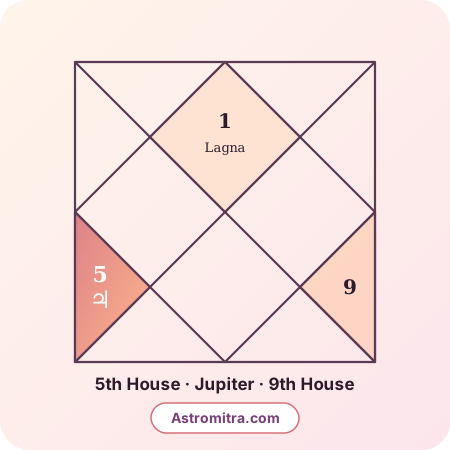
Child birth prediction in Vedic astrology — the 5th house with Jupiter, the 9th house and the lagna in a North Indian kundli
The 5th house holds the promise of children; the 9th and the lagna join it when the time comes.

Putra Bhava

The 5th House and Children in Vedic Astrology

The classical texts call the 5th house putra bhava, the house of progeny, and every question about children starts here. It is never read alone. An astrologer looks at three things in a fixed order: the house itself, the lord of the house, and the planet that naturally signifies children. Read in that order, the chart rarely contradicts itself.

The house is judged by what sits in it and what looks at it. Saturn, Mars, Rahu, Ketu and the Sun in the 5th, or casting their drishti on it, put the house under pressure; malefics on both sides of it, the old paap-kartari, squeeze it further. Jupiter, Venus, Mercury and a bright Moon in or on the 5th protect it. A malefic that owns the 5th does not harm it — no planet spoils its own house.

The lord of the 5th matters as much as the house. Placed in a kendra or trikona, in its own or exaltation sign, it carries the promise well. Placed in the 6th, 8th or 12th, joined or aspected by malefics, it struggles. Debility and combustion count against it too, but they weigh less than a malefic sitting right beside it.

Bhava
The 5th house — what occupies it and what aspects it.
Bhavesh
The 5th lord — its house, its dignity, its company.
Karaka
Jupiter — the natural giver of children.

Putra Karaka

Jupiter, the Karaka of Children

Jupiter is the putra karaka for every chart, a man's or a woman's. Where the 5th house is weak but Jupiter is strong and well placed, children still come; where both are afflicted, the reading asks for patience and good care. Jupiter's drishti is always protective — even when Jupiter rules a difficult house, its glance on the 5th or on the 5th lord supports the promise.

There are two ascendants where Jupiter is read differently. For Leo and Scorpio rising, Jupiter itself rules the 5th house. Then the lord and the karaka are the same planet, and an astrologer reads it once, as one pillar. Counting its strength twice, or its weakness twice, is how a reading tips too far either way.

Read Jupiter in the Navamsa too. A Jupiter that looks ordinary in the birth chart but gains its own or exaltation sign in the Navamsa (D9) and D7 holds far more than it appears to. The divisional charts are where a quiet Jupiter shows its real strength.

Saptamsa

Saptamsa (D7) Chart for Children

The Saptamsa divides each sign into seven parts and is the divisional chart kept for children. It does not replace the birth chart; it tests it. A promise the D1 makes and the D7 confirms is firm. A promise the D1 leaves weak can still be carried by a strong D7 — in practice I have seen the Saptamsa hold up a 5th house that the birth chart alone would have read as heavily afflicted.

Four points decide the D7: the lord of the D7 lagna, the lord of the D7 5th house, the lord of the birth chart's 5th house as it falls in the D7, and Jupiter. Kendras and trikonas support; the 6th, 8th and 12th, and debilitation, weaken.

The four points read in the Saptamsa (D7) chart for children
PointSupports WhenWeakens When

D7 Lagna Lord

In a kendra or trikona of the D7 In the 6th, 8th or 12th, or debilitated

D7 5th Lord

Own or exalted, or in a kendra or trikona In the 6th, 8th or 12th, or debilitated

Birth Chart 5th Lord in D7

Gains dignity or a good house Falls into a dusthana or its debilitation

Jupiter in D7

Own or exalted, or in a kendra or trikona In the 6th, 8th or 12th, or in Capricorn

Fertility Points

Beeja Sphuta and Kshetra Sphuta

The sphutas are the most specific fertility test Jyotish has, and the least known. Each is a single point found by adding three planetary longitudes. Beeja Sphuta, the seed, is read in a man's chart; Kshetra Sphuta, the field, in a woman's. The sign and navamsa the point falls in show the natural strength of fertility.

The rule follows the nature of each. The seed is masculine and wants odd signs; the field is feminine and wants even signs. Where both the sign and the navamsa agree, fertility is strong; where one agrees, it is moderate; where neither does, it needs care, and medical help often makes the difference. For a woman planning a pregnancy, the sphuta sits beside a second, monthly reading — her personal fertile days, which return once every lunar month.

How Beeja Sphuta and Kshetra Sphuta are calculated and judged
SphutaCalculated FromStrongest In

Beeja Sphuta (Man)

Sun + Venus + Jupiter An odd sign and an odd navamsa

Kshetra Sphuta (Woman)

Moon + Mars + Jupiter An even sign and an even navamsa

Vimshottari

Which Dasha Brings Childbirth

Once the promise is read, the timing comes from the Vimshottari dasha. A child is born in the period of a planet tied to three houses: the 5th, the house of children itself; the 9th, the 5th from the 5th and the house of blessings; and the lagna, the person who becomes a parent. A period connected to none of them rarely brings a child, however good it looks in other parts of life. Where marriage has not yet happened, the period that answers when will I get married usually comes first, and the period for a child follows it in the same chain of dashas.

A planet is tied to a house in five ways — it sits there, rules it, aspects it, sits with the lord of that house, or sits in that lord's nakshatra. Rahu and Ketu also act through the lord of the sign they occupy. The antardasha lord and the pratyantardasha lord both need that tie; the pratyantardasha narrows the window to a few months.

The House
5th
Children themselves — the house the promise lives in.
The Blessing
9th
The 5th from the 5th, and the house of fortune.
The Parent
Lagna
The person, ready to receive what the period gives.

Gochara

Jupiter and Saturn Transit for Childbirth

The dasha opens the door; the transit walks through it. For childbirth both slow planets have to agree. Transiting Jupiter and transiting Saturn must each reach the 5th or the 9th house from the ascendant — by sitting there or by drishti — and the two contacts should fall within a year of each other. Jupiter casts its 5th, 7th and 9th aspect; Saturn its 3rd, 7th and 10th.

A retrograde planet also acts from the sign behind it. Saturn retrograde in the 6th house, for example, works from the 5th as well. Ignoring retrograde motion is one of the common reasons a transit reading misses a year.

Transit alone never delivers. Jupiter crosses everyone's 5th house once in twelve years. It counts only inside a dasha that already qualifies, which is why the calculator reads the dasha first and the sky second.

Delay in Childbirth

What Delays Children in a Horoscope

Most questions that reach an astrologer about children are questions of delay, not denial. These are the patterns behind them, and what each one asks of the parent.

Delays, Does Not Deny

Malefics in or Aspecting the 5th House

Saturn's drishti slows the house down; Mars adds friction; Rahu and Ketu bring the unusual — a late start, a second attempt, a child after medical help. On its own this is the commonest cause of waiting, and the one that resolves best once the right period runs.

What Lifts It
Jupiter's aspect on the 5th, or a strong 5th lord
What Helps
Patience and timing; the dasha matters most here
A Weak Lord, Not a Closed Door

The 5th Lord in the 6th, 8th or 12th

A 5th lord hidden in a dusthana does not deliver at full strength. Children still come, often through effort and medical care. Where the same lord gains dignity in the D7, the difficulty usually turns out to be temporary.

Where to Look
Saptamsa (D7)
What Lifts It
Dignity in D7, or Jupiter's aspect on the lord
Care, Then Timing

A Weak Beeja or Kshetra Sphuta

When the sphuta falls against its nature — the seed in even signs, the field in odd — natural fertility needs support. This is the pattern where a doctor's guidance and the astrologer's timing work best together.

What It Means
Fertility needs care
What Helps
Medical advice, and the right window
A Wait, Not a Refusal

No Qualifying Dasha in the Years Ahead

Sometimes the promise is sound and the chart simply has no period tied to the 5th, 9th or lagna for some years. This is the hardest reading to hear and the most useful, because it names the period that can work and stops the anxiety about the ones that cannot.

What It Means
The clock, not the chart
What to Do
Note the next window and plan around it

Worked Example

A Child Prediction Reading From My Own Chart

My own chart is a good test of this calculator, because its 5th house is not an easy one. I have a Leo ascendant, so the 5th house is Sagittarius — and Ketu sits in it. Saturn aspects it with its 3rd drishti from Libra, and Rahu aspects it with its 7th drishti from Gemini. Three malefics on one house is as much pressure as a 5th house usually carries.

The lord of my 5th is Jupiter, which is also the karaka, so the two are read as one. It sits in Libra in the 3rd house, joined by Saturn and aspected by Rahu. On the birth chart alone, both the house and its lord read as heavily afflicted.

The Saptamsa changes the picture. Its lagna is Libra, and the D7 5th lord, my birth-chart 5th lord and Jupiter all stand well there. That is exactly the case where the divisional chart carries a promise the birth chart leaves weak. My Beeja Sphuta falls in Libra, an odd sign, but in a Capricorn navamsa, an even one — a moderate strength.

Put together, the calculator reads my chart as children come, but after some delay. That is how I would read it by hand: a real promise, held up by the D7, with the timing asking for patience.

Accuracy

How Accurate Is Child Birth Prediction?

Child birth prediction holds well at the level of the promise and the window, and it should never be stretched beyond them. The promise — easy, delayed, or needing effort — is read from fixed placements and is stable. The window comes from the dasha and the transits; given an accurate birth time, it lands on the right stretch of months far more often than chance.

Birth time is the foundation. Four minutes move the ascendant by a degree, and a quarter of an hour can change the D7 lagna altogether. With a time remembered only roughly, treat the window as a guide and have it checked against events that have already happened.

The other limit is the body. A window is an opening, not a guarantee, and past 45 a doctor's guidance matters as much as any period. Astrology describes the season; medicine looks after the field. Once the child arrives, the reading moves to the baby's own chart — the newborn baby report takes it from there.

Strongest
The promise — whether children come easily, late, or with effort.
Reliable
The window — a stretch of months where dasha and transit agree.
Weakest
Anything quoted as an exact date of birth or conception.

About the Astrologer

Who Wrote This Page

Astrologer Pramod Sharma

Written and reviewed by

Jyotish Acharya · Bharatiya Vidya Bhavan, New Delhi

Verified astrologer
25+ Years
In practice since 2001
5th Generation
Family of Vedic astrologers
Systems
Parashari, KP, Jaimini, Lal Kitab

The reading this calculator returns follows the same 5th house, Jupiter, Saptamsa, sphuta, dasha and transit method he uses when reading a chart by hand.

Questions

When Will I Have a Child — Common Questions

Your date, time and place of birth fix your Vimshottari dasha. A child usually comes in a period whose lords are tied to the 5th house, the 9th house or the lagna, while transiting Jupiter and Saturn both reach the 5th or 9th from your ascendant. The calculator above finds the next such window in your own chart.

The 5th house. It is read together with its lord and with Jupiter, the karaka of children. The 9th house, the 5th from the 5th, is read as the house of grandchildren and supports the 5th when childbirth is timed.

Jupiter, the putra karaka, for both men and women. A strong, unafflicted Jupiter supports the promise of children even where the 5th house is under pressure; a weak Jupiter asks for more care and better timing.

The dasha of a planet connected with the 5th house, the 9th house or the lagna — by placement, lordship, aspect, conjunction with the house lord, or sitting in that lord's nakshatra. Both the antardasha and the pratyantardasha lord should carry that connection.

They are fertility points. Beeja Sphuta, for a man, is the sum of the longitudes of the Sun, Venus and Jupiter; Kshetra Sphuta, for a woman, is the sum of the Moon, Mars and Jupiter. Beeja is strongest in an odd sign and odd navamsa, Kshetra in an even sign and even navamsa.

The Saptamsa (D7) is the divisional chart for children. It confirms or weakens what the birth chart promises: a well-placed D7 lagna lord, D7 5th lord and Jupiter can carry the promise even when the 5th house of the birth chart is afflicted.

No. Ketu in the 5th puts pressure on the house and usually brings delay or a need for medical care, but it does not deny children on its own. The 5th lord, Jupiter and the D7 chart decide how much that pressure matters.

No. Astrology gives windows of a few months where the dasha and the transits agree. The exact date depends on conception, and a doctor's guidance matters as much as the chart once a pregnancy is planned.

Malefics in or aspecting the 5th house, a 5th lord placed in the 6th, 8th or 12th or joined by malefics, an afflicted Jupiter, a weak Beeja or Kshetra Sphuta, or simply no qualifying dasha in the years ahead. Most of these delay; they rarely deny.

The chart can still show a favorable window, but after 45 medical support and a doctor's guidance play an important part alongside it. The calculator shows the window and says so in the reading.

No. One chart is enough to read the promise and the timing. Reading both charts together helps, because the stronger of the two often carries the couple, and an astrologer will compare them in a consultation.

AI Astrologers Talk to Astrologer



