Online PujaPerformed in your name, watch it live Login or sign upSave charts, wallet and past readings

Navamsa Chart Calculator — Your D9 Chart by Date of Birth

The Navamsa drawn beside your birth chart, every planet's D9 sign, house and degree, and what it says about marriage and strength · Swiss Ephemeris · Lahiri and 40+ ayanamsas

Enter your birth details
30M charts computed

Leave these alone unless you know the values. They are filled automatically from your birth place.

Never sold or shared Swiss Ephemeris, to the minute Dasha and transit windows

Full marriage report

Your marriage, read from the birth chart and the Navamsa together

The D9 above is the chart. The reading is what an astrologer makes of it: the 7th house in both charts, the spouse, the doshas checked properly, the marriage windows for the next ten years, and the remedies that fit — written out as a PDF you keep.

  • Lagna, rashi and nakshatra — what they make of you
  • All 12 houses and the planets in them, read in full
  • Vimshottari dasha — your periods, past and coming
  • Yogas and doshas — Manglik, Kaal Sarp, Sade Sati
  • Career, marriage, children, health and money
  • Remedies matched to your chart

₹599

18–22 pages · PDF

Get the report

In your inbox within 10 minutes

Ask an astrologer

Ask an astrologer about marriage

Answered from your own chart, in writing — not a template. Ask more together and each one costs less.

  • Answered by a verified astrologer, not AI
  • Within 24 to 48 hours
  • In writing, from your own chart
Your own question 0 / 160

Added questions appear in the list above and count toward your price. Up to 10 in all.

Your questions

1 question ₹40
2 questions ₹5 / Qsave 88%
3 questions ₹3.33 / Qsave 92%
4–6 questions ₹450 / Q
7–10 questions ₹400 / Q

Tap any question on the left. Pick two or more and the price per question drops.

Select up to 10 0
Answered in writing within 24 to 48 hours, by the verified astrologer you are matched with.

What the Navamsa chart is, and why no astrologer reads a kundli without the D9

Parashara divided the birth chart sixteen ways, and of the sixteen the Navamsa is the one that is read every single time. Each sign of the zodiac is cut into nine equal parts of 3°20′ — nava amsa, nine portions — and a planet is placed by which portion it falls in. The chart that results looks like a birth chart but says something different: not where a planet is, but what it can actually do.

In practice a kundli without its Navamsa is half a kundli; the D9 confirms, contradicts or completes everything the D1 promises. This Navamsa chart calculator draws your D9 beside your birth chart from the exact time and place of birth, lists every planet's Navamsa sign, house and degree, marks the vargottama planets, and reads the chart the way it is read at the table — the D9 lagna, the seventh house, the karaka of marriage, and where your marriage lord has gone.

Division
9 × 3°20′ per sign
Read for
Marriage · strength
Key sign
Vargottama
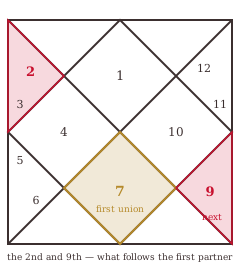
A north Indian Navamsa (D9) chart with the seventh house of marriage marked
The Navamsa: the same twelve houses, counted from the D9 lagna; the 7th is the spouse.

How the Navamsa (D9) chart is calculated from your birth chart

The arithmetic, plainly. Take a planet's longitude within its sign — Jupiter at 20° Libra, say — and divide by 3°20′: the seventh portion. Now count. For a movable sign (Aries, Cancer, Libra, Capricorn) the count starts from that sign itself; for a fixed sign (Taurus, Leo, Scorpio, Aquarius) from the ninth sign from it; for a dual sign (Gemini, Virgo, Sagittarius, Pisces) from the fifth. Libra is movable, so the seventh navamsa counted from Libra is Aries — Jupiter sits in Aries in the D9.

The calculator does this for the lagna and all nine grahas to the arc-second, which is why a birth time off by a few minutes can change a Navamsa placement: each portion is only about thirteen minutes of clock time wide at the ascendant.

Movable sign
Count from the sign itself
Fixed sign
Count from the 9th from it
Dual sign
Count from the 5th from it

Navamsa prediction for marriage — what the D9 chart says about your spouse

Every text gives the Navamsa to the seventh house's subject, and every astrologer confirms it at the table. The D9 lagna describes the native after marriage. The D9 seventh house and its lord describe the spouse and the marriage itself. Venus in the Navamsa — Jupiter in a woman's chart — shows how the native loves. A benefic in the D9 seventh brings a gentle, supportive partner; Mars, Saturn or Rahu there brings a partner of force, delay or difference. The Navamsa lord of the seventh, and the sign it sits in, are read for the spouse's nature more than any placement in the birth chart.

A 7th house that looks troubled in the D1 and clean in the D9 is a marriage that survives its early years; the reverse is the marriage that looks fine and does not hold. That is why the marriage prediction and separation pages on this site never read the 7th house without its Navamsa.

Planetary strength in the Navamsa — vargottama, exaltation and debility

This is the D9's second job, and the older one. A planet exalted or in its own sign in the Navamsa has a reserve of strength the birth chart alone will not show; debilitated in the D9, it cannot deliver what its D1 placement promises, however good that placement looks. A planet in the same sign in both charts is vargottama — "the best portion" — and the texts treat it as nearly as strong as an exalted planet. Look at your table: any planet whose D1 and D9 sign match is a planet you can rely on. A planet in pushkara navamsa — certain portions the texts single out as nourishing — is likewise protected.

Strong

Vargottama planet

Same sign in D1 and D9. Delivers what it promises through its dasha; the placement to build a life on.

Watch

Strong in D1, debilitated in D9

The commonest disappointment in a chart — a fine-looking placement that gives little. The dasha of such a planet begins well and thins out.

Reserve

Weak in D1, exalted in D9

The quiet strength. The planet looks unimpressive in the birth chart and comes through when its period runs — often the surprise of a life.

Navamsa chart analysis — the five things to check first

  1. The D9 lagna and its lordThe self after marriage, and the second half of life. A strong D9 lagna lord steadies everything that follows.
  2. The D9 seventh houseThe spouse — the sign, the planets in it, and where its lord has gone. Benefics soften, malefics test.
  3. Venus, or Jupiter in a woman's chartThe karaka of marriage: its dignity in the D9 is how easily love comes and how well it lasts.
  4. Vargottama planetsSame sign in both charts. Count them; these are the planets whose dashas keep their word.
  5. The D1 seventh lord's position in the D9Where the marriage lord has gone tells how the marriage goes — its Navamsa sign, house and dignity.

Your Navamsa reading in the calculator above walks through exactly these five, from your own placements.

Navamsa, dasha and the second half of life

Some traditions read the Navamsa as the chart of life after 36, or after marriage — the lagna chart for the first half, the D9 for the second. Whether or not one takes it literally, a running dasha lord that is strong in the D9 delivers better than one that is not; that is why the Vimshottari dasha and the Navamsa are read side by side, and why the timing of marriage is judged from the D9 as much as from the birth chart.

How accurate is an online Navamsa chart?

Birth time, again — more than for any other chart. A Navamsa portion at the ascendant is about 13 minutes long, so a birth time known only to the half hour can put the D9 lagna two or three signs away. If the time is approximate, read the planets' Navamsa placements, which move slowly, and treat the D9 lagna with caution — or have the birth time rectified. The positions themselves come from the Swiss Ephemeris, Lahiri ayanamsa by default with more than forty ayanamsas available, and match a hand-cast Navamsa to the arc-minute.

About the author

Astrologer Pramod Sharma

Written and reviewed by

Jyotish Acharya · Bharatiya Vidya Bhavan, New Delhi

Verified astrologer
25+ Years
In practice since 2001
5th Generation
Family of Vedic astrologers
Systems
Parashari, KP, Jaimini, Lal Kitab

The Navamsa reading on this page follows the five checks he makes at the table — the D9 lagna, the seventh house, the karaka, vargottama, and where the marriage lord has gone.

Questions

Navamsa chart — the questions people ask

The Navamsa is the ninth divisional chart of Vedic astrology. Each sign is divided into nine parts of 3°20′ and every planet is placed by the part it falls in, giving a second chart that shows a planet's real strength and the subject of marriage. It is the one divisional chart read in every kundli.

The birth chart (D1) shows where a planet is — its sign, house and aspects. The Navamsa shows what it can do — its inner strength, and its bearing on marriage. A planet can look strong in D1 and be debilitated in D9, or the reverse; the two are always read together.

The seventh house from the Navamsa lagna, its lord, and the planets in it describe the spouse and the marriage. Venus (Jupiter for a woman) in the D9 shows the nature of love. The D1 seventh lord's position in the D9 tells how the marriage promised by the birth chart actually goes.

A planet in the same sign in the birth chart and the Navamsa. The texts treat it as nearly as strong as an exalted planet: it delivers what it promises, and its dasha keeps its word. Your Navamsa reading lists the vargottama planets in your chart.

It describes the spouse's nature and the marriage's footing — gentle or forceful, early or delayed, steady or tested — from the D9 seventh house, its lord and the karaka. It does not give a name or a face; for the when, the dasha is read against both charts.

Certain navamsa portions the texts single out as nourishing — a planet falling in one is protected and gives good results even when otherwise weak. They are read alongside vargottama and dignity when judging strength.

More than for any other chart. A Navamsa portion at the ascendant lasts about thirteen minutes, so a half-hour error can move the D9 lagna by two or three signs. Planets' Navamsa signs move slowly and are safer; the D9 lagna needs a reliable time, or rectification.

The sign rising in the ninth division at birth — the first house of the D9. It describes the native after marriage and, in some traditions, the second half of life; its lord's strength in the D9 steadies both.
AI Astrologers Talk to Astrologer