Online PujaPerformed in your name, watch it live Login or sign upSave charts, wallet and past readings

Varshphal Calculator — Your Annual Horoscope for Any Year of Life

The solar-return chart, the muntha and its house, the year lord and the five adhikaris, the Tajika yogas, and the mudda dasha month by month

Enter your birth details
30M charts computed

Leave these alone unless you know the values. They are filled automatically from your birth place.

Never sold or shared Swiss Ephemeris, to the minute Dasha and transit windows

Full life reading

Your year, read month by month

The calculator casts the year. The report is what an astrologer makes of it: the muntha and the year lord read against your birth chart, the months the mudda dasha favours, what each Tajika yoga will actually bring, and where to be careful — written out for the twelve months ahead, as a PDF you keep.

  • Lagna, rashi and nakshatra — what they make of you
  • All 12 houses and the planets in them, read in full
  • Vimshottari dasha — your periods, past and coming
  • Yogas and doshas — Manglik, Kaal Sarp, Sade Sati
  • Career, marriage, children, health and money
  • Remedies matched to your chart

₹599

18–22 pages · PDF

Get the report

In your inbox within 10 minutes

Ask an astrologer

Ask an astrologer about career

Answered from your own chart, in writing — not a template. Ask more together and each one costs less.

  • Answered by a verified astrologer, not AI
  • Within 24 to 48 hours
  • In writing, from your own chart
Your own question 0 / 160

Added questions appear in the list above and count toward your price. Up to 10 in all.

Your questions

1 question ₹40
2 questions ₹5 / Qsave 88%
3 questions ₹3.33 / Qsave 92%
4–6 questions ₹450 / Q
7–10 questions ₹400 / Q

Tap any question on the left. Pick two or more and the price per question drops.

Select up to 10 0
Answered in writing within 24 to 48 hours, by the verified astrologer you are matched with.

A chart for one year, cast from the moment the Sun comes home

Every year, on or about your birthday, the Sun returns to the exact degree it held when you were born. That instant is the varsha pravesh, and a chart cast for it — the Varshphal — is read for the twelve months that follow. It is not a second birth chart. It is a working plan for one year, laid over the birth chart that never changes.

Varshphal comes from the Tajika system, which entered Jyotish from the Persian and Arabic tradition and settled into it comfortably. That is why the vocabulary is different — muntha, varshesh, ithasala, tripataki — and why the technique is different too: Tajika reads by aspect and by orb, in degrees, where Parashari reads by sign. The two are not rivals. The birth chart says what is possible in a life; the Varshphal says what this particular year is for.

Cast for
The solar return
Covers
Birthday to birthday
System
Tajika · annual
An annual Varshphal chart cast for the solar return
One chart, one year — from the minute the Sun regains its birth longitude.

Muntha — the point that moves one house a year

The muntha is the simplest idea in the whole system and one of the most useful. It starts at your natal ascendant and moves forward one house every year of life. At one it is in the second house, at eleven back in the twelfth, at twelve in the first again — a twelve-year wheel that keeps turning as long as you live.

The house the muntha occupies sets the year's subject. In the tenth it is a year about work and standing; in the fourth about home, property and the mother; in the seventh about marriage and partnership; in the eighth about upheaval, delay and things that surface from underneath. The lord of that house — the munthesh — carries the year's fortune, and its condition in the annual chart matters more than almost anything else on the page.

A muntha in the sixth, eighth or twelfth is not a bad year by itself. It is a year that asks for consolidation rather than expansion — and read that way, it is often the year that makes the next one possible.

Varshesh and the five adhikaris — who runs your year

Tajika does not leave the year to chance: it appoints officers. Five candidates are considered, and the strongest among them becomes the varshesh, the year lord whose nature colours the whole twelve months.

AdhikariWho it isWhat it governs
MuntheshLord of the muntha's signThe year's overall prosperity and direction
JanmeshLord of the natal ascendantThe person's own strength and health through the year
Varsha lagneshLord of the annual ascendantHow the year begins and the shape it takes
DineshLord of the weekday of the solar returnDaily affairs and routine matters
HoreshLord of the hora at the solar returnThe finer timing of events within the year

Often one planet holds several of these offices at once — and when it does, the year turns almost entirely on that planet: on what it rules in your birth chart, where it sits in the annual chart, and whether it is strong. That single observation will tell you more about a year than a page of general predictions.

Tajika yogas — how this system reads a year

Here Tajika parts company with Parashari altogether. Instead of sign-based combinations it reads planetary aspects by exact degree, within an orb — the deeper of the two planets' own orbs, halved and added. Whether a contact is applying (the faster planet still closing on the slower) or separating decides whether the matter is coming or going.

  • Ithasala — an applying aspect between the significators: the matter comes about. The single most important yoga in an annual chart, and the one a Tajika astrologer looks for first.
  • Ishrafa — a separating aspect: the matter has passed, or slips away.
  • Nakta and Yamaya — a third planet carries the light between two that do not aspect each other: help arrives through an intermediary.
  • Kamboola — the Moon supports an ithasala and strengthens it.
  • Manau, Gairi Kamboola, Radda — the obstructions: something intervenes, or a promise made is withdrawn.

Your Varshphal lists every yoga formed this year with the pairs behind it — which planets, at what angle, inside what orb, and whether the contact is closing or already past. That last column is what separates a year in which something happens from a year in which it nearly does.

Mudda dasha — the year divided into months

A year lord tells you the theme; the mudda dasha tells you when inside the year. It takes the Vimshottari order — Ketu, Venus, Sun, Moon, Mars, Rahu, Jupiter, Saturn, Mercury — and compresses the whole 120-year sequence into these twelve months, so each planet rules a stretch of days or weeks in proportion to its usual share.

Which planet opens the year is worked out from the birth nakshatra and the number of years completed, so it changes every year. Read it exactly as you read the Vimshottari dasha: what does this lord rule in the birth chart, how does it stand in the annual chart, and does the year's yoga connect it to the matter you are asking about. Each mudda period opens further into its own sub-periods, which is how a month is narrowed to a week.

Tripataki chakra and the strength of each planet

Before predicting from a planet, Tajika weighs it. The tripataki chakra gives each planet in the annual chart its hadda lord — the lord of the exact degree it occupies, a term borrowed straight from the older Persian tradition — along with the five strengths taken together.

The use is plain: a planet that comes out weak here gives little this year whatever it promises in the birth chart, and a year lord that comes out weak makes for a year of intentions rather than results. It is the check that keeps an annual reading honest.

Reading the Varshphal beside the birth chart

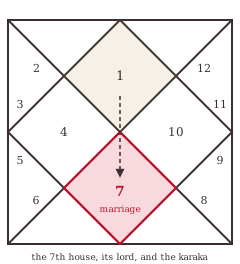
This is where most annual readings go wrong. The Varshphal cannot promise what the birth chart does not contain. If the seventh house and Venus say nothing about marriage, a fine seventh house in the annual chart will not produce one; it will produce meetings, proposals and negotiations that come to nothing.

  1. Ask the birth chart firstIs the thing promised at all — by the house, its lord and its karaka?
  2. Then the Vimshottari dashaIs this a period in which that promise can come due?
  3. Then the VarshphalDoes this year's muntha, year lord and yoga bring it forward — and if so, which mudda period?

Three layers agreeing is when an astrologer speaks with confidence. One layer alone is a guess dressed up in Sanskrit.

How accurate is an online Varshphal?

The solar return is computed to the second here, from the Sun's exact natal longitude on the Swiss Ephemeris with the Lahiri ayanamsa. That matters more than people realise: the annual ascendant changes every two hours, so a return calculated to the day rather than the minute gives the wrong year lagna and, with it, the wrong muntha house and the wrong adhikaris.

Two conventions worth knowing. The chart is cast for your place of residence at the time of the return, not necessarily your birthplace — a person who has moved gets a different annual ascendant, and Tajika accepts that. And the year runs from one solar return to the next, not from the calendar birthday; the calculator states both dates on the page so there is no confusion.

About the author

Astrologer Pramod Sharma

Written and reviewed by

Jyotish Acharya · Bharatiya Vidya Bhavan, New Delhi

Verified astrologer
25+ Years
In practice since 2001
5th Generation
Family of Vedic astrologers
Systems
Parashari, KP, Jaimini, Lal Kitab

The annual reading on this page follows the order he works in — muntha and year lord first, then the yogas, then the month the mudda dasha points to.

Questions

Varshphal — the questions people ask

The annual horoscope of Tajika astrology. A chart is cast for the exact moment the Sun returns to its natal longitude — the varsha pravesh — and read for the twelve months that follow. It works as a layer over the birth chart, not as a replacement for it.

At the solar return, which falls on or within a day of your birthday and at a precise clock time. That instant, not midnight on your birthday, begins the year; the calculator gives you the exact date and time, and the date the year ends.

A sensitive point that begins at your natal ascendant and advances one house every year of life. The house it occupies sets the year's subject — the tenth for career, the fourth for home, the seventh for marriage — and its lord, the munthesh, carries the year's fortune.

The strongest of the five adhikaris — munthesh, janmesh, the lord of the annual ascendant, dinesh and horesh. Its nature and condition colour the whole year, and when one planet holds several of these offices the year turns almost entirely on that planet.

An applying aspect between two significators, within orb and still closing. It is the yoga that says a matter will come about, and the first thing a Tajika astrologer looks for. Its opposite, ishrafa, is a separating aspect: the matter has already passed its moment.

The Vimshottari sequence compressed into one year, so each planet rules a stretch of days or weeks in its usual proportion. It is how a Varshphal narrows a prediction from the year to the month, and each period opens into sub-periods below it.

It predicts what the year is for and when inside it things move. What it cannot do is promise something the birth chart does not contain — read the birth chart first, then the dasha, then the annual chart. Where all three agree, the reading is reliable.

For where you are living at the time of the solar return. Tajika takes the place of residence, so someone who has moved abroad gets a different annual ascendant — and a genuinely different year — from the one their birthplace would give.
AI Astrologers Talk to Astrologer