Online PujaPerformed in your name, watch it live Login or sign upSave charts, wallet and past readings

When Can I Get Pregnant?

Your fertile days and boy or girl prediction from your birth chart

Enter Your Birth Details
30M charts computed

Leave these alone unless you know the values. They are filled automatically from your birth place.

Never sold or shared Swiss Ephemeris, to the minute Dasha and transit windows

Ask an astrologer

Ask an astrologer about child & pregnancy

Answered from your own chart, in writing — not a template. Ask more together and each one costs less.

  • Answered by a verified astrologer, not AI
  • Within 24 to 48 hours
  • In writing, from your own chart
Your own question 0 / 160

Added questions appear in the list above and count toward your price. Up to 10 in all.

Your questions

1 question ₹40
2 questions ₹5 / Qsave 88%
3 questions ₹3.33 / Qsave 92%
4–6 questions ₹450 / Q
7–10 questions ₹400 / Q

Tap any question on the left. Pick two or more and the price per question drops.

Select up to 10 0
Answered in writing within 24 to 48 hours, by the verified astrologer you are matched with.

Pregnancy Astrology · Moon Phase

When Will I Get Pregnant? Your Fertile Days in Astrology

Every woman knows her monthly cycle. Fewer know that pregnancy astrology sees a second one: the Moon phase she was born in, which comes back once every month. The three days before it returns are her strongest days to conceive, and the Moon's sign through those days gives the old boy or girl prediction. This fertility calculator reads both from your birth chart and gives the next dates, with the hours, for you to plan around.

The Days
Moon Phase
Boy or Girl
Moon Sign
The Strength
Kshetra Sphuta
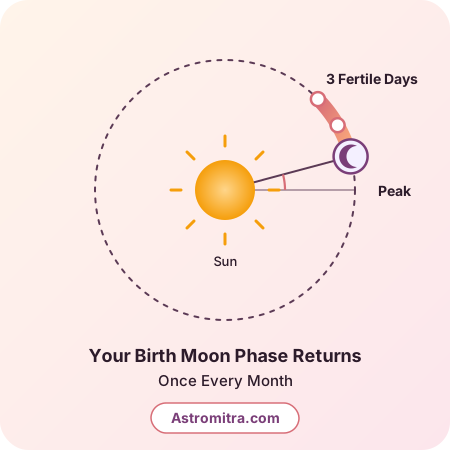
Pregnancy astrology — the Sun, the Moon's monthly path and the three fertile days before the birth Moon phase returns
Once a month the Moon comes back to the same distance from the Sun as at your birth. The three days before it are your fertile days.

Janma Tithi

Your Birth Moon Phase and the Monthly Fertility Cycle

At the moment you were born, the Moon stood at a certain distance from the Sun. In the Panchang that distance is your janma tithi, the lunar day of your birth, and it is as personal as your moon sign. The Moon goes round the Sun's position once every 29.5 days, so the same distance, to the degree, comes back once a month.

The tradition behind this reading holds that a woman's fertility rises as the Moon comes back to her birth phase. The window opens three days before the exact return and closes at it, and the return itself is the peak. Nothing else in the chart moves these days: they come from the Sun and the Moon alone, which is why they repeat so regularly through the year.

Because the Moon covers about half a degree an hour, the birth time matters here. A time that is off by an hour shifts the fertile days by about an hour too. A rough time still gives the right days; it is the exact hours inside them that need an accurate time.

Opens
Three days before the Moon returns to your birth phase.
Peaks
At the exact return, the last of the three days.
Repeats
Every 29.5 days, all through the year.

Two Cycles

Lunar Fertile Days and Ovulation: How the Two Cycles Differ

The lunar fertile days are not a new name for ovulation. Ovulation follows the menstrual cycle and moves with it; a stressful month or a change in health can shift it by days. The lunar days follow the sky and do not move at all. They fall on the same Moon phase whether the body's cycle runs early or late.

Astrologers who work with this method read the two together. In a month when the fertile days from the chart land near ovulation, the chance is taken to be at its highest. In a month when they fall far apart, the lunar days are still marked as a second chance, not a replacement for the first.

The menstrual cycle and the lunar fertility cycle compared
PointOvulation CycleLunar Fertility Cycle

Set By

The body's hormones The Moon phase at birth

Length

Varies from woman to woman 29.5 days for everyone

Can It Shift

Yes, with stress, health and age No, it follows the sky

How It Is Found

Tracking, tests, a doctor Your date, time and place of birth

Conception Calendar

Your Conception Calendar Through the Year

Since the Moon's month is 29.5 days and the calendar month is longer, your fertile days come about a day earlier each month. Over a year they fall twelve or thirteen times, and in some long months they fall twice — once at the start and again at the end. A conception calendar is simply this list of dates laid out ahead.

The calculator gives the next set only, and that is deliberate. One set of days, with its hours and its boy or girl lean, is something a couple can actually plan around. Once those days pass, opening the reading again gives the set after it.

Plan a few months, not a year. A long calendar invites anxiety over every date. For most couples, the next set of fertile days and a doctor's check-up do more good than a year of marked dates.

Boy or Girl

Boy or Girl Prediction From the Moon Sign at Conception

The boy or girl prediction in this tradition comes from one point: the sign the Moon is in at the time of conception. Odd signs are masculine and lean towards a boy; even signs are feminine and lean towards a girl. The Moon changes sign about every two and a half days, so a single set of fertile days often holds both leans, one after the other.

The calculator splits your fertile days at the hour the Moon changes sign and marks each part. Signs are counted in the sidereal zodiac, the one used in Vedic astrology. Read it as a lean, the way the tradition meant it — no chart can promise the gender of a child.

Moon sign at conception and the boy or girl lean
Moon SignOdd or EvenLeans Towards

Moon in Aries

Odd A Boy

Moon in Taurus

Even A Girl

Moon in Gemini

Odd A Boy

Moon in Cancer

Even A Girl

Moon in Leo

Odd A Boy

Moon in Virgo

Even A Girl

Moon in Libra

Odd A Boy

Moon in Scorpio

Even A Girl

Moon in Sagittarius

Odd A Boy

Moon in Capricorn

Even A Girl

Moon in Aquarius

Odd A Boy

Moon in Pisces

Even A Girl

Fertility Point

Kshetra Sphuta: Your Natural Fertility Strength

The fertile days say when. Kshetra Sphuta says how strong the ground is. It is a single point in a woman's chart, found by adding the longitudes of the Moon, Mars and Jupiter, and the sign and navamsa chart position it lands in show her natural fertility. Kshetra means the field, and a field is feminine, so this point is happiest in even signs.

The sphuta never moves the fertile days. A woman with a weak sphuta has the same three days every month as anyone else; what changes is how much care the body needs around them. The man's side is read the same way from his Beeja Sphuta, explained with the rest of the promise of children on the page that answers when will I have a baby.

How Kshetra Sphuta is judged by sign and navamsa
Sphuta InStrengthWhat It Asks For

Even Sign and Even Navamsa

Strong Good health and the right days

Only One of the Two Even

Moderate Steady care and good timing

Odd Sign and Odd Navamsa

Needs Care A doctor's advice alongside the right days

Garbhadhana

Best Time to Conceive in Vedic Astrology

The monthly fertile days are the short answer to the best time to conceive. The long answer has two more layers. Over the years, children come in a Vimshottari dasha whose lords are tied to the 5th house, the 9th house or the lagna. A couple whose fertile days fall inside such a period has the sky working with them at both ends.

Within the days themselves, the old garbhadhana muhurta keeps a few lunar days aside. They are not unlucky for the parents; they are days the tradition sets apart for rest, fasting and worship. When your fertile days touch one of them, an astrologer simply picks the hours on either side.

Days traditionally avoided for conception in Vedic astrology
DayWhat It IsWhy It Is Kept Aside

Amavasya and Purnima

New Moon and Full Moon Days of fasting and ancestor or deity worship

Ashtami

The 8th lunar day A parva day, kept for worship

Rikta Tithis

Chaturthi, Navami and Chaturdashi "Empty" days, avoided for any new beginning

Sankranti and Eclipses

The Sun changing sign; solar and lunar eclipses Junction days, set aside for charity and prayer

Worked Example

Pregnancy Astrology From My Own Chart

My own chart is a man's, and that is exactly why it makes a useful example here. The fertile days on this page are never read from a man's chart; they come from the woman's Moon phase alone. If a husband enters his own details hoping for the couple's dates, the reading asks for his wife's chart instead.

What my chart does carry is the other half of a couple's fertility. My Beeja Sphuta falls at 10°47'42" Libra. Libra is an odd sign, which suits the seed, but the point lands in a Capricorn navamsa, an even one. One of the two agrees, so it reads as moderate — sound, but not something to lean on alone.

When a couple consults me, this is the order I follow: her fertile days for the dates, her Kshetra Sphuta and his Beeja Sphuta for the strength, and the dasha in both charts for the year. If one sphuta is moderate, the stronger partner and good timing carry more of the weight, and neither number is a reason for worry on its own.

Accuracy

How Far to Trust an Astrology Fertility Calculator

The arithmetic is exact. The Moon's return to your birth phase is calculated to the minute, and so is the hour it changes sign. What the dates mean is a matter of tradition: they come from a long-standing astrological reading of fertility, not from medicine.

Keep three things in mind. These days are not a method of birth control, because conception is possible on other days too. They do not replace a doctor's check-up, and after 45 a doctor's advice matters as much as any date. And the boy or girl lean is a lean, never a promise. Used this way, the reading adds a calm, well-timed chance each month to what medicine already offers.

Once the baby arrives, the questions change to the child's own chart, and the newborn baby report takes it from there.

Exact
The dates and hours of your fertile days.
Traditional
What those days mean for conceiving.
Only a Lean
The boy or girl prediction.

About the Astrologer

Who Wrote This Page

Astrologer Pramod Sharma

Written and reviewed by

Jyotish Acharya · Bharatiya Vidya Bhavan, New Delhi

Verified astrologer
25+ Years
In practice since 2001
5th Generation
Family of Vedic astrologers
Systems
Parashari, KP, Jaimini, Lal Kitab

The fertile days, the boy or girl lean and the Kshetra Sphuta this calculator returns follow the same Moon phase, Moon sign and sphuta method he uses when reading a couple's charts.

Questions

When Can I Get Pregnant — Common Questions

In the three days before the Moon comes back to the same distance from the Sun as at your birth. This happens once a month, and the last of the three days is the peak. The calculator above gives your next fertile days with dates and times.

You need your date, time and place of birth. They fix the Moon phase you were born in, and your fertile days are the three days before that phase returns each month. The time of birth matters, because the Moon moves about half a degree every hour.

No. Ovulation follows the menstrual cycle, while the lunar fertile days follow the Moon phase of your birth. They are two separate cycles. The astrological view is that the chance of conceiving is highest in a month when the two fall close together.

Astrology gives a lean, not a certainty. The traditional rule reads the Moon's sign at the time of conception: an odd sign leans towards a boy and an even sign towards a girl, counted in the sidereal zodiac.

Aries, Gemini, Leo, Libra, Sagittarius and Aquarius, the odd signs, lean towards a boy. Taurus, Cancer, Virgo, Scorpio, Capricorn and Pisces, the even signs, lean towards a girl.

Your monthly fertile days, inside a dasha connected to the 5th house, the 9th house or the lagna. Within those days, Amavasya, Purnima, Ashtami, the Rikta tithis, Sankranti and eclipses are traditionally avoided.

Kshetra Sphuta is a woman's fertility point, found by adding the longitudes of the Moon, Mars and Jupiter in her chart. It is strongest in an even sign and an even navamsa. It shows the natural strength of fertility and does not change the fertile days.

Yes, for strength. His Beeja Sphuta, from the Sun, Venus and Jupiter, shows his side of fertility. The monthly fertile days themselves are read from the woman's chart alone.

No. The lunar fertile days are an astrological reading, not a method of contraception. Conception is possible on other days too, so please follow your doctor's advice for family planning.

The fertile days still come every month, but after 45 a doctor's advice matters as much as the right days. The reading says so whenever it applies.

AI Astrologers Talk to Astrologer