Current Planetary Positions Based on Tropical Zodiac
Western astrology measures the sky from the seasons. Its zodiac starts where the Sun stands at the March equinox, calls that point 0° Aries, and counts twelve signs of thirty degrees from there. The table at the top of this page is that zodiac at this very minute: the sign and degree of every planet, the house it falls in for your city, and how fast it is moving today.
A transit is simply a planet's present position laid over a birth chart. When transiting Saturn reaches the degree of your natal Sun, or Jupiter crosses your Ascendant, the matters those points stand for come to the front. Every transit reading starts with the current planetary positions, which is why this table is the first thing to look at before any forecast.
Understanding Planetary Positions
Read each row from left to right. The sign tells you the colour of a planet's expression: Mars in Aries acts quickly and openly, Mars in Cancer works through feeling and family. The degree shows how far the planet has travelled through that sign, which matters the moment you compare it with a birth chart, because transits work by exact degrees.
The house is the area of life the planet is passing through for the place you chose, from the self in the first house to hidden matters in the twelfth. The last column is the planet's speed over a day. The Moon moves twelve to fifteen degrees and changes sign every two and a half days; Saturn moves a few minutes of arc and stays in one sign for more than two years. A speed close to zero means the planet is stationary, about to turn retrograde or direct, and a station is when a transit is felt most strongly.
Tropical or Sidereal: Why the Signs Differ
The Earth's axis wobbles slowly, and the equinox point drifts back against the stars by about one degree every 72 years. Two thousand years ago the two zodiacs agreed; today they are about 24 degrees apart. Western astrology stays with the seasons and uses the tropical zodiac. Vedic astrology stays with the stars and uses the sidereal zodiac, subtracting that gap, called the ayanamsa.
Neither zodiac is wrong; they measure from different starting points. The practical result is that a planet in the last 24 degrees or so of a tropical sign sits in the previous sign in a Vedic chart. If you read by Vedic astrology, use our sidereal planetary positions instead, where you can also choose the ayanamsa.
Houses and the Six House Systems
The signs are the same for everyone on Earth at one moment; the houses are not. They are measured from the Ascendant, the degree rising on the eastern horizon of the place you chose, so a change of city moves every house. How the space between the Ascendant and the Midheaven is divided is a matter of house system, and this page offers the six most used.
Placidus, the default, is the system in most modern Western software and textbooks. Koch divides the quadrants by time in a similar way and has a loyal following. Equal houses give every house thirty degrees from the Ascendant, and Whole Sign houses make each sign one house, the method of the Hellenistic astrologers. Campanus and Regiomontanus divide space rather than time; Regiomontanus is the traditional choice for horary questions. A planet's sign and degree never change with the house system, only the house it is placed in, and only when it sits near a cusp.
Dignity and Retrograde Planets in Western Astrology
The cards under the table show essential dignity, the oldest measure of a planet's strength in Western astrology. A planet in domicile is in a sign it rules, like the Moon in Cancer, and acts with full resources. In exaltation it is honoured and at its most effective. In detriment it is in the sign opposite its home, and in fall it is opposite its exaltation; there it has to work harder for the same result. Uranus, Neptune and Pluto are given modern rulerships only, and Chiron none.
An R beside a planet means it is retrograde: seen from the Earth it appears to move backwards through the zodiac. Mercury does this three or four times a year, the outer planets for months at a stretch. A retrograde transit tends to bring back unfinished matters, delays and second attempts rather than fresh starts. The North and South Nodes move backwards almost all the time, which is why they are left out of the Retrograde card.
North Node, Chiron, Lilith and the Part of Fortune
The North and South Nodes are the two points where the Moon's path crosses the Sun's, always exactly opposite each other. Western astrologers read the North Node as the direction of growth and the South Node as the familiar ground of the past. The Mean Node is their averaged position, the True Node the actual one; they can differ by more than a degree, so the table gives both.
Chiron, found in 1977 between Saturn and Uranus, is read as the wound that becomes a teacher. Lilith, also called the Black Moon, is the far point of the Moon's orbit; this page gives the Mean Lilith. The Part of Fortune is not a body at all but a calculated point: the Ascendant plus the Moon minus the Sun by day, with the Sun and Moon reversed by night. It marks where ease and material luck come most naturally, and like the houses it depends on the time and the place.
My Own Chart in Both Zodiacs
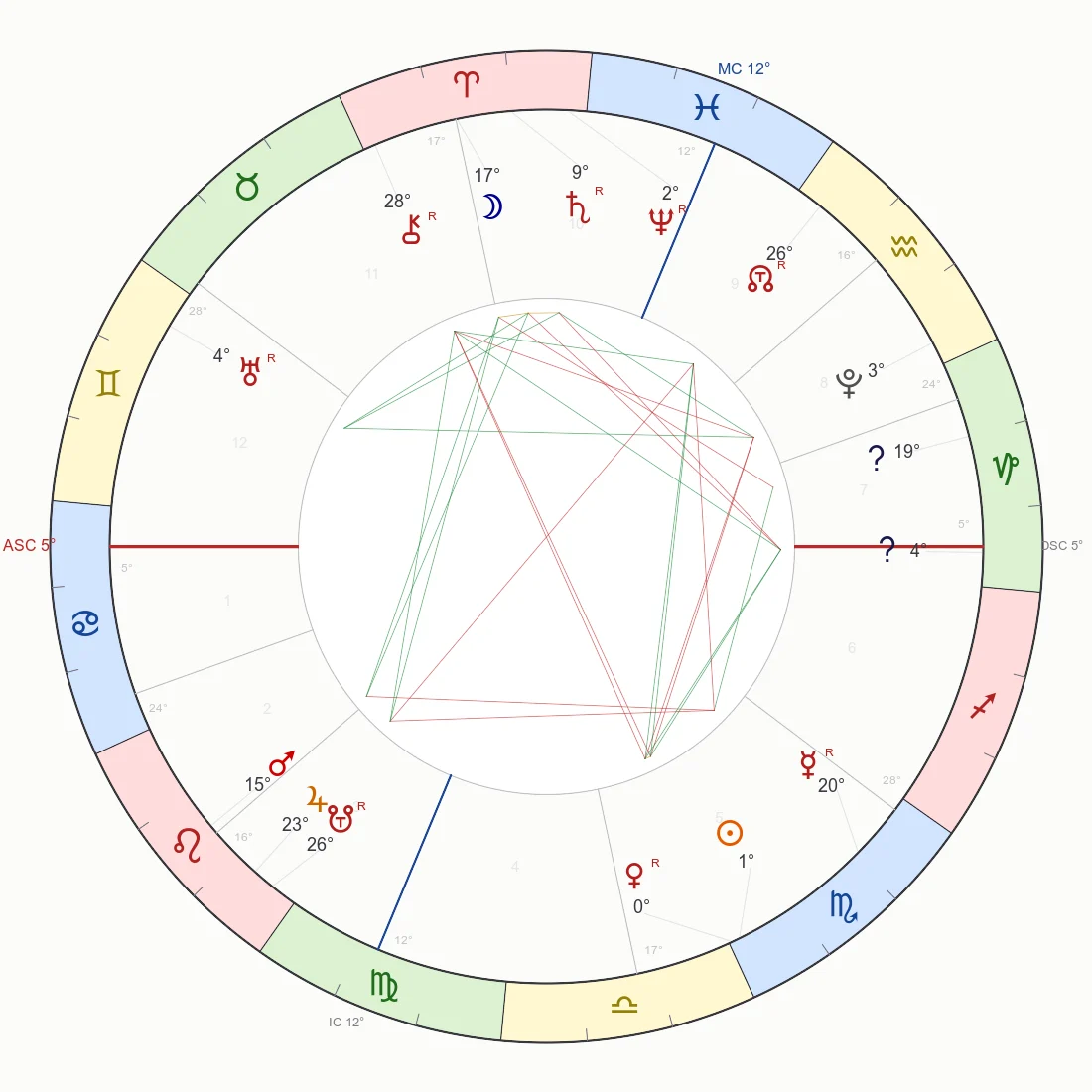
I read charts in the sidereal zodiac, and in my own birth chart the Sun, the Moon, Mercury and Venus all sit in Virgo. Move the same chart to the tropical zodiac and all four step into Libra, the Moon only just, in the first degree of the sign. Jupiter moves from Libra into Scorpio, Mars from Scorpio into Sagittarius, and the North Node from Gemini into Cancer. Saturn alone stays where it was, in Libra.
Nothing in the sky moved. The planets stand at the same points; only the ruler they are measured against has changed. That is why a Western astrologer would describe me as a Libra Sun with a Libra Moon, while my Vedic chart calls both Virgo, and why I always check which zodiac a chart was cast in before I compare two readings of it.