Online PujaPerformed in your name, watch it live Login or sign upSave charts, wallet and past readings

Transit Chart Calculator: Your Transits for Today or Any Date

Where the moving planets fall in your birth chart, the aspects they make to your planets, and what each one brings

Enter Your Birth Details
Tropical Zodiac

Leave these alone unless you know the values. They are filled automatically from your birth place.

Never sold or shared Swiss Ephemeris, to the minute Dasha and transit windows

Ask an astrologer

Ask an astrologer about career

Answered from your own chart, in writing — not a template. Ask more together and each one costs less.

  • Answered by a verified astrologer, not AI
  • Within 24 to 48 hours
  • In writing, from your own chart
Your own question 0 / 160

Added questions appear in the list above and count toward your price. Up to 10 in all.

Your questions

1 question ₹40
2 questions ₹5 / Qsave 88%
3 questions ₹3.33 / Qsave 92%
4–6 questions ₹450 / Q
7–10 questions ₹400 / Q

Tap any question on the left. Pick two or more and the price per question drops.

Select up to 10 0
Answered in writing within 24 to 48 hours, by the verified astrologer you are matched with.

Your Birth Chart Is Fixed. The Sky Is Not.

The moment you were born, the planets froze into the pattern of your birth chart. But they never stopped moving. Saturn kept walking, Jupiter kept turning, and every so often one of them reaches a point that matters in your chart — your Sun, your Moon, the top of your chart. Those meetings are transits, and they are the main way Western astrology answers the question everyone eventually asks: why now?

A transit chart lays the sky of a chosen day around your birth chart. It shows which house of your life each moving planet is lighting up, and which of your birth planets it is touching. Some of these contacts pass in an afternoon. Others take two years and change the shape of a life.

What you get from the calculator above: a verdict for the period — a life milestone such as a Saturn return when one is under way, or the overall mood of the slow planets; where every moving planet sits in your houses; and every aspect they make to your birth planets, closest first, marked as getting stronger or easing off, and grouped by whether it shapes years, months, weeks or a single day. A date picker lets you move the reading to any day you choose.

Date
Today or any day
Zodiac
Tropical, Western
Shows
Houses and aspects
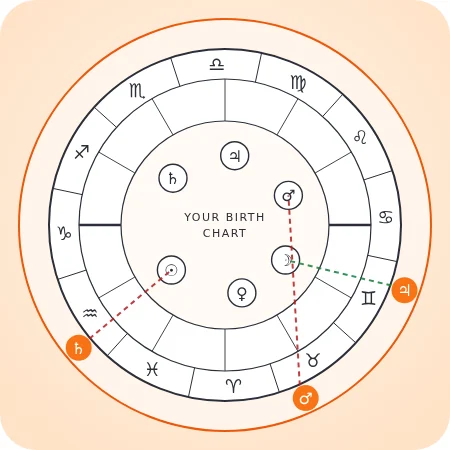
A transit chart: the moving planets on an outer ring linked by aspect lines to the planets of the birth chart inside
The planets of the day on the outer ring, touching the planets of your birth chart inside.

Fast and Slow Transits: How Long Each One Lasts

The first thing to know about any transit is the speed of the planet making it. A transit lasts about as long as the planet takes to pass, and that ranges from hours to years.

PlanetTime in Each SignWhat Its Transits Bring
MoonAbout 2½ daysMoods, appetites and the feel of a single day
SunAbout a monthWhere your energy and attention go this month
MercuryTwo to eight weeksConversations, plans, paperwork and travel
VenusAbout four weeks, longer when retrogradeLove, pleasure, money and what you want
MarsAbout six weeks, longer when retrogradeDrive, conflict, effort and courage
JupiterAbout a yearGrowth, opportunity and the season of luck
SaturnAbout 2½ yearsTests, responsibility and what is built to last
UranusAbout 7 yearsSudden change, freedom and breaks with the past
NeptuneAbout 14 yearsDreams, confusion, inspiration and letting go
Pluto12 to 30 yearsDeep transformation, endings and rebirth

This is why your reading groups transits into big life themes, the coming months, the next few weeks and the day itself. An astrologer looking at a chart always reads them in that order: the slow planets set the story, the fast ones fill in the scenes.

Transit Aspects: Conjunctions, Squares and Trines to Your Planets

A transit becomes personal when a moving planet forms an exact angle to one of your birth planets. The angle sets the tone. A conjunction merges the two — transiting Jupiter on your Venus is a season of affection and pleasure. A trine or sextile opens a door with little effort. A square brings pressure that forces a decision, and an opposition plays itself out through other people.

Two details matter as much as the angle. The orb is how far from exact the aspect is; under a degree, you feel it fully. And the direction: an applying transit is still building, a separating one is fading. Your reading shows both for every aspect, the tightest first. To see how your birth planets already relate to each other, look at your natal aspects.

Transits Through Your Houses

Even when a moving planet touches none of your birth planets, it is always passing through one of your twelve houses, and it brings its nature to that part of life. Jupiter in your tenth house is a year in which work and reputation grow; Saturn in your fourth asks you to put your home and family on firmer ground; Venus in your fifth makes a few weeks of romance and fun.

Your reading lists every moving planet with the house it is in. The houses come from your birth time, so they are as accurate as that time — the same reason your rising sign needs it. Your birth chart shows which planets you were born with in each house.

The Big Transits of a Lifetime: Saturn Return and Others

Some transits arrive at nearly the same age for everyone, because they are a planet coming back to — or turning against — its own place in your chart. Astrologers treat them as the chapters of an adult life.

  1. Jupiter Return — Every 12 YearsAround 12, 24, 36, 48 and 60. A fresh cycle of growth and optimism begins.
  2. Saturn Return — Around 29 and 58Growing up for real. What is not built on solid ground falls away; what is, becomes your life's foundation.
  3. Uranus Opposition — Early FortiesThe classic mid-life turn. A push to live more truly as yourself, often through sudden change.
  4. Neptune Square — Around FortyOld dreams lose their hold so that truer ones can take their place.
  5. Chiron Return — Around FiftyOld wounds come up to be healed, and often become a source of wisdom for others.

When one of these is under way on the date you choose, it becomes the headline of your reading.

Retrograde Transits: Why Some Last Three Times as Long

Seen from Earth, every planet except the Sun and the Moon appears to stop and move backwards for a while. If that happens near one of your birth planets, the transit is made three times: once going forward, once in reverse, and once forward again. A Saturn transit that would have passed in a few months can then hold for most of a year.

Astrologers read the three passes as a story in three acts: the issue appears, it is reviewed, and it is settled. Your reading marks every moving planet that is retrograde on the chosen day.

Looking Ahead: Your Transits for Any Date

Transits are most useful before they happen. Once your chart is open, change the date to next month, to your next birthday or to a day you are planning around — a wedding, a move, a launch — and the whole reading follows. You can also look back at a date that changed your life and see what the sky was doing.

Transits are one of three timing tools in Western astrology. The progressed chart shows how your own chart slowly unfolds with age, and the solar return sets the theme for each year from one birthday to the next. Read together, the three agree more often than not.

Western Transits and Vedic Gochar

Vedic astrology reads transits too, under the name gochar, but it measures them differently. It works in the sidereal zodiac and counts mostly from the Moon sign and the lagna, by whole signs. Its most famous transit — Saturn's seven-and-a-half-year walk over the Moon, checked with the Sade Sati calculator — is judged by sign, not by exact angle.

Western transits pay close attention to exact angles and to the outer planets, which Vedic astrology traditionally leaves aside. The two approaches often point to the same periods from different directions, which makes them worth reading side by side.

A Worked Example: My Own Transits on 1 October 2026

Here are my own transits for the day this page was written, read the way the calculator reads yours. Every position is the real one.

  1. The Headline: Uranus on My MidheavenTransiting Uranus is at 5°31'17" Gemini in my tenth house, just over three degrees from my Midheaven. It first crossed it in June 2026; it is now retrograde and will cross back at the end of December, then cross a third time in March 2027 — the three-pass pattern described above. Uranus on the Midheaven is a classic signal of change in career and public direction.
  2. A Milestone, Arriving LateThe same Uranus is also opposite my birth Uranus. Most people meet the Uranus opposition in their early forties; mine comes at 44, because Uranus moves faster in some signs than others. It is exactly the kind of life milestone the reading puts at the top.
  3. The Slow Planets on MercuryNeptune in Aries is opposite my birth Mercury within a degree, and Pluto in Aquarius trines it within half a degree. Mercury rules thinking, writing and communication; Neptune brings inspiration and some haze, Pluto depth and staying power.
  4. Jupiter's SeasonJupiter in Leo, passing through my twelfth house, is closing a sextile to my birth Sun, now 1°34' away and getting stronger. An opportunity that arrives quietly, often behind the scenes.
  5. The Fast PlanetsThe transiting Sun, at 8°06'18" Libra, is in my second house, where most of my birth planets sit, so money and resources take the month's attention. The Moon in Gemini, in my tenth house, puts work in front of me on the day itself.

Notice how the reading orders itself. The slow planets — Uranus on the Midheaven, the Uranus opposition, Neptune and Pluto on Mercury — tell the story of these two years. Jupiter sets the season, and the Sun and Moon only add the scene for the month and the day. That is the order to read your own transits in.

About the Author

Astrologer Pramod Sharma

Written and reviewed by

Jyotish Acharya · Bharatiya Vidya Bhavan, New Delhi

Verified astrologer
25+ Years
In practice since 2001
5th Generation
Family of Vedic astrologers
Systems
Parashari, KP, Jaimini, Lal Kitab

He reads transits the way this page lays them out — the slow planets first for the story, the fast ones for the timing.

Questions

Transit Chart: Questions People Ask

A transit chart places the planets as they are on a chosen day around your birth chart. Where a moving planet crosses one of your houses, or forms an angle to one of your birth planets, astrologers read a transit — an influence that lasts as long as the contact holds.

Start with the slow planets — Saturn, Uranus, Neptune and Pluto — because their transits last for months or years and shape whole chapters of life. Then look at Jupiter for the season, and the Sun, Mercury, Venus and Mars for the weeks ahead. The Moon only colours a day or two.

Yes. After you enter your birth details, the transit reading has a date picker. Choose any day — next month, your next birthday, a date you are planning around — and the reading changes to show the sky on that day against your chart.

The time when Saturn comes back to the place it held at your birth, around the ages of 29 and 58. It is the most talked-about transit in astrology: a period of growing up, taking responsibility and building something that lasts. If it is happening for you, your reading names it at the top.

An applying transit is still moving towards the exact angle and getting stronger; a separating one has passed it and is easing off. Applying transits tend to be felt as something building, separating ones as something being digested.

Because planets turn retrograde. Seen from Earth, a slow planet can cross the same point three times — once moving forward, once backwards and once forward again — which stretches one transit across many months.

The idea is the same: today's planets read against the birth chart. Western transits use the tropical zodiac and pay close attention to exact angles between planets; Vedic gochar uses the sidereal zodiac and counts mostly from the Moon sign and lagna, as in Sade Sati.

For the aspects to your planets, the birth date and place are mostly enough. For the houses the planets pass through, you need the birth time, because the houses depend on your rising sign.
AI Astrologers Talk to Astrologer