Online PujaPerformed in your name, watch it live Login or sign upSave charts, wallet and past readings

Planets in Houses Calculator: Where Each Planet Works in Your Life

The house of every planet in your birth chart, your busiest house, and a reading of what each placement means for your life

Enter Your Birth Details
Placidus Houses

Leave these alone unless you know the values. They are filled automatically from your birth place.

Never sold or shared Swiss Ephemeris, to the minute Dasha and transit windows

Ask an astrologer

Ask an astrologer about career

Answered from your own chart, in writing — not a template. Ask more together and each one costs less.

  • Answered by a verified astrologer, not AI
  • Within 24 to 48 hours
  • In writing, from your own chart
Your own question 0 / 160

Added questions appear in the list above and count toward your price. Up to 10 in all.

Your questions

1 question ₹40
2 questions ₹5 / Qsave 88%
3 questions ₹3.33 / Qsave 92%
4–6 questions ₹450 / Q
7–10 questions ₹400 / Q

Tap any question on the left. Pick two or more and the price per question drops.

Select up to 10 0
Answered in writing within 24 to 48 hours, by the verified astrologer you are matched with.

Signs Say How, Houses Say Where

Two people can share a Sun sign and lead completely different lives. One pours everything into a career, the other into family; one is always travelling, the other never leaves home. The signs alone cannot explain that. The houses can. Your planets in houses show where in life each part of you does its work — and that is often what a reading is really about.

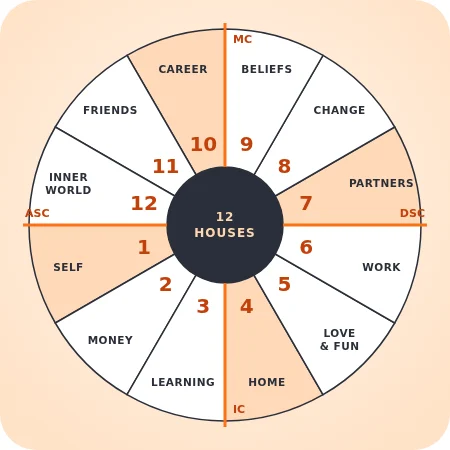
The birth chart is cut into twelve houses, each ruling one area of life: self, money, learning, home, love, work, partners, change, beliefs, career, friends and the inner world. A planet's sign describes its style; its house tells you which of those rooms it lives in.

What you get from the calculator above: the house of every planet in your chart, the house that holds the most planets, the twelve houses at a glance, and a reading of each placement — the Sun to Pluto, with Chiron, Lilith and the Part of Fortune.

Houses
Twelve areas of life
House System
Placidus
Needs
Exact birth time
The twelve astrological houses on a chart wheel, numbered from the Ascendant, with the area of life each house rules
The twelve houses, counted from the Ascendant, each with its own area of life.

Why the Birth Time Decides Your Houses

The signs are fixed in the sky; the houses are fixed to the place you were born. The first house begins at your rising sign, the degree coming up over the eastern horizon at your birth, and the other eleven follow round the wheel. As the Earth turns, that degree moves about one degree every four minutes, and the whole set of houses moves with it.

So the date gives you your planets' signs, but only the time gives you their houses. A planet a degree or two from a cusp can sit in one house or the next depending on a few minutes. If your time is a rough guess, read placements near a cusp with care.

The Twelve Houses and What They Rule

HouseArea of LifeA Planet Here Puts Its Energy Into
1stSelf, body, first impressionThe personality itself
2ndMoney, possessions, valuesEarning, owning and self-worth
3rdLearning, siblings, short tripsTalking, writing and everyday contact
4thHome, family, rootsPrivate life and inner security
5thLove, fun, children, creativityRomance and self-expression
6thWork, health, daily routineService, skill and habits
7thPartners, marriage, open rivalsOne-to-one relationships
8thShared money, intimacy, changeCrisis, depth and renewal
9thTravel, higher study, beliefsMeaning, teaching and horizons
10thCareer, status, reputationPublic role and achievement
11thFriends, networks, hopesGroups, gains and future plans
12thRest, solitude, the hiddenThe inner and spiritual life

Angular, Succedent and Cadent Houses

The four angular houses — the first, fourth, seventh and tenth — start at the four angles of the chart: the Ascendant, the IC, the Descendant and the Midheaven. Planets here act strongly and in plain view; they are the ones people notice in you first.

The succedent houses — the second, fifth, eighth and eleventh — follow them and give what the angles start something to hold on to: money, pleasure, shared resources, friends. The cadent houses — the third, sixth, ninth and twelfth — are houses of learning and adjusting. Planets there work more quietly, through thought, skill and change.

A Stellium: When One House Is Crowded

Three or more planets in one house make a stellium, and the calculator names it as the busiest house in your chart. A stellium pours a large share of your energy into one area of life. It brings talent there and pressure there; the same house is usually where your biggest achievements and your hardest lessons both come from.

Read a stellium by its planets as well as its house. Sun, Moon and Mercury in a house make it part of who you are; Saturn and Pluto among them make it a place of hard work and slow, deep change.

Empty Houses Are Not Weak Houses

With ten planets and twelve houses, every chart has empty houses — most have four or five. An empty seventh house does not mean no marriage, and an empty tenth does not mean no career. It means that area of life is not where your planets are pulling hardest.

An empty house is read through the sign on its cusp and the planet that rules that sign: wherever that ruler sits, the affairs of the empty house are drawn there. The chart ruler works the same way for the first house. Transits also bring empty houses to life whenever a slow planet passes through them.

Placidus, Whole Sign and the Vedic Bhavas

There is more than one way to cut the chart into houses. Placidus, used here and by most Western astrologers, divides the sky by time, so houses come in unequal sizes. Whole Sign houses make each sign one house; Equal houses make each house thirty degrees from the Ascendant. Most planets land in the same house in all three; the ones near a cusp may not.

Vedic astrology usually counts whole signs from the sidereal lagna, which sits about 24 degrees behind the tropical Ascendant. That is why a planet in your second house here can be in your first or third house in your kundli. Neither is wrong; each system is read by its own rules.

A Worked Example: My Own Planets in Houses

Here are the houses in my own birth chart, read the way the calculator reads yours. Every placement is the real one.

  1. The Busiest HouseFive planets sit in my second house, all in Libra: the Sun, Mercury, Venus, Saturn and Pluto. That is a strong stellium in the house of money, values and what one builds, and it makes the second house the main theme of the chart.
  2. Reading the StelliumThe Sun and Mercury put identity and thinking into that house; Venus, in its own sign, brings ease and taste; Saturn, exalted in Libra, brings patience and slow building; Pluto asks for deep change along the way. This is not easy money — it is worth built over time.
  3. The Moon in the First HouseMy Moon is at 24°51'37" Virgo, about 21 degrees past the Ascendant, in the first house. Feelings show on the surface here, and the Moon colours the whole personality.
  4. The Third and Fourth HousesJupiter and Uranus share the third house of learning and communication; Mars and Neptune share the fourth, the house of home and roots.
  5. Six Empty HousesThe sixth, seventh, eighth, tenth, eleventh and twelfth houses hold no planets. The seventh, for example, has Pisces on its cusp, so I read it through Jupiter, its traditional ruler, in the third house, and Neptune, its modern ruler, in the fourth.
  6. The Vedic ViewIn my kundli the lagna is Leo, and whole-sign houses shift two placements: the Moon moves from the first house into the second, and Saturn from the second into the third. The emphasis on the second house stays.

When both systems agree on the busiest house, I treat it as the backbone of the reading. Here the Western stellium and the Vedic second house point the same way, so everything else in the chart is read in its light.

About the Author

Astrologer Pramod Sharma

Written and reviewed by

Jyotish Acharya · Bharatiya Vidya Bhavan, New Delhi

Verified astrologer
25+ Years
In practice since 2001
5th Generation
Family of Vedic astrologers
Systems
Parashari, KP, Jaimini, Lal Kitab

He reads the houses first for where a chart puts its energy, then the signs for how it uses it.

Questions

Planets in Houses: Questions People Ask

The sign a planet is in shows how it behaves; the house shows where in life it does its work. Venus in the tenth house brings charm and harmony into career and public life; the same Venus in the fourth brings them into home and family.

Enter your date, exact time and place of birth. The time fixes your Ascendant, the start of the first house, and every other house follows from it. The calculator then places each planet in its house and reads it.

The houses turn right round the chart once a day, so the Ascendant moves about one degree every four minutes. A planet near a house cusp can change house with a birth time that is even ten or fifteen minutes out.

Placidus, the system most Western astrologers use. Whole Sign and Equal houses can put a planet near a cusp in a different house, which is why two websites sometimes disagree.

Nothing bad. With ten planets and twelve houses, every chart has empty houses. An empty house is read through the sign on its cusp and the planet that rules that sign, and through the transits that pass over it.

Three or more planets in one house. It pours a large share of your energy into that one area of life, so the house becomes a main theme of the chart — a source of talent and of pressure.

The angular houses — the first, fourth, seventh and tenth — begin at the four angles of the chart. Planets there act most visibly. The succedent houses (2, 5, 8, 11) build on them, and the cadent houses (3, 6, 9, 12) adapt and learn.

They cover the same twelve areas of life, but Vedic astrology usually counts whole signs from the sidereal lagna, while this chart uses tropical Placidus houses. A planet can sit in one house here and the next house in your kundli.
AI Astrologers Talk to Astrologer