Online PujaPerformed in your name, watch it live Login or sign upSave charts, wallet and past readings

Dominant Element Calculator: Fire, Earth, Air and Water in Your Chart

Your leading and missing element, your modalities, where your planets gather and the shape of your whole birth chart

Enter Your Birth Details
Tropical Zodiac

Leave these alone unless you know the values. They are filled automatically from your birth place.

Never sold or shared Swiss Ephemeris, to the minute Dasha and transit windows

Ask an astrologer

Ask an astrologer about career

Answered from your own chart, in writing — not a template. Ask more together and each one costs less.

  • Answered by a verified astrologer, not AI
  • Within 24 to 48 hours
  • In writing, from your own chart
Your own question 0 / 160

Added questions appear in the list above and count toward your price. Up to 10 in all.

Your questions

1 question ₹40
2 questions ₹5 / Qsave 88%
3 questions ₹3.33 / Qsave 92%
4–6 questions ₹450 / Q
7–10 questions ₹400 / Q

Tap any question on the left. Pick two or more and the price per question drops.

Select up to 10 0
Answered in writing within 24 to 48 hours, by the verified astrologer you are matched with.

The Temperament of Your Whole Chart

"I'm a fire sign, so why am I so cautious?" I hear some version of that question every week. The answer is nearly always the element balance. Your Sun sign is one planet; your chart has ten, plus the Ascendant, and they do not all share its element. Count them and you find your dominant element — the temperament your whole chart runs on, which can be quite different from your Sun sign's.

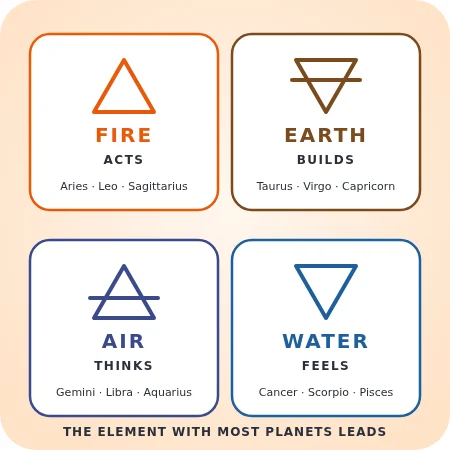
Fire acts, earth builds, air thinks and water feels. Every chart has all four in some measure, but rarely in balance: one leads, and often one is missing. Between them they describe how you meet life before you have even thought about it.

What you get from the calculator above: your planets counted by element and by modality, your leading and missing element, the half of the chart where your planets gather, the shape they make on the wheel, and any stellium of three or more planets — each with a reading.

Counts
10 planets + Ascendant
Shows
Leading and missing
Also
Modality and shape
The four astrological elements with their symbols and signs: fire acts, earth builds, air thinks, water feels
Fire acts, earth builds, air thinks, water feels — the element with the most planets leads.

The Four Elements in Your Birth Chart

ElementWhen It LeadsWhen It Is Missing
Fire
Aries, Leo, Sagittarius
Bold, warm, quick to act and to inspireHard to get started, low on confidence
Earth
Taurus, Virgo, Capricorn
Practical, patient, good with money and the bodyIdeas that never quite land in the real world
Air
Gemini, Libra, Aquarius
Thinks, talks, connects people and ideasStruggles to step back and see objectively
Water
Cancer, Scorpio, Pisces
Feels deeply, reads people, trusts intuitionFeelings that are hard to show or to name

Fire and air are the active, outgoing pair; earth and water the receptive, inward pair. A chart heavy in fire and air lives outwards and fast. A chart heavy in earth and water lives inwards and steadily. Your Sun sign, Moon and rising sign carry extra weight, so I always check whether they agree with the overall count.

A Missing Element: The Quality You Have to Learn

The missing element is often more revealing than the leading one. A quality that does not come naturally tends to become a lifelong project: people with no earth can become obsessed with order; people with little water often choose partners who feel things for them. The lack is real, and so is the effort to fill it.

Look for it elsewhere. Each element also has three houses — water, for instance, the fourth, eighth and twelfth — and planets there can stand in for an empty element. A friend or partner strong in it supplies it too, which is one reason opposites attract. And when slow planets pass through your missing element's signs, life offers the lessons it needs.

Cardinal, Fixed and Mutable: How You Handle Change

The same planets are counted a second way, by modality. Cardinal signs — Aries, Cancer, Libra, Capricorn — start things; a cardinal chart is full of beginnings and initiative. Fixed signs — Taurus, Leo, Scorpio, Aquarius — hold on; a fixed chart finishes what it starts and resists change. Mutable signs — Gemini, Virgo, Sagittarius, Pisces — adapt; a mutable chart is flexible, curious and easily spread thin.

Put element and modality together and you have the signature of the chart. Cardinal fire is Aries energy, fixed water is Scorpio energy, and so on — so a chart can read like a sign that is not the Sun sign at all.

Hemispheres and Chart Shape: Where Your Planets Gather

The balance also has a direction. Planets in the eastern half of the chart, around the Ascendant, make a self-starter who shapes their own life; planets in the western half make someone who works through other people. Planets below the horizon point to a private life and inner foundations; above it, to public life and recognition.

Then there is the overall shape, as Marc Edmund Jones described it. A Bundle packs every planet into about a third of the wheel — a specialist. A Bowl fills half — self-contained. A Bucket adds a single planet on the far side as a handle. A Seesaw splits the planets into two opposite groups; a Splash spreads them everywhere; a Locomotive leaves one empty third that the life keeps driving towards. The calculator draws your wheel and names its shape.

Elements Between Two People

Element balance is one of the first things I compare for a couple. Fire and air feed each other; earth and water hold each other. Two charts led by the same element understand each other without effort, sometimes too easily, with no one to supply what both lack. Two charts whose leading element is the other's missing one often fall hard for each other — each gives the other what was missing.

A synastry chart shows the planet-to-planet links between two charts; the element balance shows whether the two people even meet life the same way.

The Tattvas in Vedic Astrology

Jyotish uses the same four elements, the tattvas — Agni (fire), Prithvi (earth), Vayu (air) and Jala (water) — and links them to the three doshas of Ayurveda. The signs carry the same elements in both systems: Aries is fire, Taurus earth, Gemini air, Cancer water, and so round the zodiac.

What changes is where the planets fall. The sidereal zodiac moves every planet back by about 24 degrees, so many of them sit one sign earlier in your kundli — and one sign earlier is always a different element. That is why a chart can be air-led in the Western reading and earth-led in the Vedic one.

A Worked Example: My Own Element Balance

Here is the balance of my own birth chart, read the way the calculator reads yours. Every count is the real one.

  1. Air LeadsFive of the eleven placements are in air: the Sun, Mercury, Venus, Saturn and Pluto, all in Libra. This is a chart that meets life through thought, conversation and weighing both sides.
  2. The RestFire has three — Mars, Uranus and Neptune in Sagittarius. Earth has two — the Moon and the Ascendant, both in Virgo. Water has one, Jupiter in Scorpio.
  3. The Missing ElementWith water down to a single planet, feelings are processed by thinking them through. Jupiter carries the whole element alone, so its sign and house matter more than usual.
  4. The ModalitiesCardinal and mutable tie with five each; fixed has only Jupiter. Starting and adapting come easily; staying power has to be built on purpose.
  5. The ShapeAll ten planets lie within ninety degrees, from the Moon at 24°51'37" Virgo to Neptune at 24°41'01" Sagittarius — a Bundle. All ten sit below the horizon, and eight in the eastern half: a focused, self-directed chart that works from its private foundations.
  6. The Vedic ViewIn the sidereal zodiac the Sun, Mercury and Venus move back into Virgo beside the Moon, so four of the seven classical grahas are in earth. The kundli is earth-led; the Western chart is air-led.

I do not see a contradiction there. The Western chart describes how this mind works — in ideas and balance — and the Vedic chart how it lands: in practical, careful work. Read together, the two element balances describe one person more fully than either does alone.

About the Author

Astrologer Pramod Sharma

Written and reviewed by

Jyotish Acharya · Bharatiya Vidya Bhavan, New Delhi

Verified astrologer
25+ Years
In practice since 2001
5th Generation
Family of Vedic astrologers
Systems
Parashari, KP, Jaimini, Lal Kitab

He reads the element and modality balance before any single planet, and compares it with the same count in the kundli.

Questions

Dominant Element: Questions People Ask

Your dominant element is the one — fire, earth, air or water — that holds the most planets in your birth chart. It is the way you meet life first: fire by acting, earth by building, air by thinking, water by feeling. It can be different from your Sun sign's element.

Each planet is counted in the element of the sign it sits in. This calculator counts the ten planets from the Sun to Pluto together with the Ascendant, then names the element with the most. A tie is shown as a tie.

Because the Sun is one planet among ten. A Leo Sun with the Moon, Mercury, Venus and Ascendant in earth signs has a fiery heart in an earthy chart, and most people will meet the earth first.

An element with one planet or none is a quality that does not come naturally. People often work hard to make up for it, and sometimes overdo it. The houses of that element, and transits through its signs, show where you get the chance to develop it.

They are the three modalities. Cardinal signs (Aries, Cancer, Libra, Capricorn) start things; fixed signs (Taurus, Leo, Scorpio, Aquarius) hold on and see things through; mutable signs (Gemini, Virgo, Sagittarius, Pisces) adapt and change. Your leading modality shows how you handle change.

Fire and air feed each other, and so do earth and water. Signs of the same element understand each other easily. Fire with water and earth with air can work well, but they need more effort to understand each other's way of seeing things.

Yes. Jyotish uses the same four elements, the tattvas — Agni, Prithvi, Vayu and Jala — and reads them for temperament and health. Because Vedic astrology uses the sidereal zodiac, many planets shift one sign back in your kundli, so your element balance there can be quite different.

Partly. The planets' signs barely change in a day, except for the Moon. The Ascendant is counted too, and it needs the time; so do the hemispheres and the chart shape against the horizon.
AI Astrologers Talk to Astrologer