Online PujaPerformed in your name, watch it live Login or sign upSave charts, wallet and past readings

Birth Moon Phase Calculator: What Moon Phase Were You Born Under?

The phase of the Moon on the day you were born, how much of it was lit, what it says about you, and whether it was void of course

Enter Your Birth Details
Tropical Zodiac

Leave these alone unless you know the values. They are filled automatically from your birth place.

Never sold or shared Swiss Ephemeris, to the minute Dasha and transit windows

Ask an astrologer

Ask an astrologer about career

Answered from your own chart, in writing — not a template. Ask more together and each one costs less.

  • Answered by a verified astrologer, not AI
  • Within 24 to 48 hours
  • In writing, from your own chart
Your own question 0 / 160

Added questions appear in the list above and count toward your price. Up to 10 in all.

Your questions

1 question ₹40
2 questions ₹5 / Qsave 88%
3 questions ₹3.33 / Qsave 92%
4–6 questions ₹450 / Q
7–10 questions ₹400 / Q

Tap any question on the left. Pick two or more and the price per question drops.

Select up to 10 0
Answered in writing within 24 to 48 hours, by the verified astrologer you are matched with.

Born Under a Crescent, a Full Moon or Something in Between

Look up on the night you were born and the Moon would have been somewhere in its monthly journey — a thin silver curve, a half disc, a full bright face, or nothing at all. That shape is your birth moon phase. It comes from the angle between the Sun and the Moon, and astrologers have long read it as a clue to the role a person plays: the one who starts, the one who builds, the one who shares, the one who lets go.

It is a quieter part of the chart than the Sun sign, and it is often the part people find most surprising. Someone born under a Balsamic Moon who has always felt older than their years, or a First Quarter person who thrives on crisis, will often recognise themselves at once.

What you get from the calculator above: the Moon drawn as it looked at your birth, the phase you were born under and what it says about you, how much of the Moon was lit, whether it was waxing or waning, the eight phases with yours marked, whether your Moon was void of course, and the Sun and Moon positions the phase was worked out from.

Phases
Eight of 45° each
Cycle
About 29½ days
Also Shows
Void of course Moon
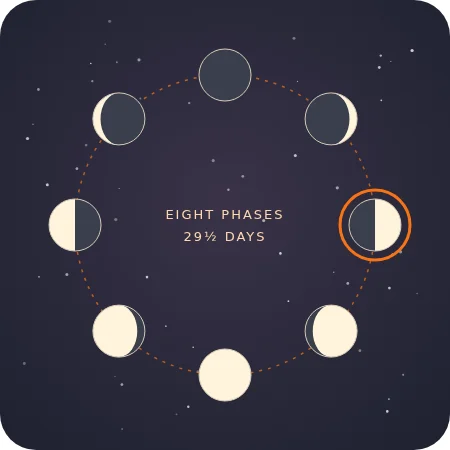
The eight phases of the Moon in a circle, from New Moon through First Quarter and Full Moon to Balsamic
The eight phases of the Moon's monthly cycle; the one you were born in is your birth moon phase.

The Eight Moon Phases and the People Born Under Them

The eight-phase system was set out by the astrologer Dane Rudhyar in the twentieth century, and it is the one most Western astrologers use. Each phase covers 45° of the Sun–Moon angle, or about three and a half days of the month.

PhaseMoon Ahead of the SunPeople Born Under It
New Moon0° – 45°Instinctive starters who live forwards and act before they explain
Crescent45° – 90°Determined to break away from the past and build their own way
First Quarter90° – 135°Action-takers who thrive on challenge and make hard decisions
Gibbous135° – 180°Perfecters who study, refine and keep improving what they care about
Full Moon180° – 225°Aware, expressive and shaped by their relationships
Disseminating225° – 270°Natural teachers who pass on what life has taught them
Last Quarter270° – 315°Questioners who let go of what no longer fits and rethink their beliefs
Balsamic315° – 360°Old souls, wise and inward, preparing the ground for what comes next

Waxing or Waning: Building Up or Giving Back

The first four phases are waxing: the lit part of the Moon grows every night. People born under a waxing Moon tend to be builders, reaching outwards, learning by doing and starting things that are theirs. The last four are waning: the light shrinks back towards the next New Moon. Waning-Moon people tend to be distributors and finishers — they share, teach, simplify and know when something has run its course.

Neither half is better. A team needs both, and most families have some of each. Your reading tells you which half you were born in and how much of the Moon's face was lit.

Born on a Full Moon or a New Moon

The two turning points of the cycle are read with extra weight. A New Moon birth puts the Sun and Moon in the same sign: what you want and what you need are fused, which gives single-minded focus and sometimes a blind spot for other people's view. A Full Moon birth puts them in opposite signs: you feel the pull between two sides of life, see others clearly, and spend much of your life finding the balance.

In both cases, an eclipse near your birth makes the theme stronger still. The Sun and Moon signs at these births are worth reading together — your Sun sign and your Moon sign describe the two sides that meet, or face each other.

Was Your Moon Void of Course When You Were Born?

As the Moon crosses a sign, it forms aspects to the Sun and the planets one after another. After the last of them, until it enters the next sign, it is "void of course". Horary and electional astrologers watch this closely; in a birth chart it is read as a person who follows their own rhythm, a step apart from the crowd, who does best when not pushed.

Your reading checks this for your birth — the Moon's last aspect, the next one if there was one, and when the Moon moved into the next sign — and draws it on a line across the sign.

Moon Phase and Moon Sign: Reading Them Together

Your Moon sign is the style of your emotions; your moon phase is the stage of the cycle you were born into. A Moon in Taurus born under a Crescent Moon is steady and loyal, but restless to make its own way; the same Taurus Moon under a Disseminating Moon wants to share what it has built. Both sit inside the larger picture of your birth chart, alongside your rising sign.

The cycle also keeps turning after birth. Your progressed Sun and Moon form their own lunation cycle of about thirty years, and a progressed New Moon is one of the great turning points of an adult life — the progressed chart shows where you are in it.

Moon Phase and the Vedic Tithi

Indian astrology measures the same Sun–Moon angle more finely. A tithi is a 12° step of it, giving thirty tithis in a lunar month — fifteen in the bright half, Shukla Paksha, ending at Purnima, and fifteen in the dark half, Krishna Paksha, ending at Amavasya. Every panchang lists the tithi of the day.

The eight Western phases and the thirty tithis describe the same Moon. Because the angle between Sun and Moon is the same in both zodiacs, your tithi and your moon phase always line up: a Shukla Navami birth falls in the First Quarter phase, and a birth on Krishna Pratipada, just after the full Moon, falls in the Full Moon phase. Your Vedic Moon sign, though, can differ from your Western one.

A Worked Example: Reading My Own Birth Moon

Theory is easy to agree with. So here is the Moon from my own birth chart, read step by step exactly as the calculator reads yours. The numbers are the real ones from my chart.

  1. The AngleAt my birth the Moon stood 333°40' ahead of the Sun. In plain words, it was about 26 degrees behind it, a thin crescent rising before dawn, with only 5% of its face lit.
  2. The Phase333° falls in the last 45° slice of the cycle, so mine is a Balsamic Moon, the final phase before the New Moon.
  3. Waxing or WaningWaning, and almost at its end. This is the phase of closing one cycle and preparing the next.
  4. The SignThe Moon was at 24°52' Virgo, with the Sun in Libra: a careful, analytical Moon in a closing phase.
  5. Void of CourseEighteen minutes before I was born, the Moon made its last major aspect, a square to Neptune. It met no other planet before entering Libra about nine hours later, so my Moon was void of course.
  6. The TithiIn the panchang the same moment is Krishna Trayodashi, the thirteenth tithi of the dark half, two days before Amavasya.

What do I take from it? Three separate signals agree: a Balsamic phase, a void Moon, and a dark-half tithi close to Amavasya. Together they describe a nature that works best quietly and in its own time, more at home finishing and refining than racing to start. That is how I read any chart: never one factor alone, but several that agree.

About the Author

Astrologer Pramod Sharma

Written and reviewed by

Jyotish Acharya · Bharatiya Vidya Bhavan, New Delhi

Verified astrologer
25+ Years
In practice since 2001
5th Generation
Family of Vedic astrologers
Systems
Parashari, KP, Jaimini, Lal Kitab

He reads the birth Moon by its sign, its phase and its tithi together — three views of the same light.

Questions

Birth Moon Phase: Questions People Ask

Enter your date, time and place of birth above. The calculator measures how far the Moon was ahead of the Sun at your birth and names the phase — one of eight, from New Moon to Balsamic — with how much of the Moon was lit.

From the angle between the Sun and the Moon along the zodiac. At 0° the two are together and the Moon is new; at 180° they are opposite and the Moon is full. The circle is divided into eight phases of 45° each.

Born with the Sun and Moon opposite each other, you tend to see life through relationships and through other people's eyes. Full Moon people are often aware, expressive and pulled in two directions — between what they want and what others need — and they come into their own when they find balance.

Born with the Sun and Moon together, you tend to act on instinct and live forwards rather than looking back. New Moon people are often pioneers who start things, sometimes before they can fully explain why.

No. Your Moon sign is the sign the Moon was in; your moon phase is its relationship to the Sun. Two people with the Moon in Cancer can be born under a New Moon and a Full Moon, and astrologers read the two together.

The Moon is void of course when it has made its last major aspect to the planets and will make no other before it leaves its sign. Born under a void Moon, people often follow their own inner rhythm and do their best work in their own way and time.

The phase is usually clear from the date alone, because each phase lasts about three and a half days. The time matters if you were born near the change from one phase to the next, and for the exact percentage lit and the void of course check.

Both come from the Sun–Moon angle. The Western moon phase divides the cycle into eight phases of 45°; the Vedic tithi divides it into thirty steps of 12°, from Pratipada to Purnima and Amavasya. They describe the same Moon in two levels of detail.
AI Astrologers Talk to Astrologer