Online PujaPerformed in your name, watch it live Login or sign upSave charts, wallet and past readings

Aspect Calculator: How Your Planets Talk to Each Other

Every aspect in your birth chart with its exact orb, your tightest aspect, patterns like the Grand Trine and Yod, and a reading of each one

Enter Your Birth Details
Tropical Zodiac

Leave these alone unless you know the values. They are filled automatically from your birth place.

Never sold or shared Swiss Ephemeris, to the minute Dasha and transit windows

Ask an astrologer

Ask an astrologer about career

Answered from your own chart, in writing — not a template. Ask more together and each one costs less.

  • Answered by a verified astrologer, not AI
  • Within 24 to 48 hours
  • In writing, from your own chart
Your own question 0 / 160

Added questions appear in the list above and count toward your price. Up to 10 in all.

Your questions

1 question ₹40
2 questions ₹5 / Qsave 88%
3 questions ₹3.33 / Qsave 92%
4–6 questions ₹450 / Q
7–10 questions ₹400 / Q

Tap any question on the left. Pick two or more and the price per question drops.

Select up to 10 0
Answered in writing within 24 to 48 hours, by the verified astrologer you are matched with.

The Conversations Inside Your Birth Chart

Read the planets in a chart one at a time and you get a list of qualities. Read their aspects and you get a person. Why does a warm, sociable Venus go cold the moment someone gets close? Why does a cautious Saturn suddenly gamble? The answer is almost always an aspect — another planet leaning on it. Your birth chart aspects are the conversations between the parts of you, and they are where a reading comes alive.

An aspect is a meaningful angle between two planets: together, a sixth of the circle apart, a quarter, a third, or face to face. Some angles let two planets help each other; others set them pulling in different directions until you find a way to use both.

What you get from the calculator above: the balance of flowing and testing aspects in your chart, your tightest aspect, any aspect patterns such as a Grand Trine, T-Square or Yod, the full aspect grid, and every aspect with its exact orb and a reading — tightest first.

Shows
How planets interact
Measured
To the exact orb
Includes
Aspect patterns
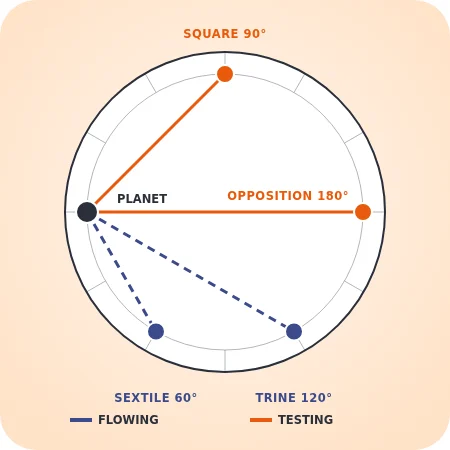
A zodiac circle showing the major aspects from one planet: sextile at 60 degrees and trine at 120 as flowing, square at 90 and opposition at 180 as testing
The major aspects from one planet: flowing sextile and trine, testing square and opposition.

The Major Aspects and What They Do

AspectAngle and Usual OrbWhat It Does
Conjunction ☌︎0°, up to about 8°Fuses two planets into one force
Sextile ⚹︎60°, up to about 4–5°An opportunity that rewards a little effort
Square □︎90°, up to about 7°Friction that forces action
Trine △︎120°, up to about 7°Natural talent and easy flow
Quincunx ⚻︎150°, up to about 3°An awkward fit that needs constant adjusting
Opposition ☍︎180°, up to about 8°A tug of war that asks for balance

The conjunction, sextile, square, trine and opposition are the five Ptolemaic aspects, used since ancient Greece. Each divides the circle by a whole number — one, six, four, three, two — and the nature of that number colours the aspect. The quincunx was added later; it joins signs with nothing in common, which is why it feels so uneasy.

Orbs: How Close Is Close Enough

Planets rarely sit at an exact angle, so every aspect is allowed some leeway, called the orb. A trine with a one-degree orb is felt every day; at seven degrees it is a background hum. That is why the calculator lists your aspects tightest first and names your tightest aspect on its own — it is usually one of the loudest notes in the whole chart.

Two more details sharpen the reading. The Sun and Moon are given wider orbs than the other planets. And an aspect is either applying — the faster planet still moving towards exact — or separating, already past it. Applying aspects tend to feel like something still unfolding; separating ones like a lesson already learned.

Easy Aspects, Hard Aspects: Why You Need Both

Trines and sextiles are the flowing aspects. They mark talents that come without effort — and, for the same reason, talents that are easy to leave unused. Squares and oppositions are the testing aspects. They make pressure, restlessness and conflict, and that pressure is what gets things done.

A chart heavy with trines can be gifted and comfortable but short of drive; a chart heavy with squares can be restless, but it builds strength. The calculator counts both, with the conjunctions in their own group, and tells you which way your chart leans.

Aspect Patterns: When Three or More Planets Join Up

Sometimes aspects lock several planets into one shape, and the shape becomes a theme of the whole life. A Grand Trine joins three planets by trines in one element — a circuit of ease and talent. A T-Square puts two planets in opposition with a third square to both; the third planet, the apex, is where the pressure comes out. A Grand Cross is four planets in two oppositions and four squares — great stamina under great strain.

A Yod, the "finger of God", has two planets in sextile, both quincunx a third. The apex planet carries a sense of special purpose that takes years of adjustment to understand. A Kite is a Grand Trine with an opposition through it, giving the easy talent a direction. A stellium — three or more planets close together in one sign or house — is a pattern too; your planets in houses shows where one falls.

Which Planets Are Talking: Reading an Aspect

An aspect is always read as a sentence: two planets and a verb. The planets say what is involved — the Sun for identity, the Moon for feelings, Mercury for the mind, Venus for love, Mars for drive, Saturn for limits. The aspect is the verb: they blend, help, clash or pull apart.

Aspects between the personal planets shape everyday character. Aspects from Uranus, Neptune and Pluto to a personal planet are what make a chart unusual. Aspects to the Ascendant and Midheaven bring a planet into how you meet the world and what you do in it. Between two charts, the same angles become a synastry chart; with today's sky, a transit chart.

Western Aspects and Vedic Drishti

Jyotish reads aspects differently. Vedic drishti works by whole signs and in one direction: every planet aspects the seventh sign from itself, Mars also the fourth and eighth, Jupiter the fifth and ninth, Saturn the third and tenth. Degrees matter less, and there is no trine or sextile in the classical scheme.

Western aspects are measured to the degree and work both ways. Neither replaces the other. When I read a kundli and a Western chart for the same person, I trust the contacts that show up in both: a Western opposition is almost always a Vedic seventh-house aspect as well.

A Worked Example: The Aspects in My Own Chart

Here are the aspects in my own birth chart, read the way the calculator reads yours. Every number is the real one.

  1. The BalanceMy flowing and testing aspects are close to even in number. That is a chart with real gifts and enough pressure to make it use them.
  2. The Tightest AspectSaturn at 24°40'53" Libra is sextile Neptune at 24°41'01" Sagittarius, with an orb of just eight seconds of arc. Saturn gives form, Neptune gives vision; at this precision the two work as one, turning ideas into something that holds.
  3. A Double YodSaturn and Neptune in sextile are both quincunx Chiron at 26°50'14" Taurus. Neptune also makes a sextile to Pluto at 26°37'54" Libra, and both of those are quincunx Chiron too. Two Yods point to the same apex: Chiron in the ninth house, the wounded healer as teacher.
  4. The Tightest QuincunxPluto to Chiron is within twelve minutes of arc, the closest link in the pattern. It is the awkward, never-finished adjustment that a Yod is known for.
  5. A Hard Aspect to the MoonThe Moon at 24°51'37" Virgo is square Neptune, about ten minutes of arc from exact. Feelings and imagination are tightly bound; sensitivity is high, and so is the need to tell intuition from wishful thinking.
  6. An Easy Link for Love and DriveVenus at 16°01'02" Libra is sextile Mars at 17°27'54" Sagittarius, within about a degree and a half: charm and initiative that support each other.

If I had only an hour with this chart, I would spend most of it on the Yod. Patterns like it outweigh any single aspect, and this one gathers the chart's slow planets into a point that the rest of the chart keeps returning to.

About the Author

Astrologer Pramod Sharma

Written and reviewed by

Jyotish Acharya · Bharatiya Vidya Bhavan, New Delhi

Verified astrologer
25+ Years
In practice since 2001
5th Generation
Family of Vedic astrologers
Systems
Parashari, KP, Jaimini, Lal Kitab

He reads aspects tightest first and patterns before single aspects, and checks every Western aspect against the drishti in the kundli.

Questions

Birth Chart Aspects: Questions People Ask

Aspects are the angles between the planets in your chart — 0, 60, 90, 120 and 180 degrees, among others. They show which parts of you work together easily, which pull against each other, and which are fused into one. A planet's sign shows its style; its aspects show who it is talking to.

Enter your date, time and place of birth. The calculator measures the exact angle between every pair of planets, keeps the ones within orb of a recognised aspect, and lists them tightest first with a reading of each. The Ascendant and Midheaven aspects need an accurate birth time.

The orb is how far an aspect is from exact. A square is exactly 90 degrees; at 87 or 93 degrees it is a square with a 3-degree orb. The smaller the orb, the stronger the aspect feels. Wider orbs are usually allowed for the Sun and Moon than for other planets.

None is simply good or bad. Trines and sextiles bring ease and talent; squares and oppositions bring tension, which pushes you to act and grow. Many of the most accomplished charts are full of squares, and a chart with only trines can lack drive.

An applying aspect is still getting closer to exact; a separating aspect has passed exact and is moving apart. Many astrologers feel applying aspects more strongly, as something still building, and separating aspects as something already learned.

They are aspect patterns — three or more planets linked in a set shape. A Grand Trine joins three planets by trines in a triangle of ease; a T-Square puts two planets in opposition with a third square to both; a Yod points two planets in sextile at a third by quincunxes, the "finger of God".

No. Vedic drishti works by whole signs and in one direction: every planet aspects the seventh sign from itself, and Mars, Jupiter and Saturn have extra special aspects. Western aspects are measured by exact degree, work both ways, and include angles like the trine and sextile.

Planet-to-planet aspects hardly change with the time, except for the fast Moon, which moves about half a degree an hour. Aspects to the Ascendant and Midheaven change quickly and need a reliable birth time.
AI Astrologers Talk to Astrologer