Online PujaPerformed in your name, watch it live Login or sign upSave charts, wallet and past readings

Composite Chart Calculator: The Chart of Your Relationship

One chart made from two: what your relationship is about, how it feels, how others see you as a couple, and every aspect inside it

Enter Both Birth Details
Tropical Zodiac

First Person

Filled from the birth place. Change them only if the place is not in the list.

Second Person

Filled from the birth place. Change them only if the place is not in the list.

Never sold or shared Swiss Ephemeris, to the minute Aspects, house overlays and score

Ask an astrologer

Ask an astrologer about marriage

Answered from your own chart, in writing — not a template. Ask more together and each one costs less.

  • Answered by a verified astrologer, not AI
  • Within 24 to 48 hours
  • In writing, from your own chart
Your own question 0 / 160

Added questions appear in the list above and count toward your price. Up to 10 in all.

Your questions

1 question ₹40
2 questions ₹5 / Qsave 88%
3 questions ₹3.33 / Qsave 92%
4–6 questions ₹450 / Q
7–10 questions ₹400 / Q

Tap any question on the left. Pick two or more and the price per question drops.

Select up to 10 0
Answered in writing within 24 to 48 hours, by the verified astrologer you are matched with.

What a Composite Chart Tells You About a Relationship

Every couple knows the feeling that the relationship has a life of its own — moods, habits and a direction that neither person would have alone. The composite chart is the astrologer's way of drawing that third thing. It takes two birth charts and makes one, and that one chart belongs to the relationship rather than to either of you.

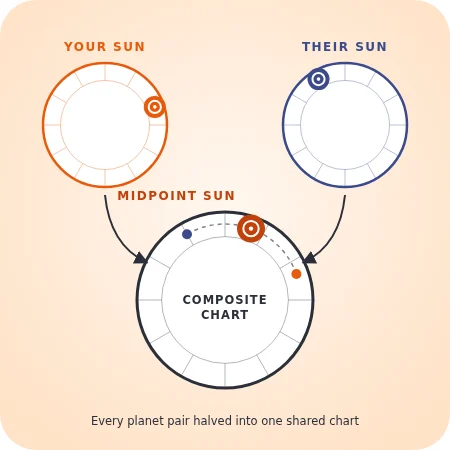
The method is simple. When one person's Sun stands at 29° Taurus and the other's at 22° Leo, the composite Sun falls halfway between them, at 10° Cancer. Do the same for the Moon, every planet, the Ascendant and the Midheaven, and a complete chart appears — with its own signs, houses and aspects, read exactly like a birth chart.

What you get from the calculator above: what your relationship is built around, from the composite Sun and its house; how it feels inside, how others see you as a couple and how you love, from the Moon, the rising sign and Venus; the composite wheel with every planet and house cusp; the balance of elements and modes; and every aspect inside the chart, the closest read out in plain words.

Built From
Midpoints of both charts
Zodiac
Tropical, Western
Reads
The relationship itself
Two birth charts feeding one composite chart, with the composite Sun placed at the midpoint between the two Suns
The composite chart takes the midpoint of each planet pair — here, the two Suns.

How a Composite Chart Is Made

Each planet in the composite chart is the midpoint of the same planet in the two birth charts. Two points on a circle have two midpoints, one on each side, and the composite always takes the nearer one — the halfway point along the shorter arc between the two planets.

The Ascendant and the Midheaven are found the same way, and the composite has twelve house cusps of its own. That is what lets it say not only which sign the relationship's Sun is in, but which part of life it shines on.

One thing follows from the method: two planets that sit close together in both birth charts stay close in the composite, while a planet that the two of you hold in very different places lands somewhere neither of you has it. The composite can show qualities that only appear when the two of you are together — which is exactly how a relationship feels.

The Four Points That Matter Most in a Composite Chart

A composite chart has as many planets as a birth chart, but four of them carry most of the story. Read these first, together with the houses they sit in.

PointShowsWhat to look for
Composite SunWhat the relationship is aboutIts sign gives the bond its character; its house shows where the couple puts its energy
Composite MoonHow it feels insideWhether the two of you feel safe in the same ways, and how moods move between you
Composite RisingThe couple the world seesThe first impression you give together, at a party or a family dinner
Composite VenusHow love works between youHow affection is shown, what pleases you both, and what keeps romance alive

Your result reads each of these four in plain words, with the sign, the exact degree and the house, so you can see the shape of the relationship at a glance.

The Composite Sun House: Where Your Relationship Lives

Of everything in the composite, the house of the Sun says the most about how a couple actually spends its life together. Some of the most common placements:

7th House

The Partnership Comes First

The relationship itself is the centre of both lives. Commitment and marriage come naturally, and the two of you think of yourselves as a pair.

4th House

Home and Family

The bond turns inward, toward a shared home, roots and family. Private, protective and lasting.

10th House

A Couple Seen by the World

Shared goals, careers and public standing. Couples with a 10th-house Sun often build something together that others can see.

5th House

Romance and Play

Fun, creativity and courtship stay alive for years. Children, too, are often central to these couples.

The calculator reads the house your composite Sun falls in, whichever of the twelve it is.

Aspects Inside the Composite Chart

Once the composite planets are in place, they are measured against each other just as in a birth chart. These aspects are the inner workings of the relationship: where it flows on its own and where it asks the two of you for effort.

  1. Easy Links: Trines and SextilesParts of the relationship that support each other. A composite Venus sextile Mars keeps attraction easy; a Moon trine Saturn gives a steady, grown-up feel.
  2. Testing Links: Squares and OppositionsWhere the bond rubs. A Moon square Mercury couple can hurt each other with words they do not mean; knowing it is half the cure.
  3. Merged Energies: ConjunctionsTwo parts of the relationship working as one. Mercury with Venus fills the bond with kind words; Mars with Saturn needs care over pace.

The closer an aspect is to exact, the more it is felt every day. Your result groups every aspect into these three kinds and reads the closest ones in full.

More testing links than easy ones is not a bad sign on its own. It shows where the relationship grows — and the couples who know where those places are handle them best.

Composite Chart and Synastry: Which One to Read

Synastry keeps the two charts apart and compares them, planet against planet. It answers the question of how two people affect each other: who draws whom, where the spark is, where the friction comes from. The composite chart answers a different question — what the two of you make together.

A couple can have easy synastry and a demanding composite, or the other way round: two people who clash at first sight but build a strong life together. That is why astrologers read the two side by side. In the Indian tradition, kundli matching asks a third question — the temperamental fit of the two Moons through 36 gunas — and many couples look at all three.

Birth Time and Accuracy

Both charts are computed on the Swiss Ephemeris in the tropical zodiac before the midpoints are taken. A composite planet moves half as fast as either of its parents, so the composite planets and the aspects between them hold up well even if a birth time is out by an hour — the Moon being the one to watch.

The composite rising sign, Midheaven and houses depend on both birth times. If one of them is a family recollection, read the house of the Sun and the rising sign as provisional, and lean on the signs and aspects instead.

Astrologer Pramod Sharma

Written and reviewed by

Jyotish Acharya · Bharatiya Vidya Bhavan, New Delhi

Verified astrologer
25+ Years
In practice since 2001
5th Generation
Family of Vedic astrologers
Systems
Parashari, KP, Jaimini, Lal Kitab

He reads a composite chart the way he reads a birth chart — the Sun and its house first, then the Moon, then the aspects that hold the two together.

Composite Chart: Questions People Ask

A composite chart is a single birth chart made from two. For every planet, the point halfway between where it stood in one person's chart and where it stood in the other's becomes the composite planet. The result is not a chart of either person; astrologers read it as the chart of the relationship itself.

Synastry keeps the two charts separate and compares them: how her Venus meets his Mars, how his Saturn meets her Moon. A composite chart merges them into one and reads what the two of you become together. Synastry describes the attraction and the friction between two people; the composite describes the life the couple shares.

The Sun shows what the relationship is about and where its energy goes. The Moon shows how it feels from the inside and what makes both of you feel safe. The rising sign shows how the world sees you as a couple, and Venus shows how love is given and received. The house each of these falls in shows the part of life the bond lives in.

It shows where the relationship puts its energy. A composite Sun in the 7th house makes the partnership itself the centre of life; in the 10th it is a public couple, often building something together; in the 4th the bond turns toward home and family; in the 5th it stays playful and romantic.

No. Squares and oppositions in a composite chart show the places where the relationship asks for effort, and every lasting couple has some. A composite with no tension at all can drift. Read which planets the hard aspects touch: a square between the Moon and Mercury is a matter of how you talk about feelings, not a verdict on the bond.

For the composite planets, a close time is usually enough, because a midpoint moves only half as fast as either planet. The composite rising sign, Midheaven and houses need both times to be accurate. If one birth time is uncertain, read the houses and the rising sign as provisional.

Yes. The method works for any two people: partners, friends, a parent and child, or two people who run a business together. The readings on Astromitra are written for couples, but the Sun, Moon and aspects of a composite describe any close bond.

No. The Davison chart takes the midpoint in time and space between the two births and casts a real chart for that moment and place. The composite takes the midpoint of each planet separately. The two often agree on the main themes, and many astrologers read both.
AI Astrologers Talk to Astrologer