Online PujaPerformed in your name, watch it live Login or sign upSave charts, wallet and past readings

Kundli Matching — Free Guna Milan by Date of Birth

All eight kootas out of 36 points, Mangal Dosha on both sides, the papa balance, and what the score actually means

Enter both birth details
30M charts computed

First Person

Filled from the birth place. Change them only if the place is not in the list.

Second Person

Filled from the birth place. Change them only if the place is not in the list.

Never sold or shared Swiss Ephemeris, to the minute Ashtakoot, doshas and dasha

Kundli matching report

Instant Kundli Matching Report in 5 Minutes

Guna milan is where a matching begins, not where it ends. The report takes both charts in full — the seventh house in each, Venus, both Navamsas, the doshas with every cancellation applied — and sets out what the two of you are actually likely to build together. It reaches you within minutes.

  • All eight kootas scored and read out, koota by koota
  • Nadi and Bhakoot dosha, with every classical cancellation checked
  • Mangal Dosha in both charts, and how the two answer each other
  • The 7th house, its lord and Venus in each chart
  • Both Navamsas — where a marriage is confirmed or thinned out
  • The dashas each of you is running, and the years they agree
  • Remedies matched to the planet doing the harm, not a generic list

Ready in 5 minutes

₹599
One-time · 18–22 pages
Get the report
Cast for your two charts Private

Ask an astrologer

Ask an astrologer about marriage

Answered from your own chart, in writing — not a template. Ask more together and each one costs less.

  • Answered by a verified astrologer, not AI
  • Within 24 to 48 hours
  • In writing, from your own chart
Your own question 0 / 160

Added questions appear in the list above and count toward your price. Up to 10 in all.

Your questions

1 question ₹40
2 questions ₹5 / Qsave 88%
3 questions ₹3.33 / Qsave 92%
4–6 questions ₹450 / Q
7–10 questions ₹400 / Q

Tap any question on the left. Pick two or more and the price per question drops.

Select up to 10 0
Answered in writing within 24 to 48 hours, by the verified astrologer you are matched with.

What the thirty-six points are actually measuring

Guna milan compares two Moons. Not two people, not two horoscopes in full — two Moons: the sign each one occupies and the nakshatra it sits in. Everything the eight kootas measure comes from that single point in each chart, which is both the strength of the system and the reason it should never be the only thing consulted.

The Moon carries the mind, so what the score really tells you is how two temperaments will sit together day after day — how they argue, what soothes them, whether silence between them is comfortable. That is worth knowing and it is not everything. Thirty points cannot save a marriage where the seventh house is wrecked in both charts, and twenty-two has carried a great many couples through fifty years. Read the points first, then read the marriage.

What you get below the form: the score with every koota read out in words, the doshas that are active and whether the classical rules cancel them, Mangal Dosha in both charts, and the papa balance between them — not a number and a verdict, but the working behind both.

Maximum
36 points · 8 kootas
Minimum
18 to proceed
Worked from
Both Moons
Two birth charts compared for guna milan
Two Moons, eight tests, thirty-six points — and then the real reading begins.

The eight kootas, one by one

Each test carries a different weight, and the weights are not arbitrary — they tell you what the tradition considered most likely to break a household.

KootaPointsWhat it tests
Varna1Ego and the work each person does; whether one defers naturally to the other
Vashya2Attraction and influence — who holds the pull in the relationship
Tara3Fortune between the two nakshatras: health, luck and how events land on the couple
Yoni4Physical compatibility and instinct, read through the animal symbol of each star
Graha Maitri5Friendship between the two Moon-sign lords — mental affinity, the thing that keeps a marriage talking
Gana6Temperament: deva, manushya or rakshasa — how each one behaves under stress
Bhakoot7The distance between the two Moon signs; prosperity and household harmony
Nadi8Constitution and progeny — the single heaviest test in the whole system

Look at the last two rows and you understand most disputes about matching. Bhakoot and Nadi carry fifteen points between them, so a pair that fails both cannot reach eighteen no matter how well the other six agree — which is exactly why their cancellations matter so much, and why an astrologer checks them before anyone panics.

What the score means, honestly

25 to 36

A strong match on temperament

The two minds fit. Above 32 is uncommon and worth noting, though it is no substitute for reading the two seventh houses.

18 to 24

Acceptable — and the commonest range of real marriages

Enough agreement to proceed. Which kootas failed matters more than the total: a low Yoni is a different matter from a low Graha Maitri.

Below 18

Below the classical minimum

A reason to read both charts properly, not to refuse. Check the cancellations first — most low scores in practice come from Bhakoot or Nadi, and both cancel more often than families realise.

Nadi dosha — the eight points everyone fears

Every nakshatra belongs to one of three nadis — Adi, Madhya or Antya. When both charts share the same one, Nadi dosha is said to arise and all eight points are lost at a stroke. It is read for constitution and for children, and it is the single commonest reason a family is told a match is impossible.

What is left out of that telling is the list of cancellations, which the same texts give. Nadi dosha is treated as cancelled when the two Moon signs are the same but the nakshatras differ, when the nakshatra is the same but the pada differs, when the Moon sign lords are the same planet, and by several other conditions an astrologer will check in order. A match dismissed on Nadi without those checks has usually been dismissed too early.

Bhakoot dosha and its cancellations

Bhakoot counts the distance between the two Moon signs. When they fall 6 and 8, 9 and 5, or 2 and 12 from each other, the seven points are lost and the dosha is read for strain on prosperity and on the household.

It cancels when the lords of the two Moon signs are friends, or when both signs share the same lord — and that happens often enough that the dosha is worth checking rather than assuming. As with Nadi, the useful question is never "is the dosha present" but "is it present and uncancelled", and those are two different answers.

Mangal Dosha in a match

Guna milan does not include Mangal Dosha at all — it is checked separately, in both charts, and your result shows it for each side. Mars in the 1st, 4th, 7th, 8th or 12th makes the dosha, counted from the ascendant, the Moon and Venus.

Three things decide how much it matters here. How many of those three references it counts from — one is mild, all three is not. Whether the other chart carries it too, which is the classical cancellation and the reason manglik charts are matched together. And whether any of the standard exceptions apply: Mars in its own or exalted sign, Mars aspected by Jupiter, or Mars as a yogakaraka for that ascendant. For the full working on a single chart, see the Mangal Dosha calculator.

What guna milan does not check

This is the part most matching reports leave out, and it is the part that decides marriages.

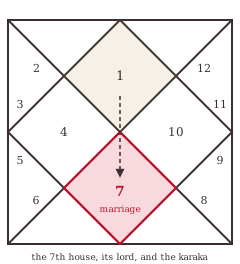
  • The seventh house in each chart — its sign, its lord and what aspects it. A wrecked seventh house is not repaired by a high score.
  • Venus — the karaka of marriage in both charts, and its condition in the Navamsa.
  • The Navamsa — where a marriage is confirmed or denied, in both charts rather than one.
  • The running dashas — whether both people are in periods that support marriage now, or one of them is in a stretch that will not hold it.
  • Longevity and the 8th house — read quietly and carefully, as it always should be.

A proper matching takes all of that and weighs it against the points. Ours gives you the kootas, the doshas and the balance of malefics immediately; the rest is what a consultation is for.

When the score comes out low

Before anything is decided, work through this in order.

  1. Check which kootas failedFifteen of the thirty-six sit in Bhakoot and Nadi. If those two are the losses, the total looks far worse than the match actually is.
  2. Apply the cancellationsNadi and Bhakoot both cancel under conditions the texts state plainly. A great many "impossible" matches clear at this step.
  3. Read both seventh housesTwo sound seventh houses with a low score are a better prospect than two afflicted ones with a high score. This is the single most useful check on this page.
  4. Compare the dashasIf both are running periods that support marriage, the match has the wind behind it whatever the total says.

And a plain word: a low score is not a reason to break an engagement between two people who want to marry. It is a reason to read the charts properly and to know where the friction will be.

How accurate is online kundli matching?

The arithmetic is exact. Both charts are computed on the Swiss Ephemeris with the Lahiri ayanamsa, the kootas follow the standard tables, and the doshas are checked with their cancellations rather than reported bare. If two sites give you different totals, it is almost always a different ayanamsa or a nakshatra rounded at its boundary.

Birth time matters differently in different parts of the reading. The Moon stays in a nakshatra for about a day, so the eight kootas survive a rough time. Mangal Dosha, the Navamsa and anything read from the seventh house need both times accurate to the minute, since the ascendant changes every two hours. Give the best times you have, and treat the house-based parts as provisional if one of them is a family recollection.

Astrologer Pramod Sharma

Written and reviewed by

Jyotish Acharya · Bharatiya Vidya Bhavan, New Delhi

Verified astrologer
25+ Years
In practice since 2001
5th Generation
Family of Vedic astrologers
Systems
Parashari, KP, Jaimini, Lal Kitab

The matching on this page follows the order he uses at the table — the kootas, then the cancellations, then both seventh houses.

Kundli matching — the questions people ask

Eighteen out of thirty-six is the classical minimum. Between 18 and 24 is acceptable, 25 to 32 is good, and above 32 is rare. Below 18 the charts are read more carefully rather than the match being refused.

From the Moon — its sign and its nakshatra in each chart. That is why both birth times and places are asked for; a date alone cannot produce a guna milan.

Nadi carries eight of the thirty-six points, so sharing the same nadi drops the score sharply. It is read for constitution and progeny — but it cancels under several conditions, including the same Moon sign with different nakshatras, and those must be checked before it is treated as a bar.

It arises when the two Moon signs stand 6/8, 9/5 or 2/12 from each other, and is read for prosperity and harmony. It cancels when the two sign lords are friends or the same planet.

Yes, and many do. Points measure temperamental fit from the Moon alone. They do not measure the seventh house, Venus, the Navamsa or the periods each person is running — and those decide far more.

For the eight kootas a close time is usually enough, since the Moon stays in a nakshatra for about a day. For Mangal Dosha, the Navamsa and the seventh house, both times need to be accurate — the ascendant moves every two hours.

Check the severity first. A dosha counted from one reference only is mild; from all three it needs attention. A partner carrying the same dosha cancels it, as do Mars in its own or exalted sign and a Jupiter aspect.

It is the first test, not the last. A full matching reads both seventh houses, Venus, the Navamsa, the doshas with their cancellations, and the dashas both people are running. The points open the conversation.
AI Astrologers Talk to Astrologer