Online PujaPerformed in your name, watch it live Login or Sign UpSave charts, wallet and past readings

Marriage Prediction by Date of Birth

When will I get married? Enter your date, time and place of birth for a free marriage prediction based on Vedic marriage astrology: your marriage timing and age, love or arranged marriage, what is delaying it, and what your future husband or wife will be like.

Enter Your Birth Details

No problem. We will use 12:00 noon. Your planets' signs stay accurate; the Lagna and house results may shift.

Leave these alone unless you know the values. They are filled automatically from your birth place.

Swiss Ephemeris, to the minuteDasha and transit windows

7th house · Venus · Darakaraka

Marriage Astrology: What Your Kundli Says About Marriage and Married Life

Almost everyone who sits with me for a marriage reading asks the same two questions: when will I get married, and what will my husband or wife be like? Your kundli holds both answers. The moment you were born fixed every planet in its place, and the seventh house, read with its lord, Venus and the Darakaraka, shows how your marriage will unfold: the years it is likely to arrive, the nature of the person you marry, how the two of you are likely to meet, and what the partnership will ask of you.

House of marriage
7th
Significator
Venus
Spouse indicator
Darakaraka
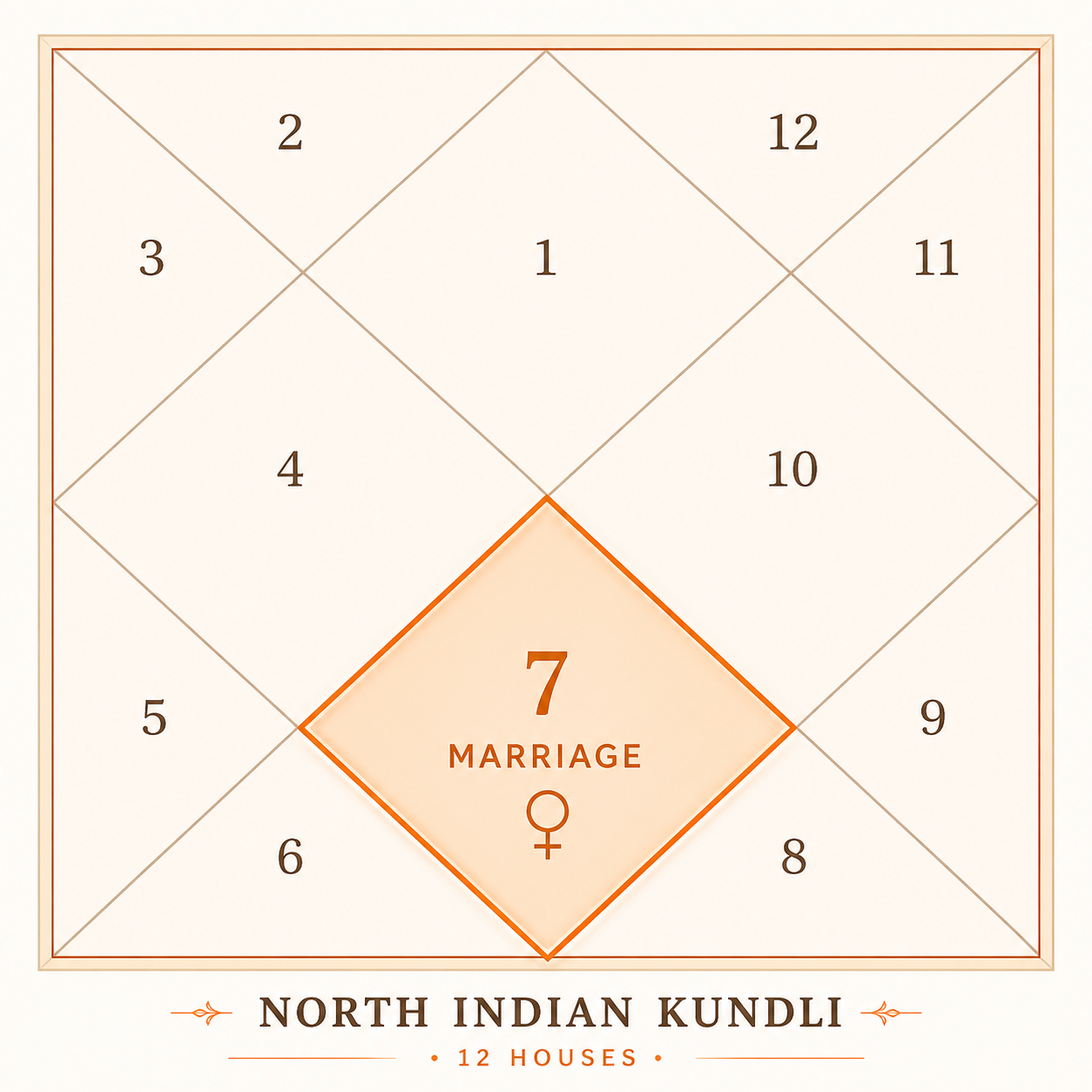
Seventh house shaded in a north Indian kundli — the house of marriage in Vedic astrology, marked with Venus
The 7th house in a north Indian kundli — the house read for marriage, the spouse and every kind of partnership.

The basics

What is Marriage Prediction by Date of Birth?

Marriage prediction by date of birth is the reading of a single birth chart for everything it says about marriage — whether marriage is promised, when it is likely to arrive, what kind of person you are likely to marry, and what the partnership will ask of you. It is not a compatibility score between two people. That is kundli matching, and it needs two charts. This reading needs only yours.

The date alone is not enough, and this is where most free tools fall short. Your date of birth fixes the position of the Sun and, roughly, the slower planets. It does not fix the ascendant, which changes sign every two hours, and the ascendant decides which sign falls on the 7th house — the house of marriage. Two people born on the same day in the same city, four hours apart, carry different 7th houses and different marriage readings. This is why the calculator asks for the time and the place along with the date.

What the birth details give the astrologer is one precise thing: the position of every planet at the moment you were born, measured against the sidereal zodiac. Everything below is read from that single snapshot.

Date of birth
Fixes the Sun and the slower planets.
Time of birth Critical
Fixes the ascendant, and with it the sign on your 7th house.
Place of birth
Gives the latitude and longitude the houses are calculated from.

The method

What is This Marriage Calculator Based On?

This marriage calculator is based on classical Vedic astrology — Parashari principles as laid down in the Brihat Parashara Hora Shastra, with the Krishnamurti Paddhati reading run alongside it. There is no numerology in it, no name matching, and no compatibility percentage generated from two names. Those tools are entertainment. This one is a chart calculation.

Five things are computed from your birth details and then read together:

  1. The 7th house and its lordThe sign on the 7th cusp, the planets in it, and the house your 7th lord travelled to — the promise of marriage sits here.
  2. Venus and JupiterVenus is the natural significator of marriage and of the wife; Jupiter carries the husband in a woman’s chart. Their strength decides how easily affection is given and received.
  3. The Navamsa (D9)The ninth divisional chart, which confirms or withdraws what the birth chart promises. No marriage reading is complete without it.
  4. Vimshottari dasha and transitsThe 120-year cycle of planetary periods decides when the promise ripens; Jupiter and Saturn passing over the 7th house or its lord trigger it.
  5. Doshas that obstructManglik dosha from Mars, the hemming of Kaal Sarp, and the affliction of a combust or debilitated 7th lord — each delays rather than denies.
Not name matching
Two names compared for a percentage. No chart is involved.
Not numerology alone
Useful in its own place, but it is not a reading of the 7th house.
Not a sun sign horoscope
One-twelfth of the population shares those. Your 7th house is your own.

Sidereal, not tropical. The calculation uses the Lahiri ayanamsa, so the signs here will differ by roughly twenty-three degrees from a Western horoscope. A person who is a Western Libra is often a Vedic Virgo. Neither is wrong — they measure from different starting points.

The reading

What You Can Discover From Your Marriage Prediction

A full marriage prediction by date of birth answers six questions. Some charts answer all six clearly; most answer four with confidence and leave two open.

  1. Is marriage promised at all?Read from the 7th house, its lord and the significators before anything else is attempted. Timing without promise is guesswork.
  2. When is it most likely?The dasha and antardasha that support marriage, narrowed by the pratyantardasha to a window of a few months rather than a year.
  3. Love or arranged?Decided by whether the 5th house and the 7th connect, and by which of them is the stronger.
  4. What will the spouse be like?Their temperament, background, and often the direction they come from — taken from the 7th lord, the Darakaraka and the sign on the 7th house.
  5. What will the marriage ask of you?The planets sitting in the 7th describe the recurring demand of married life, not only the person you marry.
  6. What is obstructing it?The specific dosha or affliction at work, and whether it is one that cancels.

How close the timing gets. A marriage prediction from your birth chart narrows the time to a stretch of a few months — the pratyantardasha inside a dasha that already supports marriage, confirmed by Jupiter passing over the 7th house. Most charts mark out two or three such windows across a lifetime, and the nearest one is usually within the next few years. That is close enough to plan around, and it is the precision the classical method was built to give.

Houses

Which House is Seen for Marriage in Vedic Astrology

Marriage is not read from one house. The 7th carries the promise, but six others describe what the marriage becomes — and a chart can promise marriage clearly through the 7th while showing strain somewhere else entirely.

Houses used in marriage astrology and what each one shows
HouseWhat it governsRead for
1stYou — body, temperament, vitalityWhat you bring into the partnership
7thMarriage, the spouse, all partnershipThe core promise and the spouse's nature
2ndFamily, accumulated wealth, speechThe family that forms after marriage; a second marriage
4thHome, mother, inner peaceWhether domestic life feels restful
5thRomance, children, creativityLove marriage; children after marriage
8thLongevity, upheaval, the joint purseSeparation; a second marriage; in-law wealth
11thGains, fulfilment of desireWhether the wish for marriage is met
12thBed pleasures, loss, distant placesPrivate life of the couple; distance or separation

Why the 7th sits opposite the 1st. The 7th house is directly across the chart from the house that represents you. That opposition is the whole idea of marriage in Vedic thought — you meet what you are not. Qualities you do not carry yourself tend to appear in the person you are drawn to.

Three vantage points

Why the 7th House is Read From the Moon and Venus Too

A marriage reading taken only from the ascendant is half a reading. Classical practice checks the 7th house three times — from the lagna, from the Moon, and from Venus — and takes the promise seriously only where at least two of the three agree. This single habit removes most of the wrong predictions a beginner makes.

Each vantage point answers a different question.

The useful cases are the ones that disagree. A 7th house strong from the lagna but afflicted from the Moon is the chart of a marriage that looks settled to everyone outside it and feels lonely inside it — a reading no ascendant-only method can produce. The reverse, weak from the lagna and clean from the Moon, is the marriage that arrives late or with difficulty and turns out to be the warmest thing in the person’s life.

From the lagna
The event
Whether the marriage happens, when it happens, and to whom. The 7th house as an institution, seen from outside.
From the Moon
The experience
Whether the person feels met inside the marriage, whether the home is peaceful, whether the attachment is warm or merely dutiful.
From Venus
The desire
What the person wants from closeness, and whether the marriage is likely to give it.

Where the Moon itself sits in the 7th from the lagna, treat the Moon-based reading as the stronger of the two. The mind takes over the marriage in such charts, and what the person feels about the partnership becomes more decisive than what the partnership actually is.

Planets

Planets in the 7th House and What Each Says About Your Spouse

A planet sitting in the 7th acts on marriage more directly than anything else in the chart. It does not only describe the spouse — it describes what married life will keep asking of you.

Each planet placed in the 7th house and what it indicates for marriage and the spouse
PlacementWhat it says about the spouseWhat to watch

Moon in the 7th House

A partner who meets feeling with feeling. You judge the marriage largely by how it feels rather than by how it looks. Moods move through the relationship quickly; the weather changes faster than the climate.

Venus in the 7th House

Ease, harmony and an attractive spouse. Partnership comes naturally and matters greatly. Idealisation — expecting the partner to match a picture rather than be a person.

Jupiter in the 7th House

A spouse who teaches something, or comes from a different region, faith or background. Often a well-regarded family. Little obstructs here; the risk is expecting the marriage to carry your growth on its own.

Mercury in the 7th House

A youthful, quick-witted spouse. Conversation is the currency and the marriage stays alive through talking. It cools quickly when the talking stops.

Sun in the 7th House

A spouse with standing and a certain pride. The marriage carries status. Ego needs room on both sides, or the partnership turns into a contest.

Saturn in the 7th House

Delay, duty and seriousness. Marriage often past thirty, to someone older or plainer. Slow to arrive and slow to break. The wait is real, and the years before it are usually the harder part.

Mars in the 7th House

Heat — strong attraction and friction that needs an outlet. One of the placements that creates Manglik dosha. Not a bar to marriage, but temper needs somewhere to go.

Rahu in the 7th House

A partner from outside the expected circle — different community, region or background. Intensity early, restlessness later; the middle years need work.

Ketu in the 7th House

Distance inside closeness. The marriage happens but something stays withheld. Often a spiritually inclined spouse. Long stretches spent apart, whether by circumstance or by choice.

An empty 7th house is not a problem. There are twelve houses and nine planets, so most charts have several empty ones. When nothing sits in the 7th, the reading simply moves to the lord of that sign and to Venus.

The 7th lord

7th House Lord in Different Houses — Results for Marriage

The ruler of the 7th sign carries the affairs of marriage into whichever house it occupies. This is one of the most telling parts of the reading, and it is the part most often skipped.

The 7th lord placed in each house and what it indicates
7th lord inResult for marriage
1stMarriage central to identity. The spouse comes close to home, sometimes from the same circle.
2ndMarriage brings family and resources. Often a spouse who improves the financial picture.
4thDomestic life comes first. A homely spouse; the marriage settles into one place.
5thRomance leads to marriage. One of the clearest love-marriage indications.
7thThe lord in its own house — the promise is straightforward and strong.
9thDistance, difference of background, or a shift in belief. Often marriage away from home.
10thMarriage tied to career and public standing. The spouse is met through work or influences it.
11thThe wish is met. Marriage through friends or networks; gain follows it.
6thMarriage is worked for. Friction, or a partnership that carries obligation.
8thUpheaval and depth. Marriage transforms the life rather than settling it.
12thA partner from far away, or a marriage that asks for withdrawal from an earlier life.

When the 7th lord sits in the 6th, 8th or 12th, the reading is not that marriage fails — it is that marriage will be worked for rather than handed over. A debilitated, combust or hemmed-in lord says the same thing more strongly. That is a statement about the road, not about the destination, and the two should never be confused.

The spouse

Future Spouse Prediction: What Your Future Husband or Wife Will Be Like

This is the question people actually come with, and the chart is more forthcoming about it than about anything else in marriage. Three things are read together: the sign sitting on the 7th house, the planet that rules that sign, and the house where that ruler has gone. The sign gives the temperament. The ruler gives the finer grain — its own nature colours the description. The house it occupies tells you where the two of you are likely to meet.

Read the sign first. The 7th house is one-twelfth of the sky, and whichever sign falls on it hands the spouse a recognisable disposition — earthy signs give steadiness, watery signs give feeling, airy signs give talk, fiery signs give heat and haste. A student who learns only this much can already say something useful about a stranger’s marriage.

The sign on the 7th house, its ruling planet, the direction of the spouse and the temperament each sign gives
Sign on the 7th7th lordDirectionWhat the spouse tends to be like

Aries

Mars East Direct, quick to decide, physically active. Comes into your life abruptly rather than gradually — often through a sudden introduction or a shared task.

Taurus

Venus South Steady, patient, fond of comfort and good food. Slow to commit, but once committed the person does not move.

Gemini

Mercury West Talkative, curious, younger in manner if not in years. Two sides to the temperament — the marriage stays alive on conversation.

Cancer

Moon North Emotional, home-loving, deeply attached to their mother and family. Feelings run close to the surface.

Leo

Sun East Dignified, proud, used to being noticed. Generous in a marriage, but the respect has to be visible.

Virgo

Mercury South Careful, analytical, health-conscious. Notices the details you miss; the criticism is meant as care.

Libra

Venus West Charming, sociable, well turned out. Dislikes conflict to the point of avoiding it — decisions get postponed.

Scorpio

Mars North Intense, private, slow to trust and long to remember. The bond, once formed, is not casual.

Sagittarius

Jupiter East Straightforward, well-read, drawn to travel and belief. Often from a different region, community or faith.

Capricorn

Saturn South Serious, hard-working, older in temperament. Shows affection through duty rather than words.

Aquarius

Saturn West Unconventional, socially wide, hard to pin down. Friendship comes before romance in this marriage.

Pisces

Jupiter North Gentle, imaginative, easily moved. Compassionate to a fault, and needs someone to hold the practical end.

Direction is read, not guessed. Classical texts assign each sign a quarter of the compass through its ruling planet — the Sun and Mars hold the east, Venus and Saturn the south and west, the Moon and Jupiter the north. Taken from your birthplace, that quarter is where the spouse is most often found: their home town, the town you meet in, or the town you settle in. It is a tendency and not a rule, and it firms up considerably when the 7th lord and the Darakaraka agree on the same direction.

Then read where the 7th lord went. The house it occupies is the meeting ground. In the 5th, romance comes first and the marriage grows out of it. In the 9th, the person arrives from a distance or a different background — often through a teacher, a pilgrimage or a journey. In the 10th, you meet through work. In the 11th, a friend or a network makes the introduction. This is the part of the reading that tells a person something they can actually recognise when it happens.

Age and appearance follow the same logic. Saturn touching the 7th house or its lord points to a partner older than you, or plainer, or heavier in manner; Mercury and the Moon point to someone younger in look and temperament. Venus and a well-placed Moon give beauty; the Sun gives bearing and complexion; Jupiter gives height and a broad frame. Where two of these agree, say it plainly. Where they disagree, the marriage usually brings someone who does not match the picture you had in mind — and suits you better than the picture would have.

A word of caution that experience teaches. The 7th house describes a person, not a photograph. When a chart is read for appearance alone the reading becomes brittle and often wrong; read for temperament, background and the manner of meeting, it holds up remarkably well. Take the description as a shape the spouse fits into, not a portrait to match faces against.

Significators

Which Planet is Responsible for Marriage — Venus, Jupiter and the Darakaraka (Spouse Indicator)

Where the 7th house describes the institution, the significators describe desire. Venus is the natural karaka of marriage — what you find attractive, what you value in closeness, how easily you give affection. A well-placed Venus makes partnership feel natural. A Venus under pressure — debilitated in Virgo, combust beside the Sun, or under hard aspect from Saturn — does not deny marriage, but affection usually has to be learned rather than assumed.

For men, Venus carries the spouse directly. For women, classical texts hand that role to Jupiter, though most working practice reads both and weighs whichever is stronger.

Jaimini adds a sharper tool. The planet holding the lowest degree in the chart is the Darakaraka, treated as the closest single indicator of the spouse — their temperament, and often the circumstances in which they arrive. When the Darakaraka and the 7th lord point the same way, the description firms up considerably. When they disagree, the marriage usually carries two sides that never fully reconcile.

Yogas and doshas

Manglik Dosha and Other Yogas That Delay Marriage

Doshas and yogas that affect marriage, how each forms and when it is cancelled
Dosha or yogaHow it formsWhen it is cancelled

Manglik Dosha (Mangal Dosha)

Mars in the 1st, 2nd, 4th, 7th, 8th or 12th house — counted from the ascendant, the Moon and Venus. Brings friction and often delay. A long list of conditions cancels it: Mars in its own or exalted sign, both partners Manglik, Mars aspected by Jupiter, and several more. A Manglik chart is not a barred chart.

Kaal Sarp Dosha

All planets hemmed between Rahu and Ketu. When the 7th house falls inside that span, the marriage often arrives late or after obstruction. Widely over-diagnosed. It needs the full hemming, not a partial one, and its effect on marriage depends on which houses are enclosed.

Guru Chandal Yoga

Jupiter conjunct Rahu. When it touches the 7th house or its lord, it can loosen the judgement that normally guides the choice of partner. Also read for inter-community marriage, where it is descriptive rather than obstructive.

Yogas That Support Marriage

Benefics in or aspecting the 7th, an exalted 7th lord, Venus in a friendly sign, or the 7th lord in a kendra or trikona — each strengthens the promise. Two or three of these together usually outweigh a single difficult placement elsewhere.

Upay

Remedies for Delay in Marriage

Remedies belong at the end of a reading, never at the beginning. First establish which planet is actually causing the delay — Saturn holding the 7th, Mars creating Manglik dosha, a combust Venus, a weak Jupiter in a woman’s chart. A remedy aimed at the wrong planet does nothing, and the commonest mistake in practice is prescribing for Mars when the obstruction was Saturn’s all along.

What the classical remedies do is understood plainly enough by anyone who has watched them work: they do not move a dasha or shorten it. They make the period easier to carry, and they keep a person steady while it passes. That is not a small thing — most marriages that were called off in a difficult period were called off by the people in them, not by the planets.

Classical remedies for delayed marriage by the planet responsible and when each applies
Planet responsibleClassical remedyWhen it applies

Saturn Delaying Marriage

Fasting on Saturdays; feeding labourers and the elderly; donating black sesame, iron or mustard oil; the Shani mantra on Saturday evenings. Where Saturn sits in or aspects the 7th, or holds the 7th lord.

Mars and Manglik Dosha

Tuesday fast; the Hanuman Chalisa or Mangal mantra; donating red lentils and jaggery; Kumbh Vivah only where a competent astrologer has examined the chart and found no cancellation. Where Mars occupies the 1st, 2nd, 4th, 7th, 8th or 12th and no cancelling condition applies.

A Weak or Afflicted Venus

Friday observance; offering white sweets, rice or white cloth; the Shukra mantra; keeping the conduct that Venus governs — courtesy, cleanliness, restraint in speech. Where Venus is debilitated, combust, or aspected by Saturn or Rahu.

Jupiter Weak in a Woman’s Chart

Thursday observance; respect and service to teachers and elders; donating turmeric, chana dal or yellow cloth; the Guru mantra. Where Jupiter is weak, combust, or joined to Rahu in a woman’s chart.

Rahu Unsettling the 7th House

Durga Saptashati or the Rahu mantra; donating blankets and mustard oil; keeping the household’s elders informed rather than presenting them with decisions. Where Rahu sits in the 7th or with its lord.

Two rules govern all of these. The first is that a remedy is chosen for the planet that is weak or afflicted in your chart, not for the planet whose remedy is popular — this is why a general list, including this one, can only point at the shape of the answer. The second is patience: classical practice expects a remedy to be kept for a full cycle of the planet’s own day, forty days at the least, and usually through the antardasha that is causing the trouble.

On gemstones, the honest position is that a stone strengthens a planet and therefore strengthens everything that planet does in the chart, helpful and unhelpful alike. That is why a gemstone should never be worn on the strength of one placement read in isolation. The temple and household remedies above carry no such risk, which is why classical texts reach for them first.

Common patterns

Common Marriage Horoscope Patterns and What They Mean

Charts are individual, but a handful of patterns come up again and again in practice. These five cover the majority of the marriage questions that reach an astrologer, and knowing which one you are looking at settles most of the reading.

Marriage comes easily

A Strong 7th House with a Well-Placed Venus

The 7th lord in a kendra or trikona, unafflicted, with Venus in a friendly or own sign, and benefics aspecting the 7th. Marriage comes without much struggle, usually at the customary age for the family, and to someone the family accepts. This is the quiet chart, and it is worth saying plainly to such a person that nothing in their marriage needs fixing — half of what an astrologer does is stopping people from repairing what is not broken.

Usual age band
22 – 27
What to do
Nothing. Read it once and let it be.
Delays, does not deny

Saturn in the 7th House — Marriage Age and What It Really Does

Saturn in the 7th house, or aspecting it, is the single most common reason a marriage is late. Twenty-eight to thirty-three is the usual band, and where Saturn is also retrograde or joined to Rahu it can stretch further. But delay is the whole of Saturn’s effect, not denial. What Saturn gives in exchange is duration — a spouse who is serious, often older or from a plainer background, and a marriage that survives what lighter marriages do not. In thirty years of reading charts I have not seen Saturn in the 7th prevent a marriage. I have seen it make people give up two years before it arrived.

Usual age band
28 – 33
What Saturn gives back
Duration — a marriage that outlasts the easy ones.
Unconventional, not unstable

Rahu in the 7th House or with the 7th Lord

Rahu in the 7th house brings the marriage the family did not expect — a different community, region, language or faith, or a partner met in a way that has no precedent in the household. The attraction is strong and quick at the start. What Rahu asks for is patience in the middle years, when the novelty settles and the differences that were exciting become ordinary. Where Jupiter aspects that Rahu the marriage steadies; where Saturn does, it turns into a long endurance.

Hardest stretch
Years 4 – 9
What settles it
A Jupiter aspect, or time and plain patience.
Affection, not the institution

A Weak or Afflicted Venus

Venus debilitated in Virgo, combust within a few degrees of the Sun, or under a hard aspect from Saturn or Rahu, does not deny marriage — Venus signifies affection and the wife, not the institution itself. What it changes is the ease. Affection has to be learned rather than assumed, and the early years often ask more work than the person expected. Where the 7th house and its lord are strong and only Venus is troubled, the marriage holds and the difficulty stays private.

What is affected
Ease, not the event
What holds it
A strong 7th lord carries the marriage regardless.
The road, not the destination

The 7th Lord in the 6th, 8th or 12th House

These three are the dusthanas, and a 7th lord placed in them is the pattern most often misread as a broken marriage. It is not. It says the marriage will be worked for — through obligation in the 6th, upheaval in the 8th, or distance and separation of place in the 12th. Where the lord is otherwise strong, or where Jupiter aspects it, the marriage takes place and holds. Confusing the road with the destination has caused more unnecessary fear than any other single reading in Jyotish.

What it says
Marriage is worked for
What it does not say
That the marriage fails.

Dasha · Transit · Varshphal

When Will I Get Married? Marriage Date and Year From Your Kundli

When will I get married is the one question a kundli answers with periods rather than a date. Everything above settles whether marriage is promised and what it will be like. Timing is a separate calculation, and it is never mixed with the promise: once the promise stands, the birth chart is set aside in favour of the clocks running over it.

Four clocks are read, and each does a different job. The Vimshottari dasha decides which years are even eligible. The transits of Jupiter and Saturn decide which months inside those years carry the event. The Varshphal, the chart cast for your solar return each year, confirms or withholds the year. And Krishnamurti Paddhati asks whether the sub-lord of the 7th cusp allows marriage at all, and under which planets.

When will I get married — dasha, transit and the annual chart meeting on one marriage window
A marriage window opens where the dasha, the transit and the annual chart point at the same stretch of months.

An astrologer trusts the stretch where three of the four agree. Most charts carry two or three such marriage windows in a lifetime, each a few months wide. Where only one clock speaks, the honest answer is that the chart has not made up its mind yet — and saying so is worth more than a confident year that passes.

Dasha opens
The period must belong to the 7th lord, Venus, or a planet tied to the 7th.
Transit triggers
Jupiter and Saturn must touch the 7th house, its lord, or the natal Moon.
The year confirms
The annual chart and its Vivah Saham must carry the same year.

Vimshottari

Which Dasha Gives Marriage?

The answer always begins with the running dasha — never with a transit. A planet can only deliver what it signifies, and only while its period runs. For marriage, four planets qualify: the lord of the 7th house, Venus as the natural significator, any planet sitting in the 7th, and any planet aspecting it. A period belonging to none of these will not bring a marriage, however favourable it looks for career or money.

The connection must be real, not decorative. A planet is tied to the 7th by occupation, by lordship, by aspect, or by conjunction with the lord — and nothing else. Being in a friendly sign, or exalted somewhere far from the 7th, is not a connection. Most wrong marriage dates come from stretching this list.

The four levels of the Vimshottari dasha and what each one decides about marriage timing
LevelWhat It IsWhat It Decides

Mahadasha

120 years, split between nine planets The decade. A Venus or Jupiter mahadasha over the right years is the most favourable setting for marriage.

Antardasha

A sub-period inside the mahadasha The year. Marriage falls in the antardasha of the 7th lord, of Venus, or of a planet in or aspecting the 7th.

Pratyantardasha

A sub-period inside the antardasha The months — usually two to four. This is the window an astrologer quotes.

Sookshma

Finer still, days to a fortnight Rarely used for marriage; useful only when a muhurat is chosen inside a confirmed window.

From the Marriage Year Down to the Month

An antardasha can run for a year and a half, and nobody plans a life around that. Inside the qualifying antardasha, the pratyantardasha of a planet that is also connected to the 7th marks the months where the event actually lands. A Venus–Jupiter–Mercury chain, where all three touch the 7th, is a far tighter answer than Venus–Jupiter alone. Windows are counted from the legal age onward, and a period that also connects to the lord of the 1st brings a proposal the person is ready to accept.

Wide
Mahadasha
Six to twenty years. Tells you the decade, nothing more.
Usable
Antardasha
Months to a year and a half. The year most astrologers quote.
Sharp
Pratyantardasha
Two to four months. The window worth planning around.

Venus is not automatic. A Venus antardasha favours marriage only where Venus itself is connected to the 7th in that chart. Venus running from the 6th or 12th, cut off from the 7th house and its lord, more often brings attachment than marriage — the single most common misreading in Vimshottari.

Gochara

Double Transit of Jupiter and Saturn for Marriage

The dasha opens a door; the transit walks through it. In classical practice no major event is accepted without gochara support, and for marriage that support has a name — the double transit. Jupiter and Saturn must both touch the 7th house or its lord within the same stretch of time.

Jupiter moves through one sign a year; his aspect on the 7th house, on the 7th lord or on the natal Moon is the classical trigger an astrologer waits for before naming a marriage year. Saturn takes two and a half years to cross a sign and grants permanence; where he touches the same points, the marriage does not merely happen, it holds. Jupiter alone brings proposals. Jupiter with Saturn brings weddings.

The transit is judged from the ascendant, the natal Moon and Venus — the same three vantage points used for the promise. A transit favourable from the Moon but hostile from the ascendant produces the engagement that is announced and then quietly dropped.

Transit alone never delivers. Jupiter crosses everyone’s 7th house once every twelve years, and most of those crossings pass without a wedding. It counts only inside a dasha that already qualifies.

Tajik

Vivah Saham — the Marriage Year in Your Annual Chart

Varshphal is the chart cast for the moment the Sun returns to its natal position each year, and it governs that year alone. Most readings stop at its ascendant and 7th lord. The Tajik system goes further with the saham — a calculated point, not a planet, each one standing for one affair of life. The one that carries marriage is the Vivah Saham, an arc from Venus, the giver, to Saturn, the withholder, projected from the ascendant:

Vivah Saham = Venus − Saturn + Ascendant

If the result falls outside the arc between Venus and Saturn, thirty degrees are added. The year is then judged on three questions: does the running dasha lord connect with the saham or its lord, does the Munthā reach it or the 7th, and does Jupiter transit the saham or its dispositor that year? Where two of the three say yes, the year carries the marriage.

This is the step that turns a shortlist of three years into one. The ordinary Varshphal rule leaves seven or eight years standing out of twelve; the saham leaves three or four.

Krishnamurti Paddhati

KP Sub-Lord of the 7th Cusp and Marriage Timing

KP asks a narrower question than Parashari, and answers it first. Before any period is examined it reads the sub-lord of the 7th cusp. If that sub-lord signifies the 2nd, 7th or 11th houses — family, partner, desire fulfilled — marriage is promised. If it signifies the 1st, 6th or 10th, it is obstructed, and no dasha will produce the event.

Where the promise stands, KP times it through ruling planets and the sub-lord chain, on Placidus cusps with its own ayanamsa. That is why a KP window and a Parashari window rarely coincide exactly, and why the calculator runs the two separately and never averages them. Where they overlap, that overlap is the strongest statement a chart makes about time.

Promises marriage
Sub-lord of the 7th cusp signifying the 2nd, 7th or 11th house.
Obstructs it
Sub-lord signifying the 1st, 6th or 10th house.
Times it
Ruling planets and the sub-lord chain, on Placidus cusps.

Marriage age

At What Age Will I Get Married?

The age at marriage is simply whatever the calendar reads when the qualifying dasha arrives — which is why one placement gives different ages in two charts. These bands are what practice shows, read together rather than one at a time.

Placements that shape the age at marriage and the usual age band for each
PlacementUsual AgeWhat It Does

Venus with the Moon, 7th Unafflicted

20 – 25 Early. Attachment forms young and the family agrees.

Jupiter on the 7th, Venus Strong

22 – 27 The customary age for the family. Marriage arrives without much pushing.

Mars Creating Manglik Dosha

26 – 32 Uncancelled, it pushes the window out; cancelled, it does not move it at all.

Saturn on the 7th or Its Lord

28 – 33 Delay, not denial. Often an older or more serious spouse.

7th Lord in the 6th, 8th or 12th

30 + The window is real but arrives after a stretch of effort.

Rahu on the 7th or Its Lord

Uneven Comes suddenly, often outside the expected circle, rarely at the planned age.

A chart with Saturn on the 7th and a strong Venus does not marry at twenty-two or at thirty-three — it marries in the late twenties, where the two pull against each other. The single-placement reading is what produces predictions that miss by a decade.

Two charts

Kundli Matching for Marriage — Where It Fits and Where It Does Not

Everything above is read from one chart. Matching is a different exercise — it compares two. The familiar Ashtakoot method scores eight factors out of thirty-six, and most families treat eighteen as the passing mark.

The score is the beginning, not the answer. Two of the eight koots — Bhakoot and Nadi — carry more weight than the rest and can be cancelled by other placements, which a raw score does not show. A match of twenty-eight with an uncancelled Nadi dosha is weaker than a match of twenty with everything else clean.

Matching also cannot tell you when. That still comes from the dasha and transit of each chart read separately. A pair can match well and still wait years, because neither chart has reached a period that supports marriage.

Western astrology has its own way of comparing two charts. A synastry chart calculator lays one birth chart over the other and reads the angles between the planets — Venus to Mars, Moon to Sun, Saturn to the Moon — and shows in which houses of your chart your partner's planets fall. It answers a different question from guna milan: not whether the two of you pass, but where you flow and where you rub.

Related readings from this chart: your love prediction by date of birth, when marriage is indicated, whether it arrives through love or arrangement, the signs of a second marriage, and what the chart shows about separation and divorce.

Accuracy

How Accurate is Marriage Prediction by Date of Birth?

Accuracy in this work depends almost entirely on the birth time. Given a time recorded to the minute, the ascendant and the 7th cusp are exact, the Navamsa is dependable, and the timing windows hold up well. Given a time remembered as “around evening”, the ascendant may be wrong by a whole sign, and with it the entire 7th house — which is why an astrologer will ask twice about the time and rectify it against events that have already happened before committing to a prediction.

What the method is strongest at is description and pattern: the temperament of the spouse, the manner of meeting, whether the marriage arrives early or late, what the partnership will keep asking of the person. These come out right far more often than chance allows, and they are what a reading should be judged on.

Timing is the harder part, and honest practice states it as a window rather than a date. Where the dasha, the transit and the annual chart all point at the same stretch of months, that window carries real weight. Where they scatter, the correct answer is that the chart is not speaking clearly yet — and saying so is more useful to the person than a confident date that passes.

One thing no chart decides is conduct. Jyotish describes the terrain a person is walking through; the walking is theirs. Two people with the same difficult 7th house, one patient and one not, do not end up in the same marriage. Read the chart to prepare, never to surrender.

Strongest at description
The spouse’s temperament, background and the manner of meeting.
Strongest at pattern
Whether the marriage arrives early or late, and what it keeps asking of you.
Timing, given as a window
Firmest where the dasha, the transit and the annual chart agree.

Questions

Marriage Prediction by Date of Birth — Common Questions

When will I get married according to my date of birth?

You are most likely to marry in the dasha or antardasha of your 7th house lord, of Venus, or of a planet placed in or aspecting your 7th house. Your date, time and place of birth fix that dasha chain for life. The pratyantardasha inside it narrows the answer to a window of two to four months, and Jupiter's transit over the 7th house or its lord confirms which window carries the wedding.

At what age will I get married?

Most charts marry between 22 and 30; Saturn on the 7th house usually brings marriage between 28 and 33, while a strong Venus and Jupiter bring it in the early twenties. The exact age is whatever the calendar reads when the dasha that supports marriage arrives, which is why the same placement gives different ages in two different charts.

Why is my marriage getting delayed?

Marriage is usually delayed by Saturn aspecting the 7th house or its lord, an uncancelled Manglik dosha, a weak or combust 7th lord, or a running dasha that has no link to the 7th house. These patterns slow marriage down rather than take it away. Most often the promise is clearly there in the chart, and it simply ripens when the right period arrives.

Which planet is responsible for marriage?

Venus is the main planet of marriage, with Jupiter read as the significator of the husband in a woman's chart. The lord of the 7th house carries the actual promise of marriage, while Saturn, Mars and Rahu show whether it comes early, late or after some effort.

What will my future husband or wife be like?

Your spouse's nature is read from the sign on your 7th house, its ruling planet and the Darakaraka in your chart. The sign gives the temperament, the ruling planet adds detail, and the house that ruler sits in shows where you are likely to meet — at work, through family, through friends or far from home.

Will I have a love marriage or an arranged marriage?

A love marriage is indicated when the 5th house of romance and the 7th house of marriage are connected by exchange, aspect or conjunction. Venus or Rahu linked to either house strengthens it, and where the 7th stands strong on its own, the marriage usually comes through family. The love or arranged marriage calculator checks this link in your own chart.

Is Manglik dosha a problem for marriage?

Manglik dosha can delay marriage or add some friction, and in many charts it is cancelled by other placements. It forms when Mars sits in the 1st, 2nd, 4th, 7th, 8th or 12th house, and it is cancelled when Mars is in its own or exalted sign, aspected by Jupiter, or when both partners are Manglik. The Manglik dosha calculator checks your chart with these cancellation rules applied.

About the astrologer

Who Wrote This Page

This reading and the pages around it are written by Pramod Sharma, Jyotish Acharya, trained at the Institute of Astrology, Bhartiya Vidya Bhavan, and in practice for over twenty-five years. His work covers Parashari and Jaimini Jyotish, Krishnamurti Paddhati and Lal Kitab, with marriage and timing questions forming the largest part of the charts that reach him.

The calculators on Astromitra run the same classical calculations he uses by hand, and the interpretations are drawn from the texts and from three decades of charts read in consultation. Where practice differs from the books — as it does on Manglik dosha and on Kaal Sarp — this site says so rather than choosing the more dramatic reading.

Marriage timing report

The Full Reading, Written for Your Chart

An astrologer works through your D1 and D9 charts and returns a written report on when marriage is indicated, which dasha periods carry it, and what the 7th house says about the person you are likely to meet.

  • Two to three marriage windows with month and year, ranked by strength
  • 7th house, 7th lord and Navamsa lagna read together
  • Vimshottari mahadasha and antardasha table for the next twelve years
  • Manglik and Kuja dosha status, with cancellation rules applied
  • Spouse indications: direction, background, nature of the meeting
  • Remedial measures matched to the afflicted planet, not a generic list

Delivered in 24 hours

₹599
One-time · 18–22 pages
Human-written Private

Ask an astrologer

Ask an astrologer about marriage

Answered from your own chart, in writing — not a template. Ask more together and each one costs less.

  • Answered by a verified astrologer, not AI
  • Within 24 to 48 hours
  • In writing, from your own chart
Your own question 0 / 160

Added questions appear in the list above and count toward your price. Up to 10 in all.

Your questions

1 question $12
2 questions $10 / Qsave 17%
3 questions $1.67 / Qsave 86%
4–6 questions $9 / Qsave 25%
7–10 questions $8 / Qsave 33%

Tap any question on the left. Pick two or more and the price per question drops.

Select up to 10 0
Answered in writing within 24 to 48 hours, by the verified astrologer you are matched with.
AI Astrologers Talk to Astrologer