Online PujaPerformed in your name, watch it live Login or sign upSave charts, wallet and past readings

North Node Calculator: Your Life Path and Purpose

Your North Node sign to the exact degree, the house it falls in, the South Node opposite, and what the axis says about the direction of your life

Enter Your Birth Details
Tropical Zodiac

Leave these alone unless you know the values. They are filled automatically from your birth place.

Never sold or shared Swiss Ephemeris, to the minute Dasha and transit windows

Ask an astrologer

Ask an astrologer about career

Answered from your own chart, in writing — not a template. Ask more together and each one costs less.

  • Answered by a verified astrologer, not AI
  • Within 24 to 48 hours
  • In writing, from your own chart
Your own question 0 / 160

Added questions appear in the list above and count toward your price. Up to 10 in all.

Your questions

1 question ₹40
2 questions ₹5 / Qsave 88%
3 questions ₹3.33 / Qsave 92%
4–6 questions ₹450 / Q
7–10 questions ₹400 / Q

Tap any question on the left. Pick two or more and the price per question drops.

Select up to 10 0
Answered in writing within 24 to 48 hours, by the verified astrologer you are matched with.

The Point That Shows Where Your Life Is Heading

Some things you are simply good at, without ever having tried. Others feel awkward every time — and yet life keeps steering you towards them. Astrologers read that pull through the lunar nodes. Your North Node shows the direction your life is asking you to grow in; the South Node opposite shows the comfort zone you start from. Between the two runs the line of your life path.

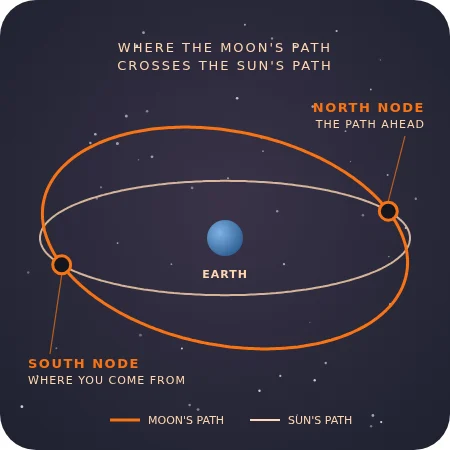
The nodes are not planets. They are the two points where the Moon's path around the sky crosses the Sun's. Eclipses happen only near them, which is why every tradition of astrology, East and West, has treated them as points of fate. In Jyotish they are Rahu and Ketu.

What you get from the calculator above: your North Node sign with its exact degree, the house it falls in, and a reading of the path it points to and the South Node habits it pulls you away from — shown first, before every planet in your chart is read by its sign.

Shows
Your life direction
In Each Sign
About 18 months
Nodal Return
Every 18.6 years
The Moon's tilted path crossing the Sun's path at two points, the North Node and the South Node, with Earth at the centre
The North and South Nodes are the two points where the Moon's path crosses the Sun's.

What the Lunar Nodes Are

The Moon's orbit is tilted about five degrees to the Sun's path, the ecliptic. Twice a month the Moon crosses that path: once going north, at the North Node, and once going south, at the South Node. When a New or Full Moon falls near one of these crossings, the Sun, Moon and Earth line up closely enough for an eclipse.

The nodes move backwards through the zodiac, taking about 18.6 years for a full circle and staying roughly eighteen months in each sign. Like any slow point, a node is shared by everyone born in the same year and a half; its house and the planets it touches make it yours.

Mean Node or True Node: Which One Should You Use?

There are two ways to work out the North Node, and astrologers have argued over them for a century. The Mean Node smooths the Moon's orbit into its average and moves steadily backwards, about three minutes of arc a day. The True Node follows the orbit as it really is at that moment. Because the Sun keeps tugging at the Moon's orbit, the True Node swings up to about a degree and three-quarters either side of the mean, and for a few days at a time it even moves forward.

In most charts the difference changes nothing: same sign, same house, same reading. It matters in three cases — when the node sits within a degree or two of a sign or house cusp, when you are reading tight aspects to it, and when you are timing a nodal return or a transit over it to the day. That is the moment to look at both.

Classical Jyotish and most Vedic astrologers use the Mean Node for Rahu and Ketu; many modern Western astrologers prefer the True Node. Astromitra handles both. The Mean Node is the default, so your North Node here and Rahu in your kundli always come from the same calculation. If you work with the True Node, switch it once in Chart Settings and every chart you open — Western, Vedic and KP — follows that choice.

North Node and South Node: Path and Comfort Zone

The two nodes always sit exactly opposite each other, so they are read as one axis. The South Node is what you already have: talents that come without effort, habits you fall back on under stress, the familiar way of doing things. Many astrologers describe it as what you bring with you from the past.

The North Node is where you are headed. Its qualities often feel unnatural at first, and life keeps bringing situations that ask for them anyway. Moving towards the North Node rarely means giving up the South Node's gifts — it means using them in service of something new.

The North Node in the Twelve Signs: Where Your Path Leads

North Node InGrow TowardsComfort Zone (South Node)
AriesIndependence and self-beliefLibra: pleasing others, keeping peace
TaurusCalm, steady self-relianceScorpio: crisis and intensity
GeminiCuriosity and open questionsSagittarius: certainty and big beliefs
CancerFeeling, family and belongingCapricorn: duty and control
LeoCreativity and being seenAquarius: hiding in the group
VirgoPractical work and good habitsPisces: drifting and escape
LibraPartnership and fairnessAries: going it alone
ScorpioDepth, trust and changeTaurus: holding on to comfort
SagittariusMeaning, faith and the big pictureGemini: endless detail
CapricornAmbition and your own authorityCancer: leaning on the familiar
AquariusFriendship and wider causesLeo: needing the spotlight
PiscesFaith, compassion, letting goVirgo: fixing and controlling

The Nodes in the Houses: The Life Areas on Your Axis

Because the nodes are opposite, they always fall on a pair of opposite houses, and that pair names the balance your life is working out: self and partner (1st and 7th), what you own and what you share (2nd and 8th), daily learning and higher belief (3rd and 9th), home and career (4th and 10th), personal joy and the wider group (5th and 11th), daily work and the inner life (6th and 12th). The North Node's house is the side to grow into.

The house needs your birth time. The planets in houses reading shows the North Node in its house beside every planet, and your birth chart shows the whole axis on the wheel. A planet sitting on either node, or square to both, is drawn deeply into the story.

Nodal Returns at 19, 37 and 56

Every 18.6 years the nodes come back to their birth positions — at about 18 or 19, 37, 56 and 74. These nodal returns are well known for turning points: leaving home, a change of career, a new sense of purpose. Halfway between them, at about 9, 28 and 47, comes the nodal reversal, when the North Node passes over the birth South Node and old patterns ask to be faced.

Eclipses in your North Node or South Node sign mark the same kind of moments in between. You can follow the nodes over your chart in the transit chart.

Rahu and Ketu: The Nodes in Vedic Astrology

This is one place where the two systems speak almost the same language. Jyotish calls the North Node Rahu and the South Node Ketu, and gives them more weight than Western astrology does — they are two of the nine grahas, with their own dashas lasting eighteen and seven years. Rahu is hunger, ambition and the pull towards the new and foreign; Ketu is detachment, past skill and the road to moksha.

The sidereal zodiac puts Rahu and Ketu about 24 degrees back, so they often fall in the previous sign in your kundli. The meaning is close to the Western one: Rahu's house is where you hunger to grow, Ketu's where you already know the way.

A Worked Example: My Own North Node

Here are the nodes in my own birth chart, read the way the calculator reads yours. Every number is the real one.

  1. The SignOn the default Mean Node, my North Node is at 7°59'32" Cancer, so my South Node is at 7°59'32" Capricorn. The path leads from Capricorn's duty and self-reliance towards Cancer's feeling, care and belonging.
  2. Mean Against TrueSwitched to the True Node, it sits at 7°39'21" Cancer, twenty minutes back. Same sign, same house, so nothing in the reading changes. Had my node been within a degree of a cusp, I would have read both.
  3. The HouseThe North Node is about three and a half degrees inside my eleventh house, which begins at 4°26'38" Cancer. The South Node falls in the fifth. The axis runs from personal creativity towards friendships, networks and shared goals.
  4. Lilith on the South NodeBlack Moon Lilith is at 12°51'59" Capricorn, just under five degrees from my South Node, in the same fifth house. That doubles the Capricorn note of the comfort zone: independence, and a reluctance to depend on anyone.
  5. Square MercuryMercury at 3°35'29" Libra is square both nodes, about four and a half degrees from exact. Mercury rules my Ascendant, so the chart ruler sits at the turning point of the axis: thinking and speaking are how this chart moves from one node to the other.
  6. The Vedic ViewIn my kundli, on the same Mean Node, Rahu is at 14°22' Gemini with a Leo lagna, which puts Rahu in the eleventh house and Ketu in the fifth. Both systems put the North Node in the eleventh, and Jyotish counts Rahu in the eleventh among its best placements for gains.

When the Western and Vedic charts put the nodes on the same pair of houses, I read that axis with full confidence. Here both point the same way: from the private fifth house towards the eleventh, from one's own work towards the circle it serves.

About the Author

Astrologer Pramod Sharma

Written and reviewed by

Jyotish Acharya · Bharatiya Vidya Bhavan, New Delhi

Verified astrologer
25+ Years
In practice since 2001
5th Generation
Family of Vedic astrologers
Systems
Parashari, KP, Jaimini, Lal Kitab

He reads the North Node with its South Node as one axis — by sign for the qualities, by house for the life areas — and checks it against Rahu and Ketu in the kundli.

Questions

North Node: Questions People Ask

The North Node is the point where the Moon's path crosses the Sun's path going north. It is not a planet but a sensitive point, and astrologers read it as the direction of growth in your life — the qualities you are here to develop, even when they feel unfamiliar.

The South Node sits exactly opposite the North Node. It shows the skills and habits that come naturally to you, often described as what you bring with you from the past. It is a comfort zone: useful, but a place to grow out of rather than stay in.

Enter your date of birth, with the time and place. The North Node stays about eighteen months in each sign, so the date alone almost always gives the sign. The birth time is needed for the house, which shows where in life your path unfolds.

Yes, always the opposite sign and the same degree. A North Node in Cancer means a South Node in Capricorn; a North Node in the 11th house means a South Node in the 5th.

The Mean Node by default, the same node your Vedic kundli uses for Rahu and Ketu on Astromitra, so the two charts always agree. You can switch to the True Node in Chart Settings, and the choice then applies to every chart you open, Western and Vedic alike.

The Mean Node is the average position of the node and moves smoothly backwards. The True Node is its actual position at that moment, which swings up to about a degree and three-quarters either side of the mean and now and then even moves forward. The two give the same sign and house except within a degree or two of a cusp.

The nodes take about 18.6 years to go round the zodiac, so the North Node returns to its birth position at around 18 or 19, 37, 56 and 74. These ages often bring a change of direction, a new purpose, or a chance to get back on your path.

Yes. In Vedic astrology the North Node is Rahu and the South Node is Ketu. Jyotish treats them as two shadow planets with their own strength and results. Because it uses the sidereal zodiac, Rahu and Ketu usually fall one sign earlier in your kundli than the nodes in this chart.

Rarely for the sign. The node moves only about three minutes of arc a day, so the time matters only on the day it changes sign — and always for the house it falls in.
AI Astrologers Talk to Astrologer