
Instant Report
Instant Marriage Report — When It Comes, and with Whom
The two questions everybody actually asks — when will it happen, and what will they be like — answered from the 7th house, the Navamsa, and the dasha running over your chart right now. Fifteen pages, in your inbox in about ten minutes.
- A marriage window, with the years named
- Navamsa (D9) — the chart marriage is judged in
- Manglik dosha checked, and its cancellations counted
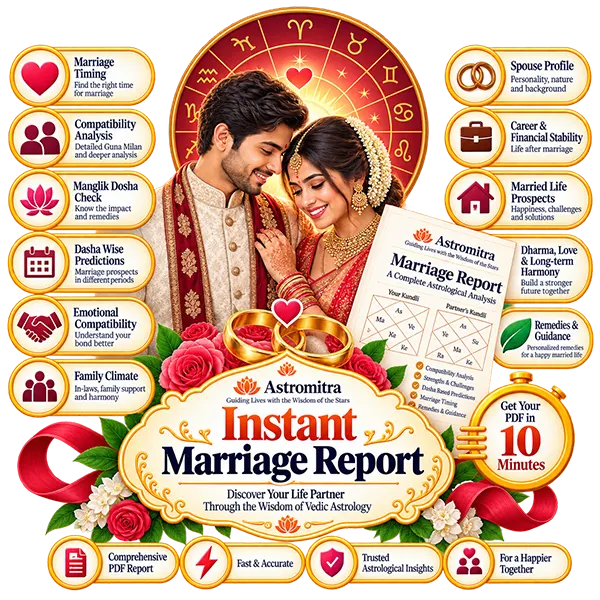
What A Vedic Marriage Report Tells You
Two questions bring most people to an astrologer about marriage, and neither of them is subtle. When is it going to happen? And what sort of person is it going to be? Everything else — the doshas, the matching, the remedies — is really in service of those two.
A chart has answers to both, but they are answers of a particular kind. Jyotish will give you a window of years rather than a date, and a type of person rather than a name. Anybody promising more than that is selling something other than astrology. Within those limits, though, the chart is remarkably specific: which years carry the marriage, why it has been delayed, what your spouse's temperament is likely to be, and where they are likely to come from.
Navamsa (D9) — The Chart Marriage Is Judged In
The seventh house of your birth chart is where marriage begins, not where it is decided. Jyotish keeps a second chart for that: the Navamsa, or D9, drawn by dividing every sign into nine parts. It is the chart a Jyotishi turns to the moment marriage is the question.
The reason is simple. The birth chart shows what is promised; the Navamsa shows whether the promise holds. A seventh house that looks strong in D1 and weak in D9 is a marriage that arrives and then asks for work. Where the two agree — where a sign repeats across both, which the texts call Vargottama — the indication is firm. This report reads both, and says plainly when they disagree.
What Arrives In The PDF
- Two charts, drawn. D1 (birth) and D9 (Navamsa), side by side, with your 7th sign, its lord and Venus set out at the top.
- The planetary table. Every graha with its degree, house, nakshatra and dignity, and whether it works for you or against you in this chart.
- The 7th house, in full. Its sign, its lord and where that lord has gone, what sits in the house and what aspects it — and what each of those does to the marriage itself.
- Venus and Jupiter as karakas. Venus for love and marital happiness in every chart; Jupiter for the husband in a woman's. Read separately, because they answer different questions.
- Manglik dosha. Present or not, how severe, and — the part most readings skip — how many cancellation conditions your chart carries, with each one named.
- Marriage timing. The dasha running now, the antardasha that carries marriage, the Jupiter and Saturn transits that open the window, and the years those point at.
- Your spouse. Nature and temperament, likely background and profession, the direction they may come from, and how you are most likely to meet.
- Married life. The early years and the long view read separately, because for a great many charts they are not the same story.
- Remedies. Per graha — Venus, the 7th lord, and Mars where the dosha calls for it — with the mantra, the day, the fast and the donation.
Marriage Timing — Why It Is A Window, Not A Date
Marriage timing in Jyotish rests on two things happening together. The dasha has to activate the seventh house — usually through its lord, or through Venus — and a transit has to support it, most often Jupiter crossing the seventh house or its lord. One without the other produces proposals that come to nothing.
So the report names the dasha you are in, the sub-period that carries the marriage, the transits to watch, and the stretch of years where the two overlap — usually a window of two or three, sometimes with a second, weaker one further out. It also says, where the chart shows it, why marriage has been slow: a Saturn aspect on the seventh delays almost every chart it touches, and knowing that is worth more than another year of wondering.
Manglik Dosha — Checked, And Then Cancelled Where It Should Be
More marriages are worried about manglik dosha than are affected by it. Mars in the 1st, 4th, 7th, 8th or 12th raises it — but the classical texts give a long list of conditions that cancel it, and most charts that carry the dosha carry at least one of them.
This report checks the dosha, grades how serious it is, and then counts the cancellations by name: Mars in its own or a friendly sign, the dosha not repeating from the Moon, the effect weakening with age. Where it stands after all that is what you are told — not a warning designed to frighten you into a remedy. If matching is the way to settle it, that is said too.
Read The Same Way, Married Or Not
- Unmarried. Timing, the spouse indication, and what is delaying matters take the weight.
- Engaged or matched. The dosha section and the married-life reading are the ones to take to the decision.
- Already married. The early-years and long-view sections explain the friction, and the remedies address the graha causing it.
Matching two charts against each other is a different reading — that is kundli matching, which needs both birth details.
What You Need To Order Your Marriage Report
Your date of birth, your time of birth, and the place. Nothing else — no questionnaire, and your partner's details are not needed for this reading.
Birth time matters more here than almost anywhere, because the Navamsa moves nine times faster than the birth chart; a few minutes can change it entirely, and with it the whole marriage judgement. If your time is uncertain, say so to yourself while you read — the grahas' signs, the dasha sequence and the dosha from the Moon still hold. Our free kundli will show you the chart before you decide.
Common Questions
Will it tell me the date of my marriage?
No, and be careful of anything that says it will. Jyotish gives a window — a stretch of two or three years where the dasha and the transits support marriage — and names the periods behind it so you can see the reasoning. A single date from a chart is a guess dressed up.
Does it say who I will marry?
It describes a type, not a person: temperament, likely background and profession, whether they are likely to be older, the direction they may come from, and whether you are more likely to meet through family or through work. That is what the 7th house, its lord and Venus can honestly support.
I have been told I am manglik. Will this settle it?
It will tell you whether the dosha is there, how serious it is, and how many of the classical cancellations your chart carries — each one named. A great many charts that are called manglik turn out to have the dosha reduced or cancelled outright, and that is worth knowing before it shapes another decision.
Is this the same as kundli matching?
No. This reads one chart — yours. Matching reads two against each other for gunas, dosha compatibility and long-term fit, and needs both sets of birth details. If you have a proposal in hand, take kundli matching; if you are asking about your own marriage, take this.
Is this written by an astrologer?
No, and we would rather say so than let you find out. It is built by our own system from the classical rules — Parashari, Lahiri ayanamsa, Vimshottari dasha, with the Navamsa and the dosha cancellation conditions — applied to your chart. Thorough, and yours alone, but nobody sat down with it. If that is what you want, the personalized marriage report is read and prepared by Jyotish Acharya Pramod Sharma himself and takes a few working days.
How quickly does it arrive?
Usually within ten minutes of payment, emailed as a PDF. You do not have to wait on any page while it is prepared — close the tab and it will reach you. The same file stays in My Reports for ninety days.


